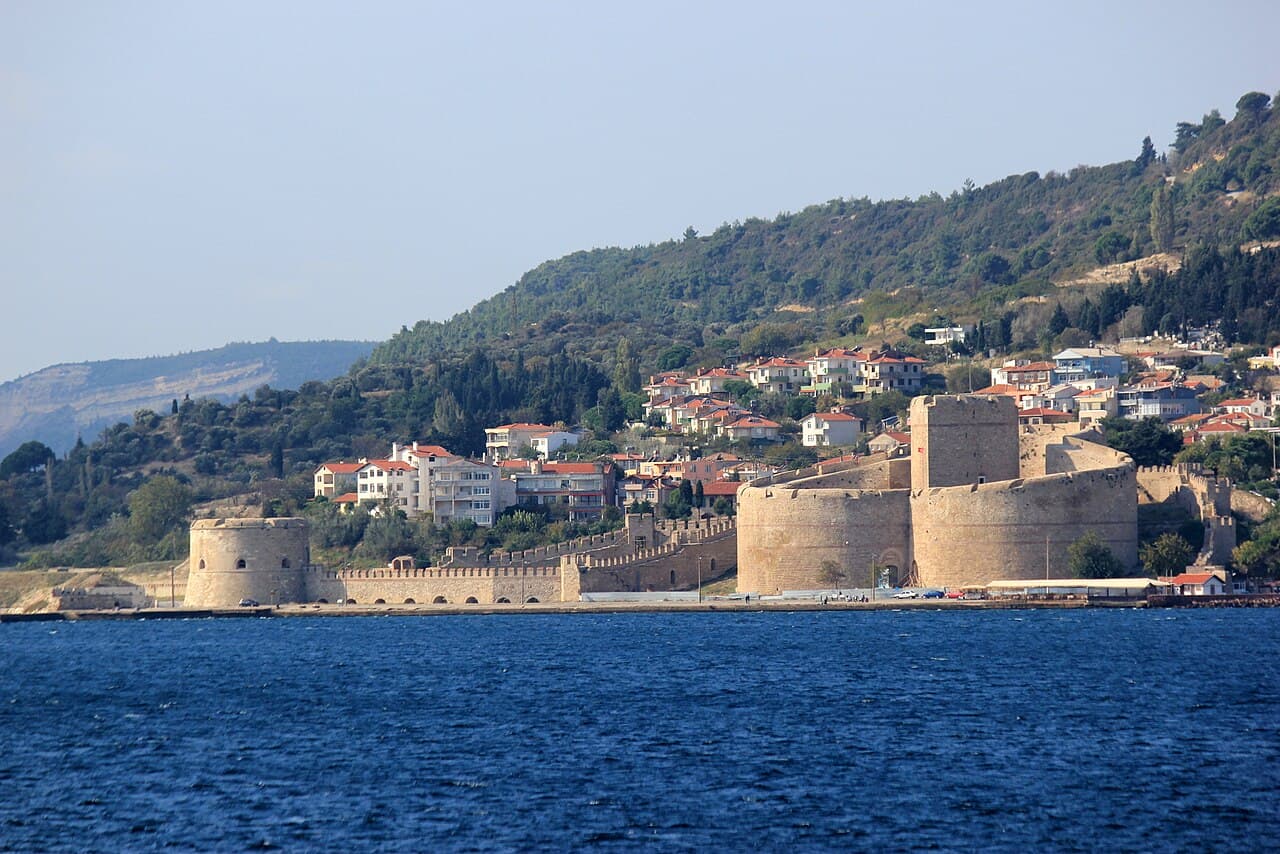
Kilitbahir Castle
Kilitbahir Castle, known locally as Kilitbahir Kalesi, is a remarkable Ottoman fortress situated on the European shore of the Dardanelles Strait in the province of Çanakkale, Turkey. This castle stands as a testament to the strategic military foresight of the Ottoman Empire during the mid-15th century, constructed primarily to control naval passage and secure the vital waterway connecting the Aegean Sea to the Sea of Marmara and beyond. Its location in the village of Kilitbahir underscores its role as a maritime sentinel overseeing one of the most critical chokepoints in the region.
The castle's inception dates back to 1452, when Sultan Mehmed II, known as Mehmed the Conqueror, recognized the necessity of fortifying the narrowest segment of the Dardanelles to prevent European fleets from supplying or reinforcing the Byzantine capital of Constantinople during its siege. Kilitbahir, alongside its counterpart Çimenlik Castle on the Asian side, was designed to dominate the strait and establish Ottoman naval supremacy. The fortress's construction was supervised by Yakup Bey, governor of Gallipoli, and architect Muslihiddin, who implemented an innovative design that would influence fortress construction in the region.
Architectural design and features
Kilitbahir Castle is distinguished by its unique three-leaf clover, or trefoil, layout, which is an uncommon design among Ottoman fortifications. The castle's core is a towering triangular keep, rising approximately 30 meters with seven floors, connected by stone bridges to three semi-circular bastions that form the castle's three 'leaves.' This configuration provides overlapping fields of fire and robust defensive capabilities, maximizing the castle's ability to repel naval and land assaults.
The fortress measures about 220 meters in length and 120 meters in width, enclosed by formidable inner and outer walls. The outer walls reach roughly 7 meters in height and are about 2.2 meters thick, constructed from roughly hewn stone blocks that provide durability against artillery. The walls are complemented by nine smaller towers, each approximately 1.5 meters high, enhancing surveillance and defense. Surrounding the castle is a wide moat between 10 and 12 meters across, adding an additional layer of protection.
The southern walls facing the strait feature embrasures for cannon fire, reflecting the castle's role as an artillery platform. The use of white marble frames around doors and windows and ceramic elements in arches demonstrates attention to both functionality and aesthetics. The castle's design integrates both medieval defensive concepts and adaptations for gunpowder weaponry, marking a transitional moment in military architecture.
The sarı kule and later enhancements
In 1541, during the reign of Sultan Suleiman the Magnificent, Kilitbahir Castle underwent significant strengthening to meet evolving military challenges, particularly amid the ongoing Cretan War (1645–1669) against Venice. A new courtyard was added to the southern side of the outer walls, protected by the Sarı Kule (Golden Tower), a round tower that expanded the fortress's defensive perimeter. This extension also increased the moat's breadth, further securing the castle against naval threats.
Throughout the 18th century, French military advisors contributed to the modernization of the fortress, reflecting the Ottoman Empire's engagement with European military engineering practices. In the early 19th century, under Sultan Selim III, repairs and updates were made in response to the geopolitical pressures of the Napoleonic Wars. Later, during the late Ottoman period under Sultan Abdul Hamid II, additional restorations were carried out, including the construction of the nearby Namazgâh Bastion around 1870, signaling the castle's continued strategic relevance despite the decline of its military importance.
Historical significance and military role
Kilitbahir Castle played a crucial role in securing Ottoman control over the Dardanelles Strait, a vital maritime corridor connecting the Mediterranean to the Black Sea. Its primary function was to prevent European naval forces from bypassing Ottoman defenses and reinforcing besieged cities, particularly during the pivotal 1453 conquest of Constantinople. The fortress's strategic location allowed the Ottomans to control naval traffic and deter enemy fleets effectively.
The castle's military importance persisted through several centuries, witnessing upgrades and restorations aligned with the empire's shifting defense needs. It was actively involved in the Dardanelles Wars, where control of the strait was contested fiercely. Although its role diminished with the advent of modern artillery and changing warfare tactics, Kilitbahir remained a symbol of Ottoman military architecture and strategic foresight.
Role during the siege of constantinople
During the siege of Constantinople, Kilitbahir Castle served as a critical blockade point to prevent the arrival of European aid via the sea. Its artillery batteries, including numerous cannons, were positioned to challenge any naval forces attempting to breach the strait. The fortress worked in tandem with Çimenlik Castle on the opposite shore, creating a crossfire zone that effectively sealed off the waterway.
Evolution through conflicts
Following the fall of Constantinople, the castle's function evolved to guard against potential counterattacks by European powers seeking to reclaim lost territories. The enhancements made by Suleiman the Magnificent and subsequent sultans reflect continued Ottoman investment in maintaining control over this strategic passage. The fortress also adapted to new military technologies, incorporating artillery defenses and structural reinforcements.
Present-day status and visitor information
Today, Kilitbahir Castle stands as a well-preserved example of 15th-century Ottoman military architecture, open to the public as a museum. Visitors can explore its distinctive architectural features, including the towering triangular keep, the three semi-circular bastions, and the Sarı Kule extension. The castle's location offers stunning views over the Dardanelles Strait, providing both historical insight and scenic beauty.
The site is managed by Turkish cultural authorities and charges an entrance fee for visitors. It is accessible from the nearby town of Eceabat and well worth a visit for those interested in Ottoman history, military architecture, and the strategic importance of the Dardanelles throughout history.
Kilitbahir Castle remains a significant cultural heritage site, embodying centuries of military innovation and geopolitical significance. Its unique trefoil design, historical associations with Sultan Mehmed II and Suleiman the Magnificent, and role in controlling one of the world's most important maritime passages continue to attract scholars, tourists, and history enthusiasts alike.
Frequently asked questions (FAQ)
- How do I get to Kilitbahir Castle?
- Kilitbahir Castle is located in the village of Kilitbahir near Eceabat in Çanakkale Province. It is accessible by car or local transport from Eceabat, which is connected to the Dardanelles ferry routes.
- What are the opening hours for visiting Kilitbahir Castle?
- The castle is open daily from 09:00 to 18:00, allowing visitors ample time to explore the fortress and its surroundings.
- Is there an entrance fee to visit Kilitbahir Castle?
- Yes, there is an entrance fee of €5 for adults and €3 for children, which helps support the maintenance and preservation of the site.
- What is unique about Kilitbahir Castle's architecture?
- Kilitbahir Castle features a distinctive three-leaf clover or trefoil layout with a central triangular keep and three semi-circular bastions, a rare design in Ottoman fortifications.
- Can I explore the interior of Kilitbahir Castle?
- Visitors can explore the castle's interior, including the seven-story triangular keep, courtyards, and defensive walls, gaining insight into Ottoman military architecture.
- Why was Kilitbahir Castle built?
- The castle was built by Sultan Mehmed II in 1452 to control the narrowest point of the Dardanelles Strait and prevent European naval forces from aiding Constantinople during its siege.
- Are there guided tours available at Kilitbahir Castle?
- Guided tours may be available seasonally or through local tour operators, providing detailed historical and architectural information about the fortress.
Photo gallery

Information
Opening hours
09:00-18:00, daily
Ticket prices
€5 adult, €3 child
Current owner
State museum
Address
Yalı Cd., Kilitbahir, Eceabat, Çanakkale, Turkey
Loading map...
Visitor reviews
No reviews yet. Been here? Write the first review and help other travelers!
Write the first reviewVisited this castle? Share your experience
Your review helps other travelers and adds first-hand knowledge to our encyclopedia.



