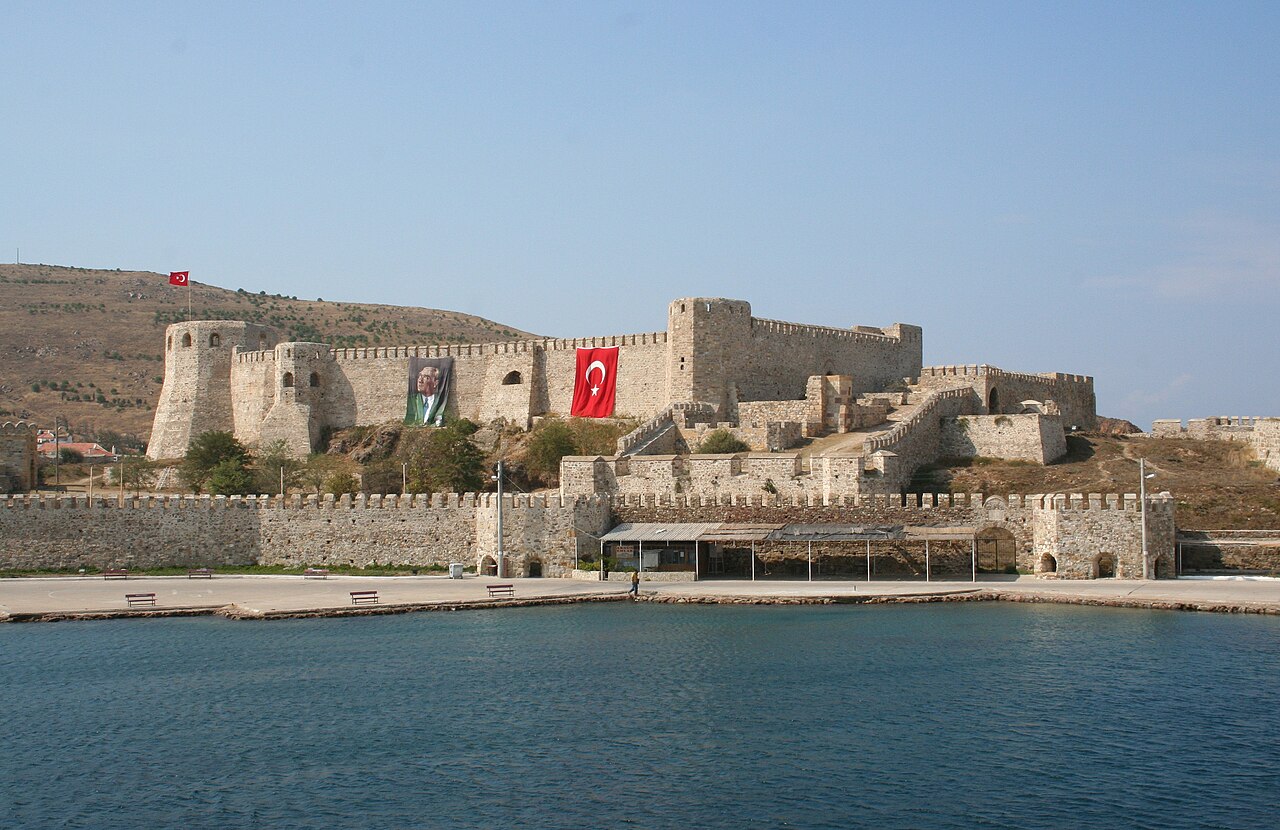
Myrina Castle
Myrina Castle stands as a monumental example of medieval military architecture on the island of Lemnos, Greece. Perched on a promontory about 120 meters above sea level, this hill castle commands sweeping views over the Aegean Sea and the town of Myrina. Its strategic location and massive fortifications reflect centuries of complex history, from ancient times through Byzantine, Venetian, and Ottoman rule.
The site of Myrina Castle was originally the acropolis of the ancient city of Myrina, with fortifications dating back to the Mycenaean civilization around the 13th century BCE. The earliest walls were constructed using cyclopean masonry, characterized by enormous, irregular stone blocks fitted without mortar, a hallmark of Mycenaean defensive architecture. However, no visible remains of these early fortifications survive today, as their stones were repurposed in later construction phases.
The medieval castle as it is known today was first built by the Byzantines in the early 12th century CE, during the high medieval period. This initial construction was part of the empire's efforts to secure its Aegean territories. In 1185, Emperor Andronikos I Komnenos ordered significant strengthening of the castle's defenses, underscoring its military importance. The fortress was simply called "Kástro," meaning "castle" in Greek.
Byzantine and Venetian control
Following the Fourth Crusade and the subsequent fragmentation of the Byzantine Empire, Lemnos was assigned to the Latin Empire and given as a fief to the Venetian Navigajoso family in 1207. Under Venetian rule, the castle was restored and served as the island's administrative center. To distinguish it from newer fortifications on Lemnos, it was referred to as "Palaíokastron," meaning "Old Castle."
The Byzantines regained control in 1278 under the commander Likarios, who initiated further renovations. Emperor John V Palaiologos ordered additional fortification works in 1361, reflecting ongoing regional conflicts. The castle's control shifted multiple times in the 15th century, including a period under the Genoese Gattilusi family and later the Ottomans.
Ottoman and Venetian sieges
In 1462, the Ottomans conquered Lemnos, granting it to Demetrios Palaiologos, brother of the last Despot of Mystras. Despite brief Venetian recapture attempts, the fortress remained mostly under Ottoman control from 1479 onward. The Venetians successfully defended the nearby fortress of Kotsinos in 1476 but eventually ceded Lemnos to the Ottomans by the Treaty of Constantinople in 1479.
The castle saw renewed Venetian attempts to retake it during the Sixth Ottoman-Venetian War, capturing it briefly in 1656 before losing it again in 1657 after a 36-day siege. Another siege occurred in 1770 during the Russo-Turkish War when Count Orlov led an assault, severely damaging the walls. Ottoman repairs followed, including extensive fortification work completed by Hasan Gatzi Pasha in 1780, who equipped the castle with approximately 150 cannons.
Architectural features and layout
Myrina Castle covers an expansive area of about 14.4 hectares, making it the largest fortress in the Aegean islands. Its defensive system consists of three concentric walls, each approximately eight meters tall and 1.5 meters thick, punctuated by fourteen towers spaced strategically along their length. These walls provided formidable protection against siege warfare.
The eastern side of the castle was once separated from the mainland by a wide moat, designed to hinder enemy approach, though this feature no longer exists. Access was controlled through a main gate on the east and a secondary gate to the north, allowing for controlled entry and exit.
Inside the fortress, remnants of Ottoman-era structures survive, including the ruins of a mosque with characteristic architectural elements. Vaulted underground chambers and cisterns for rainwater collection highlight the castle's self-sufficiency during prolonged sieges. The fortress's extensive artillery placements underscore its military significance well into the late Ottoman period.
Historical significance and legacy
The castle played a crucial role in the turbulent history of Lemnos, witnessing numerous sieges, battles, and changes of power. It was a key defensive stronghold during the Balkan Wars, particularly in 1912 when the Greek navy peacefully took control of the island from Ottoman forces. Subsequently, Lemnos served as a strategic naval base during World War I, especially during the Gallipoli campaign, where it supported Allied operations in the Dardanelles.
Today, Myrina Castle stands as a testament to the island's rich historical tapestry, reflecting layers of ancient, medieval, and early modern military architecture. Its imposing walls and ruins attract visitors interested in history, archaeology, and the evolution of fortress design in the Aegean region.
Frequently asked questions (FAQ)
- How do I get to Myrina Castle on Lemnos?
- Myrina Castle is located on a hill overlooking the town of Myrina on Lemnos island. Visitors can reach it by car or on foot via marked paths from the town center.
- What is the best time to visit Myrina Castle?
- The best time to visit Myrina Castle is during spring and autumn when the weather is mild and the island is less crowded, allowing for comfortable exploration of the ruins.
- Is Myrina Castle accessible for visitors with mobility issues?
- Due to its hilltop location and uneven terrain, accessibility for visitors with mobility issues is limited. Some areas may be difficult to reach without assistance.
- Are there guided tours available at Myrina Castle?
- Guided tours are occasionally offered by local tourism offices and can provide detailed historical and architectural insights. It is advisable to check in advance for availability.
- What are the opening hours and ticket prices for Myrina Castle?
- Myrina Castle is generally open to the public daily with no entrance fee, though specific opening hours may vary seasonally. Visitors should confirm current hours locally.
Information
Sources & official resources
Verify the information above using these authoritative references.
Loading map...
Visitor reviews
No reviews yet. Been here? Write the first review and help other travelers!
Write the first reviewVisited this castle? Share your experience
Your review helps other travelers and adds first-hand knowledge to our encyclopedia.