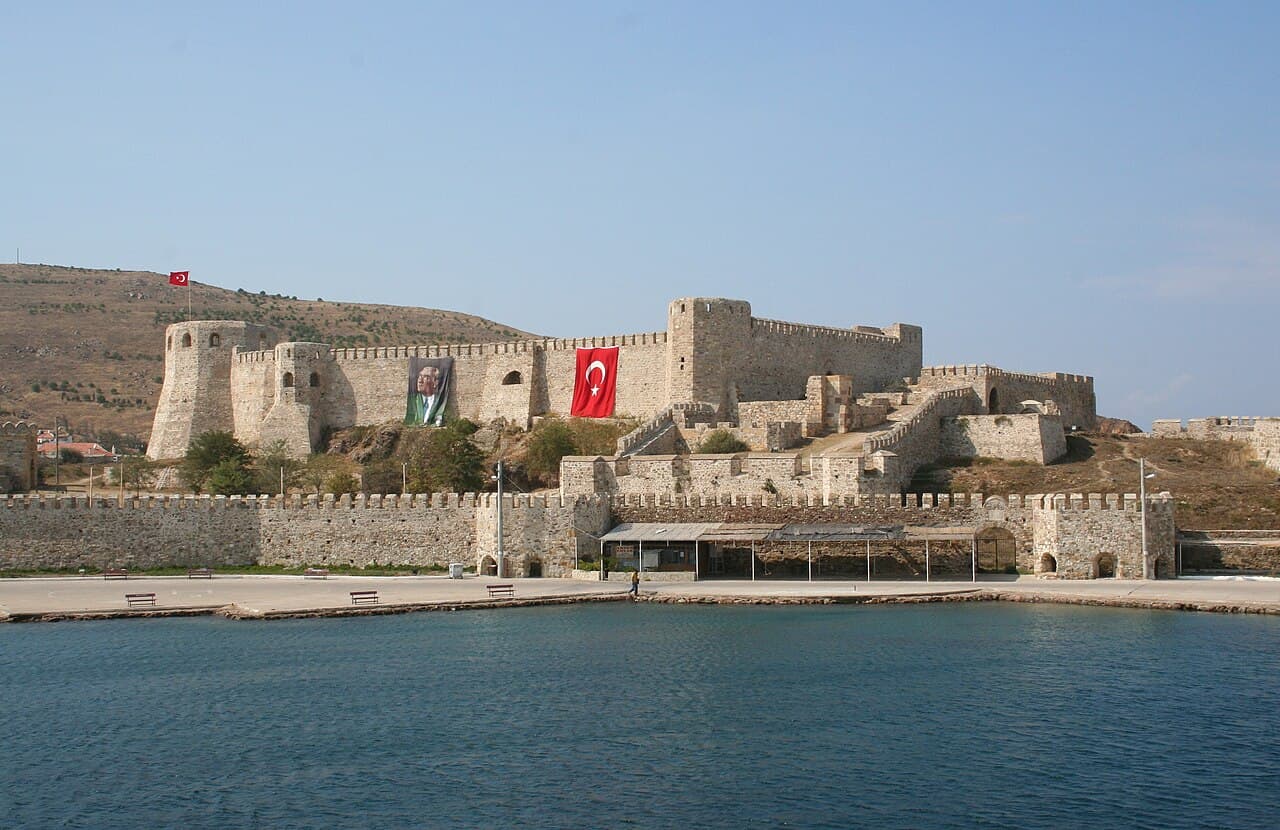
Bozcaada Castle
Bozcaada Castle, locally known as Bozcaada Kalesi, is a prominent hill castle located on the island of Bozcaada in the Çanakkale province of Turkey. The castle occupies a strategic position in the village of Alabey, commanding views over the surrounding sea and the village itself. Its location on the island has made it a key fortification throughout history, guarding the entrance to the Dardanelles Strait.
The island of Bozcaada was historically known as Tenedos in antiquity and was mentioned in the "Iliad," an ancient Greek epic poem dating back to the 8th century BC. Despite its modest size, the island held significant strategic importance due to its position controlling naval access to the Dardanelles, a vital waterway linking the Aegean Sea to the Sea of Marmara and ultimately the Black Sea. This strategic value made the island a contested site through various historical periods.
Early fortifications and medieval history
Before the current castle's construction, the island had fortifications dating back potentially to Roman times, though the exact origins are undocumented. These early defenses were certainly used and modified by the Byzantines. In the late 14th century, the island's control shifted when the Venetians received permission from the Byzantine Emperor Andronikos IV Palaiologos in 1377 to occupy the island. This occupation contributed to the War of Chioggia (1378-1381) between Venice and Genoa, a major conflict in the Mediterranean maritime power struggle.
The Treaty of Turin in 1381 ended the war and mandated the demolition of the castle and Venetian evacuation from Tenedos. The island was largely depopulated, with many inhabitants relocated to Crete. For several decades, the castle lay in ruins and the island remained mostly uninhabited.
Ottoman reconstruction and military significance
In the mid-15th century, around 1455, the island came under the control of the Ottoman Empire during the reign of Mehmed the Conqueror. Recognizing the island's strategic importance, the Ottomans undertook a comprehensive reconstruction of the ruined castle, transforming it into a strong defensive fortification. This rebuilding marked the beginning of the castle's current form, designed to withstand the artillery and siege tactics of the late medieval period.
During the Cretan War (1645-1669) between the Ottomans and Venetians, the castle was briefly captured by Venetian forces in 1656. However, the Ottomans retook the fortification in 1657, after which they repaired and expanded the castle's defenses. The outer castle, or bailey, was added during this period to enhance its defensive capabilities.
18th and 19th century restorations and expansions
The castle underwent several restorations throughout the 18th century to maintain its military readiness. In 1815, during the reign of Sultan Mahmud II, further fortifications were added to the castle complex. This period also saw the construction of the Bozcaada New Castle, a newer fortification built on a ridge overlooking the village and the original castle. This addition reflected evolving military architecture and the ongoing importance of the island's defense.
Architectural features and layout
Bozcaada Castle features a polygonal inner castle surrounded by an outer castle or bailey, which was added after the 1657 reconquest. The design incorporates thick defensive walls with battlements, towers for surveillance and defense, and a moat in some sections. Inside the castle walls, visitors can find the remains of important functional structures such as arsenals for weapons storage, a cistern for collecting and storing water, and a mosque reflecting the Ottoman period's cultural and religious presence.
Modern history and preservation
In the early 20th century, the castle was largely abandoned and fell into disrepair. By the 1960s, efforts were made to consolidate and preserve the remaining structures to prevent further deterioration. Today, the castle is partially preserved and open to visitors for a fee. It remains a significant cultural and historical landmark on Bozcaada island, attracting tourists interested in its layered history and commanding views.
Visitors to Bozcaada Castle can explore its extensive walls and towers, learn about its role in the military history of the region, and enjoy the scenic surroundings of the village and sea. The castle's combination of Byzantine, Venetian, and Ottoman influences makes it a unique site reflecting the complex history of the Aegean and the strategic importance of the Dardanelles throughout the centuries.
Frequently asked questions (FAQ)
- What is the historical significance of Bozcaada Castle?
- Bozcaada Castle, originally built by the Byzantines in the 15th century, played a crucial role in the defense against Ottoman invasions. It later served as a strategic military base and has been a witness to various historical events, showcasing the island's rich heritage.
- When was Bozcaada Castle constructed?
- The castle was constructed in the early 15th century, with significant renovations occurring during the Ottoman period. Its architecture reflects a blend of Byzantine and Ottoman styles, making it a fascinating site for history enthusiasts.
- Can I visit Bozcaada Castle year-round?
- Yes, Bozcaada Castle is open to visitors throughout the year. However, the best time to visit is during the spring and autumn months when the weather is mild and ideal for exploring the historical site.
- What are the opening hours for Bozcaada Castle?
- Bozcaada Castle typically opens at 9:00 AM and closes at 7:00 PM during the summer months. In the winter, the hours may vary, so it is advisable to check in advance before planning your visit.
- Is it possible to access Bozcaada Castle with mobility issues?
- While Bozcaada Castle is an impressive structure, access may be challenging for visitors with mobility issues due to its steep paths and stairways. It is recommended to contact the castle administration for specific accessibility options before your visit.
- What are the ticket prices for Bozcaada Castle?
- The entrance fee to Bozcaada Castle is modest, making it accessible for most visitors. Discounts may be available for students and seniors, so it’s beneficial to inquire at the ticket counter upon arrival.
- What nearby attractions can I visit after exploring Bozcaada Castle?
- After visiting Bozcaada Castle, you can explore the charming streets of Bozcaada town, visit the local vineyards, or relax on the picturesque beaches nearby. The island also boasts several historical sites worth exploring, enhancing your overall experience.
Photo gallery

Information
Loading map...
Visitor reviews
No reviews yet. Been here? Write the first review and help other travelers!
Write the first reviewVisited this castle? Share your experience
Your review helps other travelers and adds first-hand knowledge to our encyclopedia.


