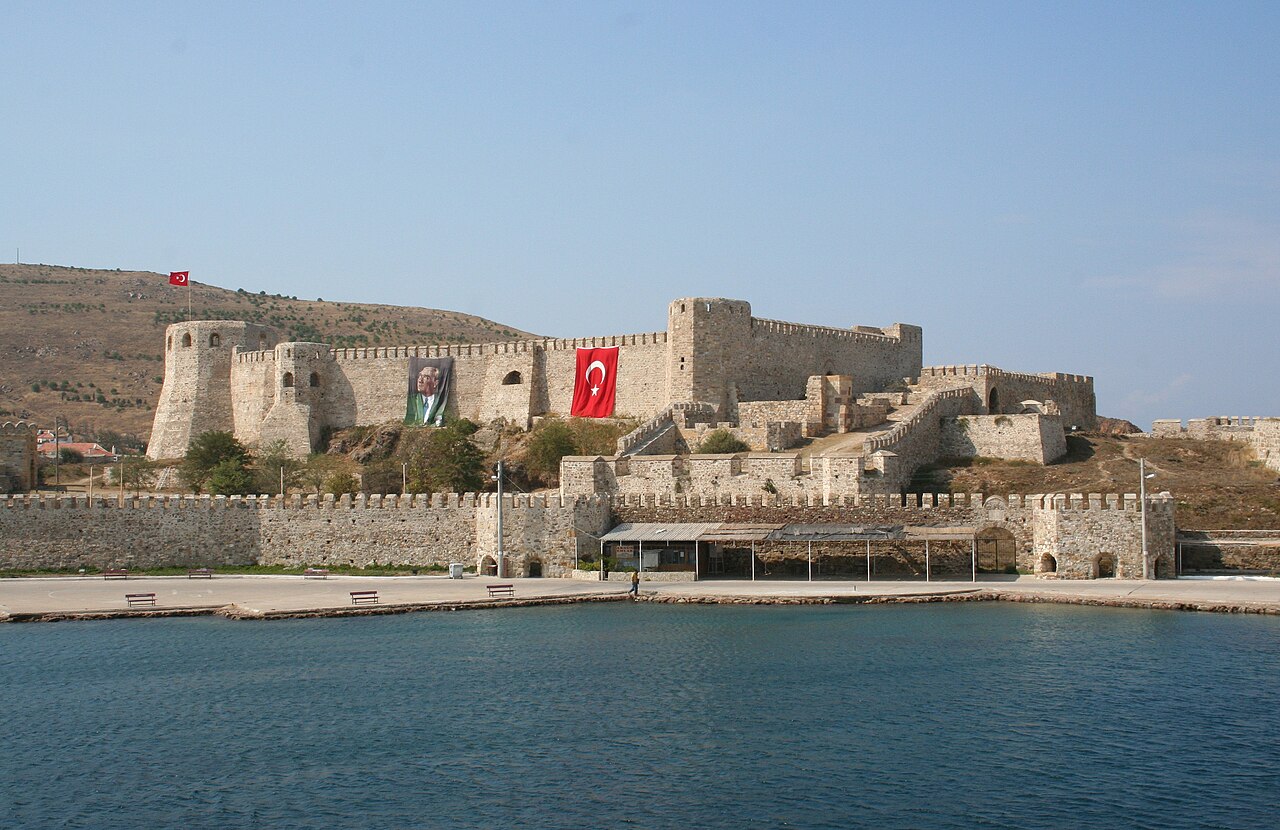
Bozcaada New Castle
Bozcaada New Castle, locally known as Yeni Kalesi (meaning 'new castle' in Turkish), is a historic fortification located on the island of Bozcaada in the Çanakkale province of Turkey. Situated north of 182 Evler Cd., this castle occupies a strategic position on the highest ridge overlooking the village and the older Bozcaada Castle below. Its elevated location provides commanding views over nearly the entire island, a critical advantage for defense and surveillance.
The island of Bozcaada, historically known as Tenedos by its Greek inhabitants before 1970, has a complex history marked by cultural shifts. The Ottomans took control of the island in the 15th century, renaming it Bozcaada. Despite its name, Bozcaada New Castle is not a traditional medieval castle but rather a fortified artillery fort built in the early 19th century, during the reign of Sultan Mahmud II.
Historical background and construction
Contrary to earlier assumptions that the castle dated from the late medieval period, a surviving stone plaque, now preserved in the nearby Bozcaada Castle, confirms that the fort was constructed around 1827 by Hafız Ali Pasha. This places the fort's construction firmly in the Ottoman period, reflecting the empire's efforts to modernize coastal defenses against naval threats.
The fort was built on a ridge above the older Bozcaada Castle and the village, taking advantage of the high ground to maximize defensive capabilities. The choice of location underscores the strategic importance of the island, situated near the entrance to the Dardanelles Strait, a vital maritime passage.
Architectural design and features
Bozcaada New Castle is designed in a roughly five-pointed star shape, a style commonly associated with bastioned forts that emerged in response to the development of artillery warfare. This star-shaped plan allowed defenders to cover all approaches with overlapping fields of fire, minimizing blind spots.
The fort's walls are constructed from rubble stone with mortar, reinforced with large stone blocks at the corners for added strength. The walls are pierced with multiple openings designed for firearms, including musket or rifle ports, and at least one wall features larger embrasures likely intended for cannons. These features indicate the fort's role as an artillery bastion rather than a medieval stronghold.
Inside the walls, there is a vaulted chamber with plastered walls, which was likely used for storage of ammunition, supplies, or provisions necessary for sustaining a garrison. The interior spaces are modest, reflecting the fort's primary military function rather than residential or ceremonial use.
Current condition and visitor experience
Today, Bozcaada New Castle remains a small ruin, yet its structural outline and key features are still discernible. Despite its ruined state, the fort is freely accessible to visitors who can explore the site and enjoy panoramic views of the surrounding landscape, including the village of Bozcaada and the older castle below.
The site offers insight into the evolution of military architecture on the island and the Ottoman Empire's coastal defense strategies in the early 19th century. While not as grand or well-preserved as other castles, Bozcaada New Castle provides a tangible connection to the island's layered history and its strategic maritime significance.
Bozcaada island and its strategic importance
Bozcaada island has long held strategic importance due to its location near the entrance to the Dardanelles Strait, a crucial naval passage connecting the Aegean Sea to the Sea of Marmara and beyond to Istanbul and the Black Sea. Control over this island allowed for monitoring and controlling naval traffic, vital for both commercial and military purposes.
The Ottoman Empire's decision to build the New Castle in the 19th century reflects the ongoing need to reinforce defenses amid changing military technologies and geopolitical tensions. The star-shaped fortification embodies the adaptation of traditional castle concepts to the demands of artillery warfare, marking a transition from medieval fortresses to modern coastal forts.
Architectural significance
The star fort design of Bozcaada New Castle aligns with the principles of bastioned fortifications that became widespread in Europe from the 16th century onward. This design aimed to counteract the destructive power of cannon fire by eliminating blind spots and enabling defenders to cover all approaches with crossfire.
Although smaller and less elaborate than many continental examples, Bozcaada New Castle represents an important example of Ottoman military architecture adapting to new technologies and strategic necessities in the early 19th century.
Preservation and cultural heritage
While the castle is in a ruined condition, efforts to preserve its remaining structures and interpret its history contribute to the cultural heritage of Bozcaada island. The castle, along with the older Bozcaada Castle and the island's historic village, forms part of a broader heritage landscape that attracts visitors interested in history, architecture, and scenic views.
Visitors to Bozcaada New Castle can appreciate not only the military architecture but also the panoramic vistas that highlight the island's natural beauty and strategic maritime position.
Frequently asked questions (FAQ)
- When was Bozcaada New Castle built?
- Bozcaada New Castle was constructed around 1827 during the reign of Sultan Mahmud II by Hafız Ali Pasha.
- What is the architectural style of Bozcaada New Castle?
- The castle features a star-shaped design typical of bastioned forts, adapted for artillery defense in the early 19th century.
- Can visitors access Bozcaada New Castle?
- Yes, the castle is freely accessible to visitors who can explore the ruins and enjoy panoramic views of Bozcaada island and the village below.
- Why was Bozcaada New Castle built?
- It was built to strengthen the island's defenses against naval threats, taking advantage of its strategic location near the Dardanelles Strait.
- What can be seen from Bozcaada New Castle?
- From the castle's elevated position, visitors can see almost the entire island, including the village of Bozcaada and the older Bozcaada Castle.
Information
Address
North of 182 Evler Cd., Turkey
Loading map...
Visitor reviews
No reviews yet. Been here? Write the first review and help other travelers!
Write the first reviewVisited this castle? Share your experience
Your review helps other travelers and adds first-hand knowledge to our encyclopedia.