Muralles de Girona
Muralles de Girona are the extensive medieval fortress walls that surround the city of Girona in Catalonia, Spain. These defensive walls represent a remarkable example of military architecture spanning several centuries, illustrating the evolution of fortification techniques from the Roman period through the Middle Ages and into the early modern era. They are a key historical and cultural landmark of Girona, offering insight into the city's strategic importance and turbulent history.
Historical development of the walls
The origins of the Muralles de Girona date back to the Roman period, when Girona was known as Gerunda. The Romans initially constructed defensive walls to protect the settlement, utilizing typical Roman military engineering methods. Over time, these walls were expanded and reinforced during the early medieval and high medieval periods to adapt to changing military needs and threats.
During the medieval era, particularly from the 11th to the 14th centuries, Girona's walls were extensively rebuilt and extended. This period saw the addition of towers, gates, and battlements designed to improve the city's defenses against sieges and attacks. The walls enclosed the historic center of Girona, which was a significant strategic and commercial hub in the region.
In the 16th and 17th centuries, the walls were further modernized with the introduction of bastioned fortifications to better resist artillery fire. This adaptation reflects the transition from medieval to early modern military architecture, incorporating angled bastions and thicker walls to deflect cannonballs.
Architectural features and layout
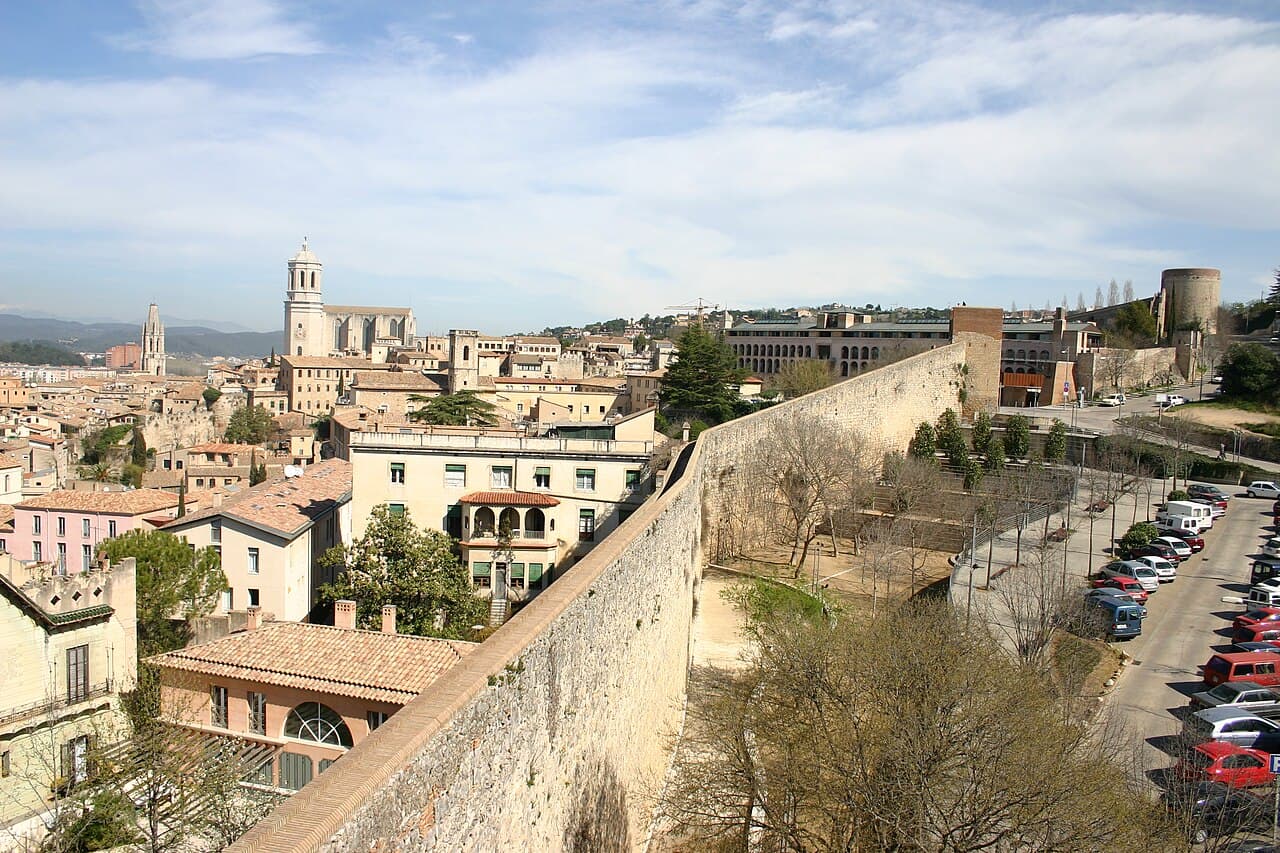
The Muralles de Girona form a nearly continuous circuit around the old town, measuring approximately 4 kilometers in length. The walls vary in height and thickness, with some sections reaching up to 12 meters high. They include numerous towers of different shapes, such as rectangular and circular, which served as lookout points and defensive strongholds.
Key features include several well-preserved gates that controlled access to the city, including the Portal de la Barca and the Portal de Sant Feliu. The walls are also equipped with battlements and walkways that allowed defenders to patrol and repel attackers.
The bastioned sections added in the early modern period are characterized by angular bastions projecting outward from the main walls, designed to cover adjacent walls with crossfire. These bastions were part of a broader effort to modernize Girona's defenses in response to advances in siege warfare.
Historical significance and events
Girona's walls have witnessed numerous historical events, including several sieges during the Franco-Spanish wars and the Peninsular War in the early 19th century. The city was besieged multiple times, demonstrating the strategic importance of its fortifications.
One of the most notable sieges occurred in 1809 during the Peninsular War, when Girona endured a prolonged siege by Napoleonic forces. The resilience of the city's walls and defenders became emblematic of Girona's resistance and determination.
Current condition and visitor experience
Today, the Muralles de Girona are well preserved and accessible to the public. Visitors can walk along significant stretches of the walls, enjoying panoramic views over Girona and the surrounding landscape. The walls are an important cultural attraction, offering insight into the city's military past and architectural heritage.
The site is maintained by local authorities and is often included in guided tours of Girona's historic center. Informational signage along the walls helps visitors understand the historical context and architectural features.
Architectural style and classification
The walls represent a blend of medieval and early modern military architecture, with Roman foundations, medieval masonry, and bastioned fortifications typical of the Renaissance period. Due to the presence of these bastions and the defensive layout, the Muralles de Girona are classified as a bastioned fortress.
Frequently asked questions (FAQ)
- How do I visit the Muralles de Girona?
- The Muralles de Girona are open daily from sunrise to sunset and can be accessed freely. Visitors can explore the walls on foot and enjoy panoramic views of the city.
- What is the historical significance of the Muralles de Girona?
- The walls have been a crucial defensive structure since Roman times, witnessing many sieges including the notable 1809 siege during the Peninsular War.
- Are the walls accessible for people with limited mobility?
- Some sections of the walls have uneven surfaces and steep stairs, which may limit accessibility for visitors with mobility issues. It is advisable to check in advance for accessible routes.
- What architectural styles are represented in the Muralles de Girona?
- The walls showcase a mix of Roman foundations, medieval masonry, and Renaissance bastioned fortifications, reflecting their long history of construction and adaptation.
- Is there an entrance fee to visit the walls?
- Visiting the Muralles de Girona is free of charge, making it accessible to all visitors interested in exploring the historic fortifications.
Photo gallery

Photo by No machine-readable author provided. Yearofthedragon assumed (based on copyright claims).•CC BY-SA 3.0
Information
Opening hours
Open daily, sunrise to sunset
Ticket prices
Free
Current owner
Municipality of Girona
Loading map...
Visitor reviews
No reviews yet. Been here? Write the first review and help other travelers!
Write the first reviewVisited this castle? Share your experience
Your review helps other travelers and adds first-hand knowledge to our encyclopedia.