Muness Castle
Muness Castle stands as the most northerly castle in Britain, located on the island of Unst in the Shetland archipelago. Constructed in 1598 by Laurence Bruce, the half-brother of Robert Stewart, Earl of Orkney, this fortress embodies the turbulent political and social dynamics of late 16th and early 17th century Scotland. Its remote location and robust design reflect both defensive necessities and the status ambitions of its builder.
Laurence Bruce was appointed sheriff of Shetland in 1573 and quickly established a reputation for harsh and often corrupt governance. His tenure was marked by replacing local officials with his own appointees and imposing heavy taxes, stirring unrest among the islanders. The construction of Muness Castle began as a strategic move amid rising tensions following the succession of Robert Stewart's son, Patrick Stewart, who became Lord of Shetland in 1591. Bruce's decision to erect the castle in 1598, even before Patrick commenced work on Scalloway Castle, was a clear assertion of power and an effort to secure his position against potential threats.
Architectural design and features
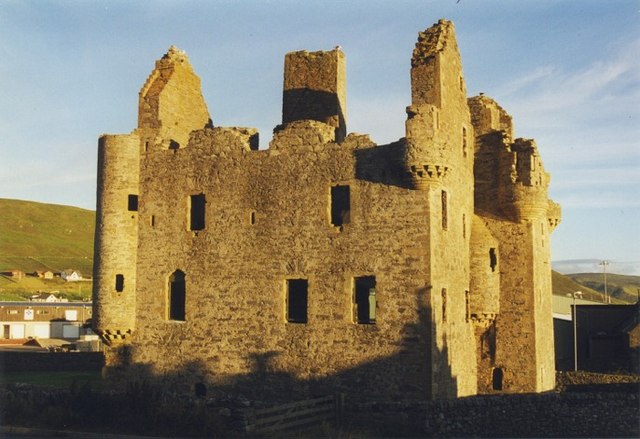
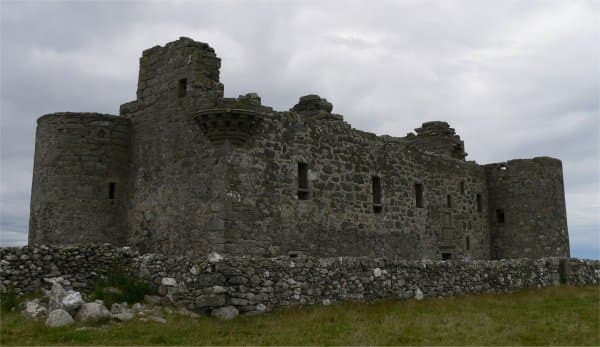
Muness Castle is a notable example of a Renaissance-era fortified residence, designed by Andrew Crawford, who also worked on Scalloway Castle. The castle's layout follows a distinctive Z-plan, a popular design in Scottish castles of the period, characterized by a rectangular main block with two projecting towers at diagonally opposite corners. However, unlike the more common square towers, Muness features circular corner towers, which enhance its defensive capabilities by eliminating blind spots and providing wider fields of fire.
The castle originally rose to three storeys, though only just over two storeys remain today. The uppermost floor has disappeared, with some of its masonry repurposed in a boundary wall surrounding the site. Decorative corbelling on two corners indicates where turrets once stood on the second floor, each equipped with gun loops—narrow slits designed for firearms, reflecting the evolving military technology of the time.
The main entrance is located on the southwest side, accessed through a well-protected door dating from the 18th century, installed during 20th-century restoration efforts. Inside, the ground floor contains four vaulted rooms linked by a long vaulted corridor. Vaulted ceilings, constructed with arches, provided structural strength and fire resistance. One ground-floor room served as a large kitchen, featuring a substantial fireplace with a built-in oven and a waste outlet for refuse disposal. Opposite this was a wine cellar, connected by a narrow staircase to the main hall above.
The first floor housed the main hall, the social and administrative heart of the castle, flanked by chambers at either end. The laird's private quarters occupied the raised western end, comprising four rooms over two levels: a living room with built-in storage within the tower, a bedroom, a small study, and a wardrobe or storage room. Additional chambers on the eastern side likely accommodated younger family members or guests. Archaeological excavations in 1975 revealed the original stone paving of the main hall was later covered with wooden flooring, installed in the early 18th century during continued occupation.
Historical context and events
The castle's history is deeply intertwined with the power struggles of the Orkney and Shetland Islands during the late 16th and early 17th centuries. Laurence Bruce's governance was controversial, and his relationship with the Stewart family was fraught with tension. In 1602, Bruce and his son accused Patrick Stewart of exploiting tenants for forced labor on Scalloway Castle and his own projects.
In 1608, Patrick Stewart led a siege against Muness Castle with 36 men and artillery, intending to capture or destroy it. The assault was unexpectedly abandoned for reasons unknown, sparing the castle temporarily. After Laurence Bruce's death in 1624, his son Andrew Bruce inherited the castle and likely undertook renovations, as evidenced by his initials on a door knocker in one of the turrets.
Muness Castle suffered a significant setback in 1627 when it was attacked and burned by French privateers from Dunkirk. This raid destroyed important documents belonging to Andrew Bruce and caused considerable damage. Despite this, archaeological evidence suggests some occupation continued, with wooden flooring laid over the original stone floors.
By the early 18th century, the castle had ceased to be a family residence. In 1713, it was rented to the Dutch East India Company to store salvaged cargo from the wreck of the Rynenburgh, a ship lost nearby. The Bruce family sold the castle in 1718, and by 1750 it was abandoned. The roof had collapsed by 1774, leaving the castle a ruin.
Later preservation and current status
Despite its ruinous state, Muness Castle remained structurally robust into the 19th century. In the mid-20th century, the site came under state care, prompting conservation efforts to stabilize the masonry and preserve what remained. A door from an 18th-century nearby building was installed during restoration, enhancing access while respecting historical authenticity.
Since 1953, Muness Castle has been protected as a historic monument and is currently maintained by Historic Environment Scotland. The castle is accessible to visitors interested in exploring one of Britain's most remote and evocative Renaissance castles, offering insight into the island's complex history and architectural heritage.
Castle grounds and ancillary structures
In its prime, Muness Castle was surrounded by a walled courtyard on the southwest side, which housed ranges of outhouses including a bakery, brewery, stables, and possibly a chapel. These ancillary buildings supported the castle's self-sufficiency and the daily life of its inhabitants. Today, only the stone foundations of these structures remain, incorporated into nearby buildings or visible as ruins.
To the south of the main building, archaeological surveys have identified traces of terraced gardens and other outbuildings, suggesting a well-planned estate layout. The castle's defensive walls and vaults remain largely intact on the ground floor, while the upper floors and roof have succumbed to time and weather.
Architectural significance and legacy
Muness Castle exemplifies the transitional nature of Scottish castle architecture at the end of the 16th century, blending traditional defensive features with Renaissance influences. Its Z-plan layout, circular towers, and gun loops illustrate advancements in military architecture responding to the introduction of firearms. The castle's robust stone vaulting and strategic design reflect a balance between fortification and domestic comfort.
The castle's history of sieges, raids, and political intrigue mirrors the broader conflicts in Shetland and Orkney during this period. Its survival as a ruin and subsequent conservation highlight the importance of preserving such sites to understand Scotland's feudal past and architectural evolution.
Today, Muness Castle stands as a testament to the resilience and complexity of Scottish Renaissance castles, offering visitors a unique glimpse into the life and times of the Shetland Islands' ruling families. Its remote location and enduring stone walls continue to captivate historians, architects, and tourists alike.
Frequently asked questions (FAQ)
- How do I get to Muness Castle in Shetland?
- Muness Castle is located on the island of Unst in Shetland. Visitors can reach Unst by ferry from the Shetland mainland, followed by local roads to the castle near Uyeasound.
- What is the historical significance of Muness Castle?
- Muness Castle is the northernmost castle in Britain, built in 1598 by Laurence Bruce. It reflects the turbulent political history of Shetland and the Renaissance architectural style.
- Can I explore the interior of Muness Castle?
- Yes, visitors can explore the ground floor and first floor remains of Muness Castle, including the vaulted rooms, main hall, and chambers. Some areas are stabilized but remain ruins.
- When is the best time to visit Muness Castle?
- The best time to visit Muness Castle is during the summer months when weather conditions in Shetland are milder and daylight hours are longer.
- Is there an entrance fee to visit Muness Castle?
- Muness Castle is managed by Historic Environment Scotland and typically offers free access to visitors, though donations are welcome to support conservation.
- Are there other attractions near Muness Castle?
- Nearby attractions include other historic sites on Unst, Shetland's natural landscapes, and the nearby town of Uyeasound with local amenities.
Photo gallery

Information
Sources & official resources
Verify the information above using these authoritative references.
Loading map...
Visitor reviews
No reviews yet. Been here? Write the first review and help other travelers!
Write the first reviewVisited this castle? Share your experience
Your review helps other travelers and adds first-hand knowledge to our encyclopedia.