Scalloway Castle
Scalloway Castle stands as a significant Renaissance-era tower house on the Shetland Islands, Scotland, embodying the turbulent history and architectural ambition of the late 16th and early 17th centuries. Constructed beginning in 1599 by Patrick Stewart, 2nd Earl of Orkney, the castle was intended to consolidate his authority over Shetland, reflecting the broader political and social dynamics of the period.
The castle’s origins are deeply entwined with the Stewart family's complex legacy. Robert Stewart, 1st Earl of Orkney, an illegitimate son of James V of Scotland, was granted the Earldom of Orkney and Shetland in 1564. His governance was marked by oppression and neglect, particularly in Shetland, which he left largely under the control of his half-brother Laurence Bruce, appointed Sheriff of Shetland. Patrick Stewart inherited this legacy in 1593 and took a more direct and forceful approach to ruling Shetland, which included the construction of Scalloway Castle as a symbol and instrument of his power.
Architectural design and features
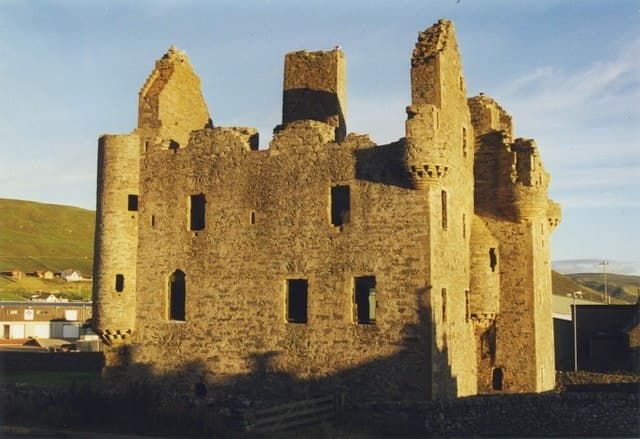
Scalloway Castle is a classic example of a Scottish Renaissance tower house, designed both for defense and status. The building follows an L-plan layout, with a main rectangular block approximately 18 by 10 metres and a smaller square wing projecting from the southwest corner. The structure rises to four storeys plus a garret, presenting a formidable profile despite its current roofless and ruinous condition.
The castle was constructed under the supervision of Andrew Crawford, the Earl’s master of works, who was also responsible for nearby Muness Castle and later the grand Earl’s Palace in Kirkwall. Crawford’s craftsmanship is evident in the castle’s distinctive corbelled bartizans—small turrets projecting from the upper corners—supported by intricately carved corbels, a hallmark of his style.
The ground floor features vaulted chambers, including a kitchen with a large hearth and a well, emphasizing the castle’s self-sufficiency. A porter's lodge, which doubled as a prison, also occupies this level. A wide, grand staircase leads visitors from the entrance to the first-floor great hall, which originally had nine windows and two fireplaces, serving as the main space for official functions and gatherings.
Above the hall were private chambers accessed by spiral staircases, though only one of these staircases remains intact today. This internal arrangement reflects the dual purpose of the castle as both a fortified residence and an administrative center.
Historical context and significance
Patrick Stewart’s rule over Shetland was marked by aggressive land acquisition and harsh governance, continuing the family pattern of corruption and brutality. His construction of Scalloway Castle in 1599 was a clear statement of his intent to tighten control over the islands. The castle also served as the venue for the Shetland thing, the local assembly or parliament, reinforcing its administrative importance.
However, Patrick's reign was fraught with conflict. His increasing number of enemies culminated in his imprisonment in Edinburgh in 1609. His son Robert’s 1614 rebellion in Kirkwall led to a royal siege and the eventual execution of both father and son in 1615. This marked the end of Stewart dominance in Orkney and Shetland.
Following Patrick’s downfall, James Law, Bishop of Orkney, took over judicial responsibilities and held court at Scalloway Castle in 1612. Later, during the Cromwellian period in the 1650s, the castle served as a barracks for troops, underscoring its continued military relevance.
Decline and preservation
By the early 18th century, Scalloway Castle had begun to deteriorate. The shifting of Shetland’s administrative center to Lerwick and the removal of stone from the castle’s ancillary buildings for local construction projects accelerated its decline. By 1754, much of the stone from the surrounding structures was repurposed, leaving only the main tower house standing.
The castle was placed into state care in 1908, and subsequent restoration efforts have focused on preserving the tower house itself. Archaeological excavations in 1979 and 1980 revealed remains of 17th-century outbuildings north of the main tower, providing valuable insight into the castle’s original complex layout.
Today, the castle remains a scheduled monument under the care of Historic Scotland. Visitors can explore the vaulted ground floor, including the kitchen and porter's lodge, and ascend the grand staircase to the open great hall. The surviving spiral staircase leads to the south wing’s upper rooms, offering a glimpse into the castle’s former grandeur.
Architectural details and visitor experience
Visitors to Scalloway Castle are immediately struck by the distinctive corbelling at every corner, a signature of Andrew Crawford’s work. The castle’s robust stone construction and defensive features, such as the bartizans, reflect the turbulent times during which it was built.
The ground floor’s vaulted store and kitchen, complete with a well, illustrate the castle’s functionality and the self-contained nature of noble residences of the period. The porter's lodge’s dual use as a prison adds to the understanding of the castle’s role in maintaining order.
The grand staircase is a notable architectural feature, leading to the first-floor great hall, which served as the heart of the castle’s social and administrative life. Although the roof is now gone, the hall’s size and layout evoke the stature the building once held.
The upper floors, accessed by spiral staircases, housed private chambers for the castle’s most important residents. These spaces provided security and privacy, essential elements in a noble residence designed to assert power and control.
Legacy and cultural importance
Scalloway Castle is a rare surviving example of a Scottish Renaissance tower house in Shetland, embodying the architectural and historical narratives of the region. Its association with the Stewart family and the dramatic events surrounding their rule provide a vivid window into the political complexities of early modern Scotland.
The castle’s enduring stone walls and distinctive features continue to attract visitors interested in Scotland’s noble residences, Renaissance architecture, and the history of the Northern Isles. As a scheduled monument, it plays a vital role in preserving Shetland’s cultural heritage and educating the public about this fascinating period.
Photo gallery

Information
Website
Visit websiteSources & official resources
Verify the information above using these authoritative references.
Loading map...
Visitor reviews
No reviews yet. Been here? Write the first review and help other travelers!
Write the first reviewVisited this castle? Share your experience
Your review helps other travelers and adds first-hand knowledge to our encyclopedia.