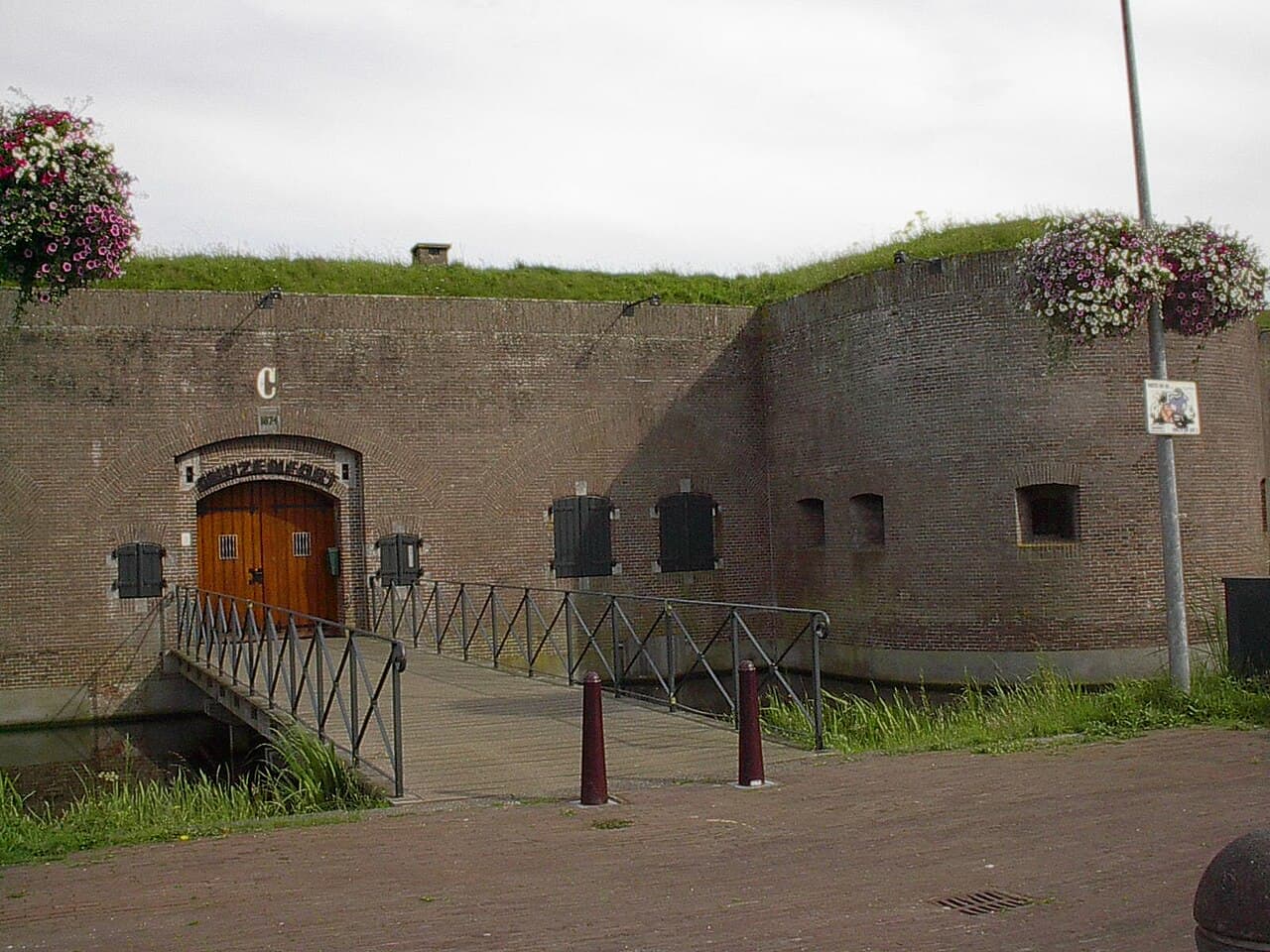
Muiden Fortress — Netherlands castle

Muiden Fortress

Muiden Fortress (Muizenfort) in the Netherlands
Muiden, Netherlands
Modern (19th–20th c.)
Well Preserved

Muiden Fortress, also known as Muizenfort, is a significant bastioned fortress located in Muiden, Netherlands. It forms an integral part of the Stelling van Amsterdam, a remarkable UNESCO World Heritage site comprising a ring of 42 forts encircling Amsterdam. This defensive ring stretches approximately 135 kilometers and was strategically placed between 10 to 15 kilometers from the city center. The fortress and the entire defensive line were constructed during the late 19th and early 20th centuries, specifically between 1880 and 1920, to protect the Dutch capital from potential invasions.

Strategic design of the Stelling van Amsterdam

The Stelling van Amsterdam was an innovative military defense system based on the principle of controlled flooding of the surrounding lowlands. The area around the forts could be deliberately inundated to a depth of about 30 centimeters, which was too shallow for boats to navigate but sufficient to hinder enemy troop movements and mechanized vehicles. This method of defense utilized the unique Dutch landscape and water management expertise.

To ensure the flooding strategy was effective, strict construction regulations were imposed on buildings within one kilometer of the defensive line. All buildings had to be made of wood, allowing them to be easily burned down to prevent obstruction during a military emergency. This measure ensured clear fields of fire and unobstructed flood zones.

Architectural features of Muiden Fortress

Muizenfort is constructed primarily of masonry and is covered with sand on its eastern side for additional protection and camouflage. The fort's design includes nine casemates, which are fortified gun emplacements or armored structures from which artillery could be fired. Among these, the two artillery casemates stand out as the most critical, each equipped with three embrasures designed to cover vital approaches such as the bridges, dike, and canal.

The fort's internal layout includes essential military facilities such as crew quarters, guard rooms, a kitchen, , and storage spaces for food supplies, gunpowder, and artillery pieces. This comprehensive design allowed the fort to function autonomously during a siege or military operation.

Historical context and military relevance

The construction of Muiden Fortress and the entire Stelling van Amsterdam reflected the military thinking of the modern period in the Netherlands. The system was designed to counter the military threats of the late 19th century, particularly from advancing artillery and infantry tactics. However, the rapid development of new military technologies such as the airplane and tank during and after World War I quickly rendered the forts obsolete as defensive structures.

Despite their obsolescence in modern warfare, the forts remain important cultural and historical landmarks. The Stelling van Amsterdam is recognized internationally for its unique integration of water management and military architecture, showcasing Dutch ingenuity in adapting landscape to defense needs.

Current use and preservation

Today, Muiden Fortress serves a dual purpose. It functions as office space and hosts the Muider Muizenfort Museum (MMM), which provides visitors with insights into the fort's history, architecture, and role within the Stelling van Amsterdam. The museum exhibits military artifacts and offers educational programs about the fortifications and Dutch military history.

The fortress is well preserved, maintaining much of its original structure and features, which allows visitors to experience the scale and design of a late 19th-century bastioned fort. The site is accessible to the public, contributing to the cultural tourism and heritage appreciation of the region.

Visiting Muiden Fortress

Visitors to Muiden Fortress can explore the fortifications, including the casemates and internal chambers. The museum offers guided tours that explain the strategic importance of the fort and the broader defensive system. The surrounding landscape also provides a glimpse into the innovative Dutch water defense techniques.

The fort's location near Amsterdam makes it a convenient destination for those interested in military history, architecture, and Dutch heritage. Its inclusion in the UNESCO World Heritage list highlights its significance and encourages preservation efforts.

Frequently asked questions (FAQ)

What is the historical importance of Muiden Fortress?
Muiden Fortress was built as part of the Stelling van Amsterdam, a defensive ring of forts protecting Amsterdam from invasion during the late 19th and early 20th centuries. It illustrates Dutch military strategy and water-based defense techniques.
Can I visit the Muider Muizenfort Museum?
Yes, the Muider Muizenfort Museum is open to visitors and offers exhibits on the fort's history, architecture, and role in the Stelling van Amsterdam. It provides educational tours and insights into Dutch military heritage.
How was the flooding defense system around the fortress designed?
The Stelling van Amsterdam used controlled flooding of lowlands to create shallow waters about 30 cm deep, preventing enemy movement by boat or vehicle. This innovative water defense was a key part of the fortification system.
Is Muiden Fortress accessible from Amsterdam?
Yes, Muiden Fortress is located about 15 kilometers from Amsterdam and is easily reachable by car or public transport, making it a popular day trip destination for history enthusiasts.
What architectural features are notable at Muizenfort?
The fort features nine casemates, including two artillery casemates with three embrasures each, designed to defend key approaches like bridges and canals. It also includes crew quarters, guard rooms, and storage for supplies and ammunition.

Photo gallery

Muiden Fortress
Click to view

Photo by Marion Golsteijn•CC BY-SA 3.0

1 photo • Click any image to view in full screen

Information

Bastioned Fortress

Sources & official resources

Verify the information above using these authoritative references.

Loading map...

Visitor reviews

No reviews yet. Been here? Write the first review and help other travelers!

Write the first review

Visited this castle? Share your experience

Your review helps other travelers and adds first-hand knowledge to our encyclopedia.
Write a review

(5/5)

0/2000 characters

Your review will be visible after admin approval

Nearby castles

0.5 km
Muiden Castle — Netherlands castle

Muiden Castle

Muiden, Netherlands

Muiden Castle, also known as Muiderslot, is a prominent historic fortress located in the town of Muiden, in the province of Noord-Holland, Netherlands. Positioned strategically at the mouth of the Vecht River where it meets the former Zuiderzee (now the IJmeer), this castle has served multiple roles over the centuries, including military defense, administrative center, and cultural hub. Its location allowed it to control important waterways and protect the surrounding region. The castle's origins date back to around 1280, when Count Floris V of Holland commissioned the first stone fortress on this site. The initial structure was a square stone castle with four round corner towers, designed to oversee and control river traffic to the vital medieval city of Utrecht. It functioned both as a defensive stronghold and a toll station for ships navigating the Vecht River, reflecting the economic and military importance of the location. One of the castle's most notable historical events occurred in 1296, when Count Floris V was captured by rebellious nobles and held prisoner at Muiden Castle. During their attempted escape to Utrecht, Floris was murdered, an event that marked a violent chapter in the castle's early history. Subsequently, Bishop Willem van Mechelen of Utrecht laid siege to and destroyed the castle amidst regional power struggles. Reconstruction and architectural evolution Approximately a century later, around 1370, the castle was rebuilt by Duke Albrecht, Count of Holland, on the remains of the original fortress. This reconstruction established the castle's characteristic quadrangular layout with four round corner towers and thick defensive walls measuring about 1.7 meters in thickness. Unlike many medieval castles, Muiden lacks a central keep or donjon; instead, it relies on its robust curtain walls, a large moat, and a defensive wall walk supported by arches on two sides to enhance its fortifications. The design of Muiden Castle is closely related to other Dutch castles such as Radboud Castle, Ammersoyen Castle, and Helmond Castle, all of which share the square plan and round towers typical of late medieval Dutch military architecture. Throughout its history, the castle primarily served as a residence for bailiffs and functioned as a courthouse and prison, rather than as a noble residence, highlighting its administrative and judicial importance. 17th-century cultural significance and the muider circle In the early 17th century, Muiden Castle became renowned as the summer residence of P.C. Hooft, a celebrated Dutch writer, poet, and historian. Hooft lived at the castle from 1609 to 1647 and transformed it into a cultural salon. He hosted the Muiderkring or Muider Circle, a gathering of leading Dutch intellectuals including Hugo de Groot (Grotius), Constantijn Huygens, and Joost van den Vondel. This group was instrumental in the flourishing of arts and letters during the Dutch Golden Age. The castle's interiors today are furnished to reflect this 17th-century period, featuring rooms, kitchens, and halls decorated with period-appropriate furniture, paintings, and household items. The surrounding gardens, including a Warmoeshof vegetable garden, herb garden, and plum orchard, have been restored to their historical appearance from Hooft's era, offering visitors insight into the cultural and domestic life of the time. Military role and later history In the late 17th century, Muiden Castle was incorporated into the Old Dutch Waterline and later the New Dutch Waterline, extensive defensive systems that used controlled flooding to protect Holland's western provinces. The castle's strategic position made it a key stronghold within these water-based defense networks. By the 19th century, the castle had deteriorated significantly and faced possible demolition. However, King William I recognized its historical importance and intervened to preserve it. Restoration efforts began in 1895 under the direction of architect Pierre Cuypers, who aimed to restore the castle's medieval character. Cuypers added battlements and crenellations inspired by romantic medieval ideals rather than original designs. Further restoration took place between 1948 and 1972, focusing on removing fanciful additions and emphasizing historical accuracy. Ongoing conservation work has maintained the castle's structural integrity and historical authenticity. Current status and visitor experience Today, Muiden Castle stands as a well-preserved Renaissance-period water castle managed as a state museum. It attracts many visitors annually, including school groups and tourists from Amsterdam and beyond. The castle hosts cultural events, exhibitions, and educational programs, contributing to the preservation and dissemination of Dutch heritage. Visitors can explore the castle's moat, drawbridge, round towers, and expansive interior halls. The museum's collection includes an impressive array of arms and armour spanning several centuries, providing insight into the castle's military history. The restored 17th-century gardens and orchards offer a tranquil setting that complements the historical experience. Modern adaptations have been made to accommodate visitors, but the castle retains much of its authentic atmosphere and architectural charm, offering a unique glimpse into Dutch medieval and early modern history. Architectural features and comparisons Muiden Castle exemplifies the quadrangular castle typology prevalent in the Netherlands during the late medieval period. Its notable absence of a central keep shifts defensive emphasis to its thick curtain walls and round corner towers. The castle is a classic example of a water castle, with a surrounding moat and drawbridge enhancing its defense in the low-lying Dutch landscape. The architectural style reflects a transition from medieval fortification to Renaissance influences, particularly visible in the castle's interior furnishings and garden layouts. Its similarities to Radboud Castle and other regional fortresses place it within a tradition of Dutch castles that balance military function with administrative roles. Gardens and landscape The castle grounds feature historically restored gardens dating to the 17th century, including a Warmoeshof vegetable garden, herb garden, and plum orchard. These gardens reflect the horticultural interests and lifestyle of P.C. Hooft and his contemporaries, blending practical cultivation with aesthetic design. Maintained to reflect historical planting schemes, the gardens provide visitors with insight into early modern Dutch garden design and complement the castle's cultural heritage.

Renaissance (15th–17th c.)
Details
0.5 km

Muider Castle

Muiden, Poland

Muider Castle, also known as Muiderslot, is a remarkable medieval fortress located in Muiden, just east of Amsterdam in the province of North Holland. Its origins date back to 1280 when Count Floris V of Holland commissioned the construction of a stone castle on this strategic site at the mouth of the Vecht River. The castle's primary function was to protect the region and control the important waterways leading to Amsterdam, making it a key element in the defense network of the area. Today, Muider Castle stands as one of the best-preserved medieval castles in the Netherlands and is part of the UNESCO-listed Defence Line of Amsterdam, a historic fortification system designed to protect the city from invasion. Architectural features and layout The castle is a classic example of a water castle, surrounded by a wide moat that enhances its defensive capabilities. It features a prominent drawbridge that serves as the main entrance, leading visitors across the water to the fortified gatehouse. The castle's defensive structures include five towers, each strategically positioned to provide overlapping fields of fire and surveillance over the surrounding landscape. The battlements and curtain walls are well-preserved, showcasing the medieval military architecture of the Late Medieval period. The castle's interior has been carefully restored to reflect the grandeur of the Dutch Golden Age, particularly the 17th century, when the castle was owned by the famous poet and statesman Pieter Corneliszoon Hooft. The chambers are furnished with period-appropriate decor, including tapestries, wooden paneling, and antique furnishings, offering visitors a glimpse into the lifestyle of Dutch nobility during this culturally rich era. Historical significance and ownership Muider Castle has played a significant role throughout Dutch history, both as a military stronghold and a cultural hub. After its initial construction by Count Floris V, the castle was expanded and modified over the centuries to adapt to changing military technologies and needs. In the 17th century, under the ownership of Pieter Corneliszoon Hooft, the castle became a center for the Dutch literary and artistic community, hosting gatherings of prominent intellectuals and artists, known as the Muiderkring. This period elevated the castle from a purely defensive structure to a symbol of Dutch cultural achievement during the Golden Age. The castle's gardens were also developed during this time, featuring formal layouts and exotic plants that reflected the wealth and global connections of the Dutch Republic. Visitor experience and activities Today, Muider Castle is a popular tourist destination offering a variety of experiences. Visitors can explore the castle's well-preserved medieval architecture, including the towers, moat, and battlements. Guided tours are included with admission, providing detailed insights into the castle's history, architecture, and the lives of its notable residents. The castle grounds feature beautifully maintained gardens that are perfect for leisurely walks. Several walking routes around the castle and along the river provide scenic views and opportunities to appreciate the historic landscape. Special activities are regularly organized, especially for families and children, such as themed guided tours and interactive events. Between April and October, visitors can enjoy daily demonstrations by a falconer showcasing birds of prey, an engaging attraction that highlights medieval hunting traditions. The castle also hosts cultural events, exhibitions, and educational programs throughout the year, making it a vibrant heritage site. Conservation and cultural heritage As part of the Defence Line of Amsterdam, Muider Castle is protected under UNESCO World Heritage status, ensuring its preservation for future generations. The castle has undergone several restoration projects to maintain its structural integrity and historical authenticity. These efforts have successfully balanced the need for modern visitor facilities with the conservation of its medieval character. The castle is managed as a museum and cultural site, welcoming thousands of visitors annually. Its blend of military architecture, cultural history, and natural beauty makes it a unique and enriching destination for those interested in medieval fortifications and Dutch history.

Late Medieval (14th–15th c.)
Details
3 km

Fort Ossenmarkt

Weesp, Netherlands

Fort Ossenmarkt, also known locally as Fort aan de Ossenmarkt, is a historic military fortification situated in the town of Weesp, within the province of North Holland in the Netherlands. Constructed in 1861, this small tower fort played a strategic role in the defense system surrounding Amsterdam, later becoming an integral part of the Defense Line of Amsterdam after 1901. Historical context and strategic importance The mid-19th century was a period marked by significant military modernization in the Netherlands. Fort Ossenmarkt was built during this era as part of a broader network of fortifications designed to protect key urban centers and transportation routes. Its location in Weesp, near the important waterways and roads, made it a valuable defensive position to control access to Amsterdam from the east. Originally, Fort Ossenmarkt was incorporated into the Weesp Fortress, a cluster of fortifications that formed a defensive ring. This ring was later absorbed into the larger Defense Line of Amsterdam (Stelling van Amsterdam), a UNESCO World Heritage site, which was constructed to safeguard the capital city through a system of forts, inundations, and military infrastructure. Architectural features and modifications Fort Ossenmarkt is classified as a tower fort, characterized by its compact design and vertical emphasis. The fort's original structure includes thick masonry walls and a moat, typical of 19th-century fortifications aiming to resist artillery fire and infantry assault. In 1876, the fort underwent significant modifications with the addition of an earthen glacis on its eastern side. This glacis, a sloped embankment of earth, was designed to absorb and deflect enemy artillery fire, enhancing the fort's defensive capabilities. The glacis partially filled the moat on that side, altering the fort’s immediate landscape and defensive perimeter. Post-military uses and restoration Following its military service, Fort Ossenmarkt's function evolved considerably. In the late 1940s, it was repurposed as a mushroom farm, reflecting a common post-war trend of adapting obsolete military structures for agricultural or industrial use. This use continued into the 1950s, after which the fort ceased to have any military role. Subsequently, the fort served as a practice location for the local fire brigade, providing a practical training ground for emergency responders. This adaptive reuse helped preserve the structure through continued functional engagement. In 1976, the fort was acquired by the local government, marking the beginning of its conservation as a heritage site. During the 1980s, restoration efforts focused on removing the earthen glacis added in the 19th century, reinstating the fort's original appearance and moat configuration. These restorations aimed to preserve the fort's historical integrity and architectural character. Current status and cultural significance Today, Fort Ossenmarkt is well preserved and serves primarily cultural and commercial purposes. While it is not open for regular public tours, the fort is accessible during special events and open days, offering visitors a glimpse into its military past and architectural features. The fort's adaptation to modern uses while maintaining its historical fabric exemplifies the challenges and successes of preserving 19th-century military architecture in urban settings. Its inclusion in the broader context of the Defense Line of Amsterdam underlines its importance as part of the Netherlands' national heritage. Architectural details and layout The fort's compact footprint is dominated by a central tower-like structure surrounded by defensive walls and a moat. The masonry construction features robust walls designed to withstand artillery bombardment. The moat, originally filled with water, added an extra layer of defense by hindering direct assaults on the walls. Inside, the fort contained barracks, storage rooms, and defensive positions such as gun emplacements. The design reflects the military engineering principles of the mid-19th century, balancing compactness with effective defense. Defensive elements Moat: A water-filled ditch surrounding the fort, providing protection against infantry and siege equipment. Glacis: The earthen slope added in 1876 to deflect artillery fire, later removed during restoration. Thick masonry walls: Built to absorb and resist cannon fire. Gun emplacements: Positions for artillery pieces to defend against attackers. Architectural style and period Fort Ossenmarkt's architecture corresponds to the modern period of fortification design, reflecting advancements in military technology and artillery during the mid-19th century. Its style is utilitarian, focused on function rather than ornamental design, typical of 19th-century military architecture in the Netherlands. Visiting Fort Ossenmarkt Visitors interested in military history and 19th-century fortifications can explore Fort Ossenmarkt during occasional open days and cultural events. The fort's interior, restored to reflect its historical state, offers insight into the living and defensive conditions of the period. Its location at Ossenmarkt 44 in Weesp makes it accessible from Amsterdam and surrounding areas. While regular public access is limited, the fort's presence enriches the cultural landscape of Weesp and the Defense Line of Amsterdam.

Modern (19th–20th c.)
Details

