Muiden Castle
Muiden Castle, also known as Muiderslot, is a prominent historic fortress located in the town of Muiden, in the province of Noord-Holland, Netherlands. Positioned strategically at the mouth of the Vecht River where it meets the former Zuiderzee (now the IJmeer), this castle has served multiple roles over the centuries, including military defense, administrative center, and cultural hub. Its location allowed it to control important waterways and protect the surrounding region.
The castle's origins date back to around 1280, when Count Floris V of Holland commissioned the first stone fortress on this site. The initial structure was a square stone castle with four round corner towers, designed to oversee and control river traffic to the vital medieval city of Utrecht. It functioned both as a defensive stronghold and a toll station for ships navigating the Vecht River, reflecting the economic and military importance of the location.
One of the castle's most notable historical events occurred in 1296, when Count Floris V was captured by rebellious nobles and held prisoner at Muiden Castle. During their attempted escape to Utrecht, Floris was murdered, an event that marked a violent chapter in the castle's early history. Subsequently, Bishop Willem van Mechelen of Utrecht laid siege to and destroyed the castle amidst regional power struggles.
Reconstruction and architectural evolution
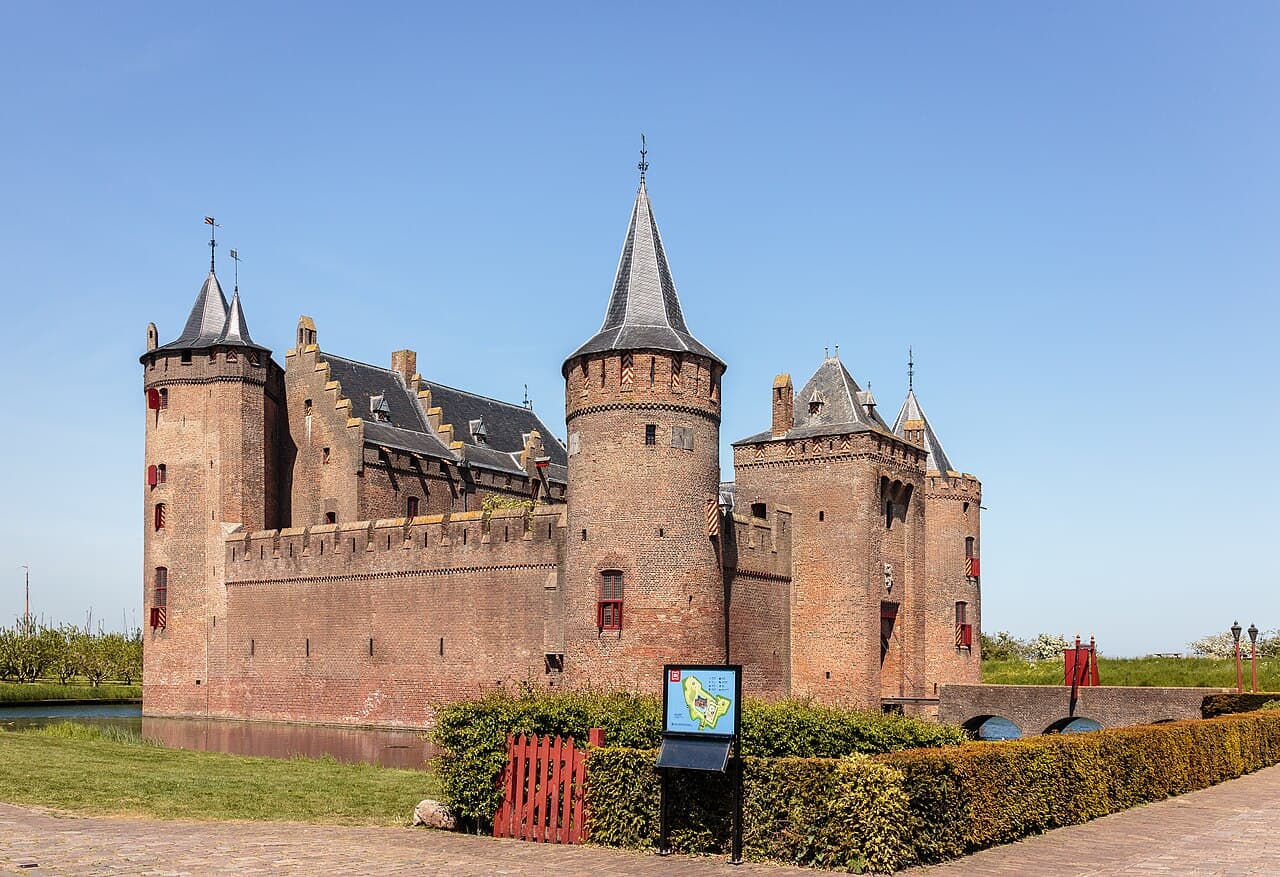
Approximately a century later, around 1370, the castle was rebuilt by Duke Albrecht, Count of Holland, on the remains of the original fortress. This reconstruction established the castle's characteristic quadrangular layout with four round corner towers and thick defensive walls measuring about 1.7 meters in thickness. Unlike many medieval castles, Muiden lacks a central keep or donjon; instead, it relies on its robust curtain walls, a large moat, and a defensive wall walk supported by arches on two sides to enhance its fortifications.
The design of Muiden Castle is closely related to other Dutch castles such as Radboud Castle, Ammersoyen Castle, and Helmond Castle, all of which share the square plan and round towers typical of late medieval Dutch military architecture. Throughout its history, the castle primarily served as a residence for bailiffs and functioned as a courthouse and prison, rather than as a noble residence, highlighting its administrative and judicial importance.
17th-century cultural significance and the muider circle
In the early 17th century, Muiden Castle became renowned as the summer residence of P.C. Hooft, a celebrated Dutch writer, poet, and historian. Hooft lived at the castle from 1609 to 1647 and transformed it into a cultural salon. He hosted the Muiderkring or Muider Circle, a gathering of leading Dutch intellectuals including Hugo de Groot (Grotius), Constantijn Huygens, and Joost van den Vondel. This group was instrumental in the flourishing of arts and letters during the Dutch Golden Age.
The castle's interiors today are furnished to reflect this 17th-century period, featuring rooms, kitchens, and halls decorated with period-appropriate furniture, paintings, and household items. The surrounding gardens, including a Warmoeshof vegetable garden, herb garden, and plum orchard, have been restored to their historical appearance from Hooft's era, offering visitors insight into the cultural and domestic life of the time.
Military role and later history
In the late 17th century, Muiden Castle was incorporated into the Old Dutch Waterline and later the New Dutch Waterline, extensive defensive systems that used controlled flooding to protect Holland's western provinces. The castle's strategic position made it a key stronghold within these water-based defense networks.
By the 19th century, the castle had deteriorated significantly and faced possible demolition. However, King William I recognized its historical importance and intervened to preserve it. Restoration efforts began in 1895 under the direction of architect Pierre Cuypers, who aimed to restore the castle's medieval character. Cuypers added battlements and crenellations inspired by romantic medieval ideals rather than original designs.
Further restoration took place between 1948 and 1972, focusing on removing fanciful additions and emphasizing historical accuracy. Ongoing conservation work has maintained the castle's structural integrity and historical authenticity.
Current status and visitor experience
Today, Muiden Castle stands as a well-preserved Renaissance-period water castle managed as a state museum. It attracts many visitors annually, including school groups and tourists from Amsterdam and beyond. The castle hosts cultural events, exhibitions, and educational programs, contributing to the preservation and dissemination of Dutch heritage.
Visitors can explore the castle's moat, drawbridge, round towers, and expansive interior halls. The museum's collection includes an impressive array of arms and armour spanning several centuries, providing insight into the castle's military history. The restored 17th-century gardens and orchards offer a tranquil setting that complements the historical experience.
Modern adaptations have been made to accommodate visitors, but the castle retains much of its authentic atmosphere and architectural charm, offering a unique glimpse into Dutch medieval and early modern history.
Architectural features and comparisons
Muiden Castle exemplifies the quadrangular castle typology prevalent in the Netherlands during the late medieval period. Its notable absence of a central keep shifts defensive emphasis to its thick curtain walls and round corner towers. The castle is a classic example of a water castle, with a surrounding moat and drawbridge enhancing its defense in the low-lying Dutch landscape.
The architectural style reflects a transition from medieval fortification to Renaissance influences, particularly visible in the castle's interior furnishings and garden layouts. Its similarities to Radboud Castle and other regional fortresses place it within a tradition of Dutch castles that balance military function with administrative roles.
Gardens and landscape
The castle grounds feature historically restored gardens dating to the 17th century, including a Warmoeshof vegetable garden, herb garden, and plum orchard. These gardens reflect the horticultural interests and lifestyle of P.C. Hooft and his contemporaries, blending practical cultivation with aesthetic design.
Maintained to reflect historical planting schemes, the gardens provide visitors with insight into early modern Dutch garden design and complement the castle's cultural heritage.
Frequently asked questions (FAQ)
- How do I get to Muiden Castle?
- Muiden Castle is easily accessible by public transportation or car. If you're traveling by train, the nearest station is Muiden, which is about a 15-minute walk from the castle. There are also parking facilities available for those who choose to drive.
- What is the historical significance of Muiden Castle?
- Muiden Castle, built in the late 13th century, played a crucial role in protecting the waterways and trade routes in the region. It is one of the best-preserved medieval castles in the Netherlands and reflects the architectural style of that era. The castle has been a witness to many significant historical events, making it a key landmark in Dutch history.
- When was Muiden Castle built?
- Muiden Castle was constructed in 1285, originally as a defensive fortress. Over the centuries, it has undergone various renovations and expansions, adapting to the changing needs of its occupants. Today, it stands as a testament to medieval architecture and history.
- Can I visit Muiden Castle year-round?
- Yes, Muiden Castle is open to visitors throughout the year, although opening hours may vary by season. It is advisable to check the official website for the most current visiting hours and any seasonal events. This allows visitors to plan their trip accordingly and enjoy the castle's rich history.
- Why is Muiden Castle a popular tourist attraction?
- Muiden Castle attracts visitors due to its stunning architecture, picturesque location, and rich history. The castle offers guided tours, exhibitions, and beautiful gardens, making it a perfect destination for history enthusiasts and families alike. Its proximity to Amsterdam also adds to its appeal as a day trip location.
- Is it possible to host events at Muiden Castle?
- Yes, Muiden Castle offers facilities for hosting various events, including weddings and corporate gatherings. The unique setting and historical ambiance provide a memorable backdrop for any occasion. For more information on booking and arrangements, it is recommended to contact the castle's management directly.
- What are the ticket prices for visiting Muiden Castle?
- Ticket prices for Muiden Castle vary depending on age and group size, with discounts available for children, seniors, and groups. Generally, adult tickets are priced around €10, while children under 12 may enter for free or at a reduced rate. It's best to check the official website for the latest pricing and any special offers.
- What are the opening hours of Muiden Castle?
- Muiden Castle typically opens at 10 AM and closes at 5 PM, but these hours may differ on holidays or during special events. It’s advisable to verify the opening times on the castle's official website before planning your visit. This ensures you have ample time to explore the castle and its surroundings.
- What nearby attractions can I visit after Muiden Castle?
- After visiting Muiden Castle, you can explore the charming town of Muiden itself, which offers lovely cafes and shops. Additionally, the nearby Naarden-Vesting, a well-preserved star fort, and the scenic nature reserves along the IJmeer are great options for a day out. Each location provides further insights into the historical and natural beauty of the region.
Photo gallery

Information
Opening hours
10:00-17:00, daily
Ticket prices
€10 adult, €5 child
Current owner
State museum
Website
Visit websiteAddress
Herengracht 1, Netherlands
Sources & official resources
Verify the information above using these authoritative references.
Loading map...
Visitor reviews
No reviews yet. Been here? Write the first review and help other travelers!
Write the first reviewVisited this castle? Share your experience
Your review helps other travelers and adds first-hand knowledge to our encyclopedia.