Mühlburg Castle
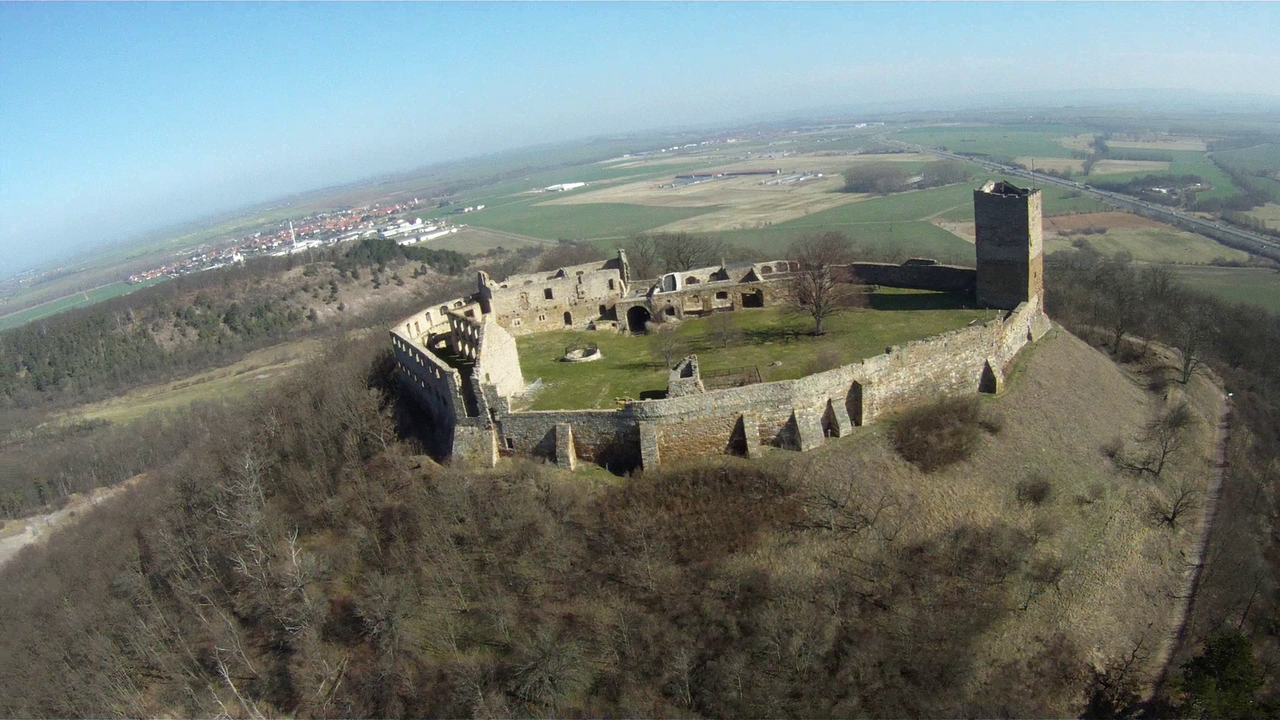
Mühlburg Castle stands as a monumental relic of medieval fortification in the heart of Thuringia, Germany. Perched on a lofty 375-meter-high natural rock spur overlooking the village of Mühlberg, it is renowned as the oldest of the Drei Gleichen castles and the oldest surviving structure in Thuringia. Its origins trace back to the early medieval period, likely founded during the era of the Thuringian Kingdom before the region fell under Frankish control in 531. The castle's strategic position atop a ridge enabled it to dominate the surrounding landscape and control vital trade routes, notably the copper trade through the region.
Early history and medieval significance
The first documented mention of Mühlburg Castle dates to May 1, 704, in a record of a donation by Duke Hedan II of Thuringia to the missionary bishop Willibrord. This early reference to "Castello Mulenberge" confirms the castle's importance in the early 8th century, although it remains unclear whether the fortification then was located exactly on the present site or constructed of stone. By the year 1000, the castle came under the control of the Counts of Orlamünde, marking its integration into the regional noble power structure.
In 1088, the castle's formidable defenses were tested when Emperor Henry IV unsuccessfully attempted to capture it during a siege. This event highlights the castle's strategic strength alongside the nearby Burg Gleichen. Around 1130, ownership transferred to the Archbishopric of Mainz following inheritance from the extinct Weimar-Orlamünde noble house. The castle was then granted as a fief to the Meinhard family, who adopted the title Counts of Mühlburg. Count Meinhard I received this fiefdom officially in 1140, marking a new chapter in the castle's history.
The Meinhard family expanded their influence by acquiring the adjacent Wachsenburg Castle in 1220. However, their line ended by 1242, prompting Mainz to reclaim Mühlburg. In 1248, Count Berthold of Henneberg was appointed as the first official castle captain, initiating a period of local administration. The city of Erfurt laid siege to Mühlburg in 1310 but failed to capture it, underscoring the castle's defensive resilience.
By 1357, Erfurt had purchased the castle and undertook significant fortification efforts, transforming Mühlburg into a fortress that controlled the vital copper trade route through the region. The castle remained under Erfurt's management until 1590, when the administrative jurisdiction known as Amt Mühlberg passed to Saxony-Weimar. Over subsequent centuries, the castle changed hands multiple times, including ownership by the Duke of Weimar in 1592, the Duke of Altenburg in 1635, a return to Mainz in 1665, and ultimately Prussian control in 1815 after a period of French rule beginning in 1806.
Architectural features and fortifications
Mühlburg Castle exemplifies a classic hill castle or ridge castle layout, strategically utilizing the natural topography for defense. The castle is accessed from the south via the Schlossleite ridge, which connects it to the neighboring Wachsenburg Castle. Visitors today cross a wooden bridge spanning the neck ditch, a deep trench cut into the ridge that served as a formidable defensive barrier against attackers.
This neck ditch forms part of an extensive system of defensive walls and trenches, regarded as among the strongest fortifications in Thuringia. Beyond the ditch lie the remains of the zwinger wall, a secondary outer wall designed to expose attackers to defenders stationed on the castle walls. This zwinger wall connects to a broader ring wall, a circular defensive barrier encircling the castle's core area.
The innermost core castle wall is built directly onto the natural rock outcrop, providing a solid foundation that made undermining or tunneling attempts nearly impossible. The castle's most prominent surviving structure is its bergfried, a tall defensive tower constructed in the 13th century. This tower rises 22 meters and features exceptionally thick walls measuring 2.7 meters, with a diameter of 7.4 meters, offering a commanding vantage point and a last refuge during sieges. The bergfried remains accessible to visitors, providing panoramic views of the surrounding landscape and the other two Drei Gleichen castles.
Fragments of the original gatehouse survive as part of the zwinger wall, though these remains are limited. Near the entrance at the start of the Schlossleite ridge once stood a chapel dedicated to Saint Radegundis. While the chapel's superstructure no longer exists, archaeological excavations have revealed its foundations, providing insight into the castle's religious significance.
Cultural heritage and modern use
In the early 20th century, from 1903 to 1907, the castle's bergfried was transformed into a lookout tower enhanced with battlements, reflecting renewed interest in the site's historical and touristic value. Around 1930, the castle caretaker Richard Opel uncovered the ruins of the medieval chapel dedicated to Saint Radegundis. Unfortunately, the chapel was dismantled in 1945, leaving only foundational remains visible today.
Since the 1970s, local community efforts have gradually restored parts of the castle, which now houses a museum exhibiting medieval pottery and household objects that reflect the site's long history. The castle grounds also include a restaurant, a functioning mailbox, and a well, maintaining the castle's ongoing use and connection to the local community.
The cultural significance of Mühlburg is further highlighted by its role in the novel "Das Nest der Zaunkönige" by Gustav Freytag, which inspired a hiking trail linking Mühlburg with the other two Drei Gleichen castles. Each year, an ecumenical service and procession commemorate Saint Radegundis's memory, with a memorial stone placed within the chapel ruins in 1987 to honor the 1400th anniversary of her death.
The local art and culture association organizes a summer open-air cinema on the castle grounds, blending historical ambiance with contemporary community activities. These features illustrate Mühlburg's layered history as a defensive stronghold, religious site, and center of local administration, reflected in its surviving architectural and archaeological remains.
Frequently asked questions (FAQ)
- When was Mühlburg Castle first mentioned in historical records?
- Mühlburg Castle was first documented on May 1, 704, in a donation record by Duke Hedan II of Thuringia to missionary bishop Willibrord.
- What defensive features does Mühlburg Castle have?
- The castle features a neck ditch, zwinger wall, ring wall, and a 13th-century bergfried tower with thick walls, all designed for strong defense.
- Can visitors access the bergfried tower?
- Yes, the 22-meter-high bergfried tower is accessible to visitors and offers panoramic views of the surrounding area, including the other Drei Gleichen castles.
- What is the cultural significance of the chapel ruins at Mühlburg?
- The chapel dedicated to Saint Radegundis is an important religious site with foundations uncovered in archaeological excavations; a memorial stone was placed in 1987 to honor her legacy.
- Are there any museums or cultural activities at Mühlburg Castle?
- Yes, the castle houses a museum with medieval artifacts and hosts a summer open-air cinema organized by the local art and culture association.
Information
Website
Visit websiteSources & official resources
Verify the information above using these authoritative references.
Loading map...
Visitor reviews
No reviews yet. Been here? Write the first review and help other travelers!
Write the first reviewVisited this castle? Share your experience
Your review helps other travelers and adds first-hand knowledge to our encyclopedia.