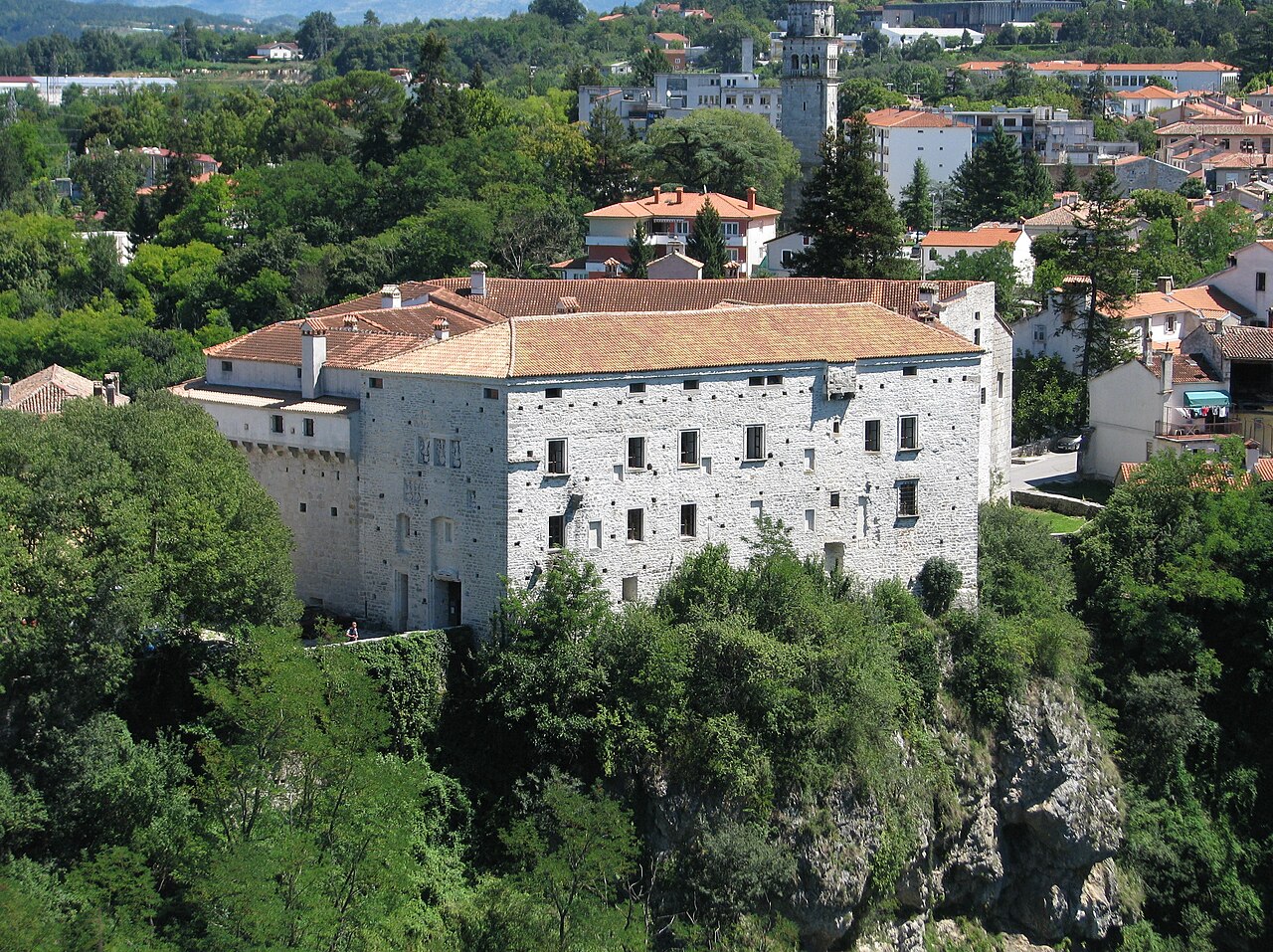
Morosini-Grimani Castle
Morosini-Grimani Castle stands as a remarkable example of a medieval fortress transformed through the Renaissance period, located in the historic town of Svetvinčenat, Croatia. This castle, named after the prominent Venetian noble families Morosini and Grimani, reflects centuries of architectural evolution and regional power struggles. Its strategic position in Istria, a region long contested by various rulers, underscores its importance as both a military stronghold and noble residence.
The castle's earliest documented mention dates back to 983 AD, when it was recorded as the property of the Bishop of Poreč. Originally constructed as a defensive structure to protect the settlement on a key trade route linking Istria's interior with its coast, the castle's core likely began in the 10th century. Over time, it underwent significant expansions and renovations that reflected the changing needs of its owners and the architectural trends of the times.
Historical development and ownership
During the Middle Ages, the castle was initially under the control of the Castropola family in the 13th century, who maintained its defensive role amidst regional conflicts. In 1384, ownership transferred to the Morosini family, Venetian nobility who played a pivotal role in the castle's Renaissance transformation. By 1485, the Morosinis had completed significant fortifications, including the construction of the castle's square layout and corner towers, marking a shift from purely medieval military architecture to Renaissance design principles.
The Morosini family continued to hold the castle until the early 16th century, with Pietro Morosini last recorded as the castle's master in 1529. Subsequently, through marriage alliances and political arrangements, the Grimani family acquired the castle around 1560. They undertook extensive renovations after a devastating fire in 1586, which reshaped the castle into a fortified residence combining military and administrative functions.
Throughout the 16th and 17th centuries, the Grimani family maintained the castle as a symbol of noble authority and defense against external threats, including the advancing Ottoman Empire and Austrian forces. Despite suffering damage from another fire in 1616, the castle remained a crucial bastion and noble seat for over two centuries.
The fall of the Venetian Republic in 1797 led to Habsburg Austrian control over the region, diminishing the castle's military significance. The 19th century witnessed the gradual decline and partial abandonment of the castle, with some looting and neglect. Protective measures initiated by Austrian authorities in the early 20th century aimed to preserve the structure as a cultural monument.
Post-World War II restoration efforts by the Yugoslav government in the 1960s and 1970s focused on conserving the castle's Renaissance features and stabilizing its structure, preparing it for cultural and educational use.
Architectural features and layout
Fortifications and towers
The Morosini-Grimani Castle is characterized by its square plan, a hallmark of Renaissance military architecture, designed with a 3:5 ratio that influenced the surrounding urban layout of Svetvinčenat. The castle is anchored by three prominent towers: two round towers on the northern corners and a square tower on the southeast corner, which served as the mastio or keep. These towers provided strategic vantage points for surveillance and defense.
The thick curtain walls encircling the castle were constructed from durable local stone, featuring battlements and narrow arrow slits to protect defenders while allowing effective use of ranged weapons. Originally, the castle was surrounded by a moat that added an extra layer of defense, though today it remains dry but visible as part of the fortification system.
Residential and administrative areas
The southeast section of the castle was designated as the residential area, housing the noble family and administrative offices. The castle's interior included spacious halls and chambers adapted over time to balance comfort with security. The main entrance on the south facade, once accessed by a drawbridge, is marked by plaques bearing the dates 1485 and 1589, commemorating the original construction and later Renaissance renovations.
Within the castle walls lies a large courtyard that historically served multiple functions, from daily activities to safe assembly during sieges. The castle's design and the surrounding urban plan, including the central square with a cistern, the parish church, and a loggia, reflect a cohesive Renaissance vision for the settlement’s development.
Significance in regional history and culture
Morosini-Grimani Castle embodies the complex history of Istria, a region shaped by shifting borders and cultural influences. Its transformation from a medieval fortress to a Renaissance noble residence mirrors broader European trends in military architecture and urban planning during the late Middle Ages and Renaissance.
The castle’s association with the Venetian noble families Morosini and Grimani highlights the influence of Venice in Istria’s political and cultural landscape. These families not only fortified the castle but also fostered the development of Svetvinčenat as a Renaissance town, integrating architecture, defense, and civic life.
Today, the castle serves as a cultural monument and museum, preserving the legacy of its noble past and the turbulent history of the region. Its well-preserved Renaissance features and medieval foundations attract scholars, tourists, and heritage enthusiasts interested in the architectural and historical heritage of Croatia and the Adriatic region.
Preservation and public access
The castle is currently well preserved thanks to ongoing conservation efforts. Restoration has focused on maintaining the structural integrity of the walls, towers, and courtyard, as well as preserving original Renaissance architectural details. The interior now hosts exhibition rooms that provide insights into the castle’s history, the noble families who owned it, and the broader historical context of Svetvinčenat and Istria.
Visitors can explore the castle’s fortified structures, admire the architectural details, and learn about the region’s history through curated displays. The castle remains a key cultural landmark in Istria, combining historical education with architectural appreciation.
Visitor information
- The castle is open to the public during regular hours, typically from morning to late afternoon, though exact times may vary seasonally.
- Admission fees may apply, often modest, supporting the castle’s maintenance and cultural programs.
- Guided tours and informational materials are usually available to enhance the visitor experience.
- The castle is accessible by road from nearby towns and is a popular stop for those exploring Istria’s historical sites.
Frequently asked questions (FAQ)
- When was Morosini-Grimani Castle originally built?
- Morosini-Grimani Castle dates back to the 10th century, with its earliest mention in 983 AD as property of the Bishop of Poreč.
- What architectural styles are represented in the castle?
- The castle features a blend of late medieval construction with prominent Renaissance architectural characteristics, especially after renovations in the 15th and 16th centuries.
- Can visitors tour the interior of the castle?
- Yes, the castle interior houses exhibition rooms that narrate the history of the Grimani family and the local town, and it is open to the public for tours.
- What defensive features does the castle have?
- Morosini-Grimani Castle includes thick curtain walls, three large corner towers, battlements, arrow slits, and was originally surrounded by a moat for enhanced defense.
- Why is the castle historically significant?
- It represents the evolution of a medieval fortress into a Renaissance noble residence and reflects the influence of Venetian noble families in Istria's history.
Information
Sources & official resources
Verify the information above using these authoritative references.
Loading map...
Visitor reviews
No reviews yet. Been here? Write the first review and help other travelers!
Write the first reviewVisited this castle? Share your experience
Your review helps other travelers and adds first-hand knowledge to our encyclopedia.