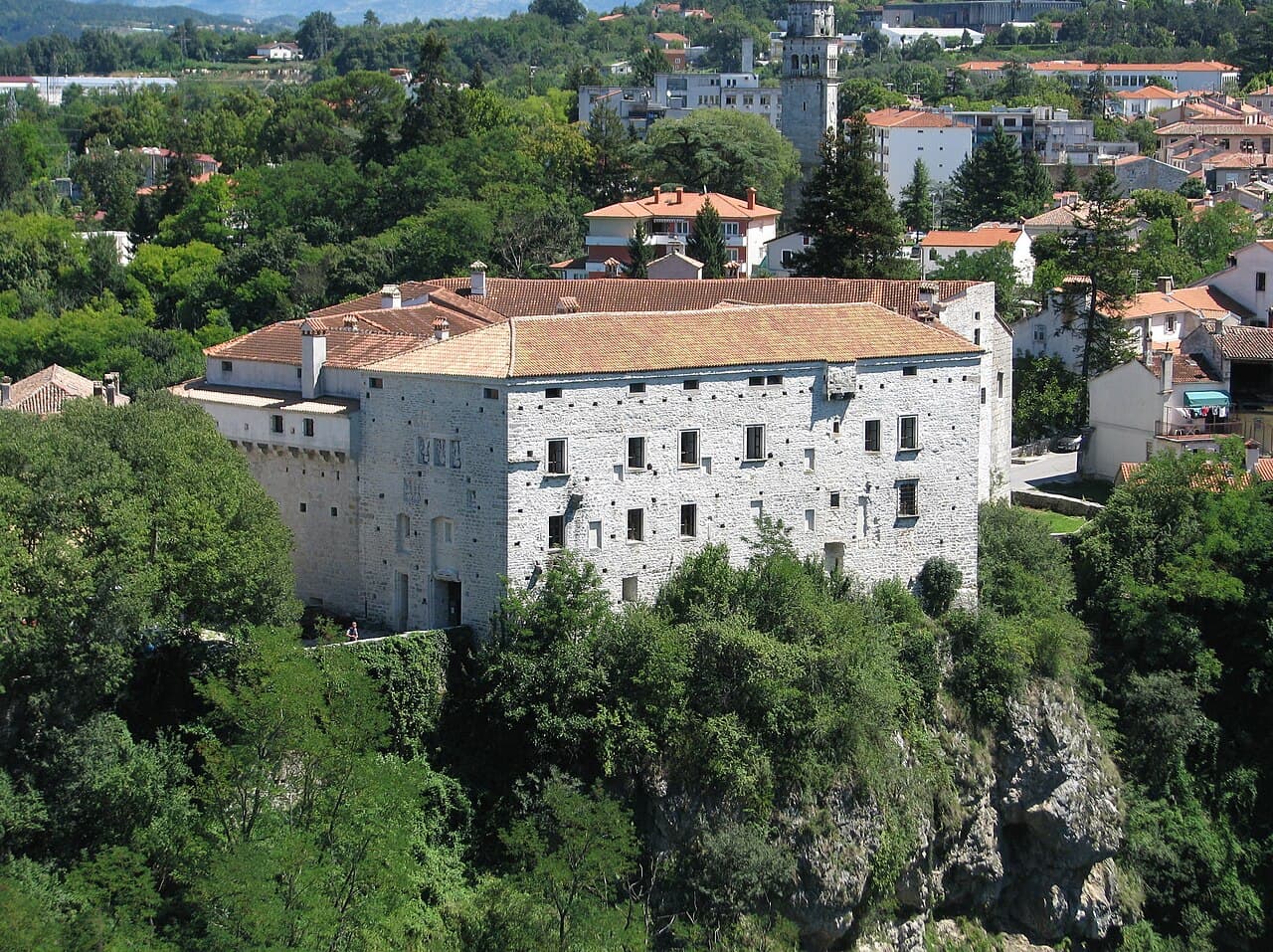
Pazin Castle
Pazin Castle stands as a monumental hilltop fortress in the heart of Pazin, Croatia, commanding a dramatic position atop a steep rock above the deep karst abyss formed by the Pazinčica river. As the largest and best-preserved castle in the Istria County, it represents a significant cultural and historical landmark with a continuous history spanning over 1100 years. The castle's strategic location and robust construction have made it a key defensive stronghold and administrative center since its first recorded mention in 983 AD by Holy Roman Emperor Otto II.
Early history and medieval significance
The origins of Pazin Castle trace back to the 10th century, with initial construction likely influenced by early Croatian and Germanic settlers in the region. Its earliest documented reference appears in an imperial charter confirming the castle's possession by the bishop of Poreč, highlighting its ecclesiastical and political importance during the early medieval period. Throughout the Middle Ages, the castle functioned as the administrative seat of the Istrian margraviate, a frontier territory governed by margraves under various Central European rulers.
In the 12th century, ownership transitioned from the bishops of Poreč to noble families such as the Schwarzenburgs and the Counts of Gorizia, culminating with the Margraves of Istria. The extinction of the ruling family in 1374 led to the castle's inheritance by the House of Habsburg, which maintained control for nearly four centuries. During this time, the castle was often leased or managed by noble families closely allied with the Habsburgs, including the Auersperg, Barbo, Mosconi, Swetkowitz, Turinetti de Prie, and Walsee families.
Strategic importance and military history
Situated on the volatile border between Habsburg territories and the Republic of Venice, Pazin Castle held vital strategic value. It endured numerous sieges and military conflicts, notably the Venetian capture in 1508, which inflicted significant damage before defenders reclaimed it the following year. The castle also played a role in the Austro-Venetian wars of the early 17th century, withstanding assaults and remaining under Habsburg control until the peace settlement of 1621.
Throughout its military history, the castle's fortifications were repeatedly reinforced and modified to adapt to evolving warfare technologies. Defensive features such as double curtain walls, drawbridges, and towers were enhanced to resist artillery and infantry attacks. The castle's location overlooking the deep karst abyss provided a natural defensive advantage, deterring direct assaults from that side.
Architectural evolution and features
Pazin Castle exhibits a complex architectural history reflecting multiple construction phases from the Romanesque origins through Gothic and Renaissance modifications. The initial structure was a simple elongated rectangular building with three floors, including a ground floor and two upper stories. Integral components included a quadrangular tower and a small chapel dedicated to the Virgin Mary, complete with its own bell tower.
Between the 12th and 14th centuries, German Gothic elements were introduced, particularly in exterior façades and interior spaces, while preserving the fundamental Romanesque floor plan. The 15th century saw further expansions, including crenellated galleries along the walls, stables, kitchens, storage rooms, and a large cistern near the main entrance to ensure water supply during sieges.
Defensive enhancements included a double straight curtain wall on the eastern side and a semicircular forewall protecting the main quadrangular tower. Access was controlled via a steep ramp with a double gate and drawbridge system, a method maintained until the early 19th century. Two primary towers fortified the castle: a quadrangular tower overlooking the abyss and a semicircular tower built in 1560 reflecting Renaissance military architecture advancements. Some battlements and towers were lowered or sealed during later modifications in the 18th and 19th centuries.
The castle's principal façade is adorned with five heraldic coats of arms representing noble families such as the Duinati, Walsee, and De Pisino, alongside two of uncertain origin, possibly linked to the Rab, Schül, or Steindorfer families. These emblems symbolize the castle's complex feudal history and shifting allegiances.
Cultural significance and modern use
Beyond its military and administrative roles, Pazin Castle has cultural importance, notably inspiring Jules Verne's novel "Mathias Sandorf" in 1885. The dramatic Pazin abyss below the fortress—a deep karst sinkhole approximately 100 meters deep and 20 meters wide—provides a striking natural backdrop that enhances the castle's mystique and literary legacy.
After World War II, the castle was nationalized and repurposed as the headquarters for the Yugoslav secret police OZNA, also serving as a detention and execution site during the tense post-war period. Since 1987, preservation efforts led by the Croatian Ministry of Culture have focused on stabilizing and restoring the fortress, reflecting its enduring historical and cultural value.
Today, the castle houses the Ethnographic Museum of Istria on the second floor, showcasing the cultural heritage and traditional life of the Istrian peninsula inhabitants. The first floor contains the City Museum and municipal archives, while the ground floor holds general-purpose spaces and a collection of church bells melted down during World War I. A ceremonial hall occupies the rotunda floor, highlighting the castle's continued role as a cultural venue.
Pazin Castle stands as one of the best-preserved medieval fortresses in Istria, with most sections restored except for the portion directly above the abyss, which remains unrestored. Its continuous use over more than a millennium and its layered architectural features make it a unique testament to the region's complex history and heritage.
Frequently asked questions (FAQ)
- When was Pazin Castle originally built?
- Pazin Castle was originally constructed in the 10th century, with the first documented mention in 983 AD.
- What architectural styles are present in Pazin Castle?
- The castle features a mix of Romanesque, Gothic, and Renaissance architectural elements due to multiple construction phases over centuries.
- What is the significance of the Pazin abyss?
- The Pazin abyss is a dramatic karst sinkhole beneath the castle, about 100 meters deep, which provided natural defense and inspired Jules Verne's novel "Mathias Sandorf."
- Who owns Pazin Castle today?
- Today, Pazin Castle is owned and managed by the Croatian Ministry of Culture, which oversees its preservation and use as a museum.
- Can visitors explore the interior of Pazin Castle?
- Yes, visitors can explore the castle's interior, including the Ethnographic Museum of Istria and the City Museum, showcasing local cultural heritage.

Information
Sources & official resources
Verify the information above using these authoritative references.
Loading map...
Visitor reviews
No reviews yet. Been here? Write the first review and help other travelers!
Write the first reviewVisited this castle? Share your experience
Your review helps other travelers and adds first-hand knowledge to our encyclopedia.



