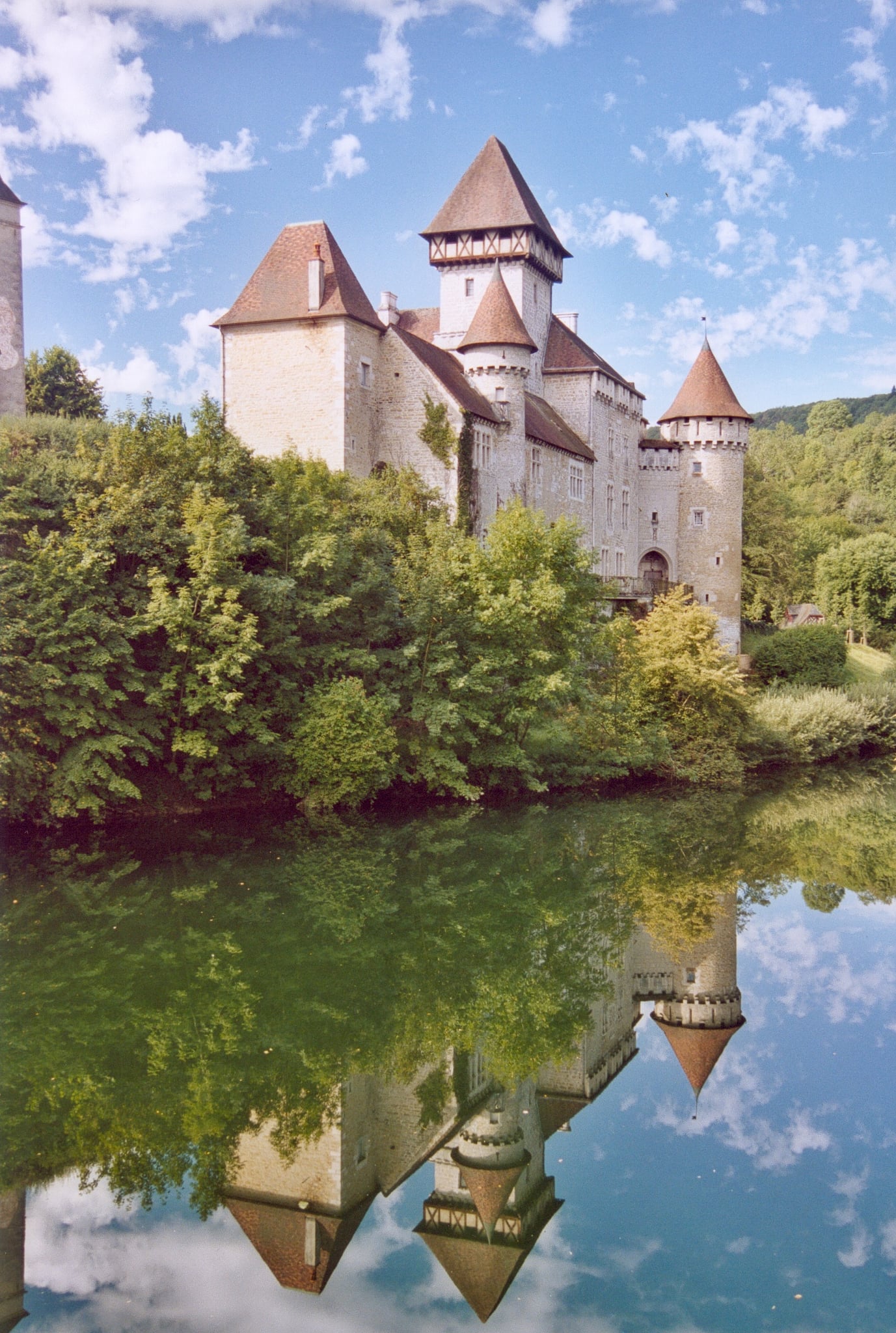
Montrond Castle
Montrond Castle, known locally as Château de Montrond, stands on an oval plateau called Montrond Hill, rising about 90 meters above the surrounding landscape near the village of Montrond-le-Château in the Doubs department of eastern France. This strategic location provided natural defense advantages and commanding views of the surrounding countryside.
The castle was constructed in 1231 by Amédée de Neufchâtel, the Lord of Montrond, with Pierre V de Scey cited as a co-builder. The site likely hosted an earlier fortification, possibly a wooden tower, given that the seigneury of Montrond had existed for nearly a century before the stone castle's foundation. This suggests a long-standing importance of the location for regional control and defense.
Medieval origins and architectural features
Montrond Castle was designed as a hill castle, utilizing the natural elevation of Montrond Hill to enhance its defensive capabilities. The castle's layout was adapted to the oval shape of the plateau, a typical approach in medieval fortifications to maximize the use of terrain. While detailed architectural plans have not survived, the castle would have included essential medieval defensive elements such as curtain walls, towers, and a gatehouse to control access.
The castle's construction in the high medieval period reflects the military and feudal needs of the time. Stone was the primary building material, replacing earlier wooden structures to provide improved durability and defense against siege warfare.
Historical events and significance
One notable event impacting Montrond Castle was the 1356 Basel earthquake, which caused the collapse of one of its towers despite the epicenter being over 150 kilometers away. This highlights the vulnerability of medieval stone structures to natural disasters as well as the castle's prominence in the region.
In 1492, the castle hosted Archduke Maximilian of Austria, the future Holy Roman Emperor, who celebrated Christmas there. Maximilian was the son-in-law of Charles the Bold and husband of Mary of Burgundy, linking Montrond Castle to significant European dynastic politics of the late 15th century.
Siege and dismantling in the 17th century
During the Franco-Dutch War in 1674, Montrond Castle was besieged and captured by the troops of Louis XIV of France. This conflict involved France's attempt to wrest control of the Spanish province of Franche-Comté, as Spain was allied with the Dutch. After its capture, the castle was deliberately dismantled to prevent its future military use, a common practice in the era to neutralize strategic fortifications.
Following its dismantling, the remaining structures were repurposed as agricultural buildings, which contributed to the gradual loss of the castle's original military character. Over time, the site fell into ruin.
Decline and present condition
By the early 20th century, only a single tower ruin approximately 10 meters high remained visible. This tower collapsed in 1935, and what was left was subsequently demolished due to safety concerns. Today, Montrond Castle exists primarily as an archaeological site with limited visible remains.
The site is freely accessible to visitors, but it is heavily overgrown, making it difficult to discern architectural details or the full extent of the original castle. The modest remains and lack of substantial structures mean that Montrond Castle is not a major tourist attraction but holds interest for those studying medieval fortifications and regional history.
Cultural and historical legacy
Despite its ruined state, Montrond Castle reflects the evolution of medieval fortifications in the Franche-Comté region and illustrates the shifting political landscape of eastern France. Its connection to notable historical figures such as Archduke Maximilian and its involvement in significant conflicts like the Franco-Dutch War provide valuable context for understanding the region's past.
As a high medieval hill castle that experienced both natural disasters and military conflict, Montrond Castle exemplifies the challenges faced by such fortifications over centuries. Its present condition as a ruin offers insights into the processes of decay and the impact of historical events on architectural heritage.
Frequently asked questions (FAQ)
- How do I get to Montrond Castle?
- Montrond Castle is located in Montrond-le-Château, France, easily accessible by car or public transport from nearby cities. If you're driving, take the A36 motorway and follow the signs to Montrond-le-Château. For those using public transport, local bus services connect the castle with major train stations.
- What is the historical significance of Montrond Castle?
- Montrond Castle dates back to the 12th century and played a crucial role in the feudal system of the region. It served as a defensive stronghold and residence for nobility, reflecting the architectural styles of the medieval period. The castle's history is intertwined with local legends and events that shaped the surrounding area.
- When was Montrond Castle built?
- Construction of Montrond Castle began in the early 12th century, making it one of the oldest castles in the region. Over the centuries, it has undergone various renovations and expansions, showcasing the evolving architectural styles. Today, visitors can see elements from different historical periods throughout the castle.
- Can I take a guided tour of Montrond Castle?
- Yes, guided tours are available at Montrond Castle, providing visitors with an in-depth understanding of its history and architecture. Tours are typically conducted in multiple languages, and advance booking is recommended to secure your spot. Check the castle's official website for tour schedules and availability.
- Why is Montrond Castle considered an architectural gem?
- Montrond Castle is renowned for its impressive medieval architecture, featuring well-preserved towers, ramparts, and intricate stonework. The castle's design reflects the defensive needs of its time while also showcasing the aesthetic sensibilities of the era. Visitors often admire its strategic location and panoramic views of the surrounding landscape.
- Is it possible to host events at Montrond Castle?
- Yes, Montrond Castle offers facilities for hosting various events, including weddings, corporate retreats, and cultural gatherings. The picturesque setting and historic ambiance make it a unique venue for special occasions. It's advisable to contact the castle management for details on availability and services.
- What are the opening hours of Montrond Castle?
- Montrond Castle is typically open to visitors from 10 AM to 6 PM, with extended hours during the summer months. It is advisable to check the castle's official website for the most current opening hours, especially around holidays or special events. Planning your visit during peak hours can enhance your experience.
- What are the ticket prices for visiting Montrond Castle?
- Ticket prices for Montrond Castle vary depending on the age and status of the visitor, with discounts often available for students, seniors, and children. Generally, adult tickets are priced around €10, while reduced rates may apply for families and groups. Check the official site for current pricing and any special promotions.
- When is the best time to visit Montrond Castle?
- The best time to visit Montrond Castle is during the spring and early autumn when the weather is mild and pleasant for outdoor exploration. Additionally, visiting during these seasons allows you to enjoy the beautiful landscapes surrounding the castle. Summer can be busy, so consider early mornings or weekdays for a quieter experience.
- Are there nearby attractions to see while visiting Montrond Castle?
- Yes, there are several attractions near Montrond Castle, including beautiful hiking trails and quaint villages that capture the charm of the region. The scenic countryside is perfect for exploring local wineries and enjoying traditional French cuisine at nearby restaurants. Don't miss the opportunity to discover the rich culture and history of Montrond-le-Château while you're there.
Information
Address
East of Rue de l'Église, Montrond-le-Château, Doubs, France
Loading map...
Visitor reviews
No reviews yet. Been here? Write the first review and help other travelers!
Write the first reviewVisited this castle? Share your experience
Your review helps other travelers and adds first-hand knowledge to our encyclopedia.