Montjuïc Castle stands prominently atop Montjuïc hill in Barcelona, Spain, embodying centuries of military, political, and social history. Its strategic location overlooking the city and harbor has made it a key defensive site since medieval times. The castle's origins trace back to a medieval watchtower, established to monitor maritime approaches, situated on a hill historically known as Mons Judaicus or Mons Jovicus, named for the medieval Jewish cemetery that existed there from the ninth to the fourteenth century. This connection gives the castle its name, Montjuïc, linking it indelibly to the religious and cultural heritage of Barcelona's Jewish community.
The fortress evolved through multiple phases, reflecting the changing military technologies and political circumstances of Catalonia and Spain. In 1640, during the Catalan revolt against King Philip IV, a hastily constructed earth fortification was erected within thirty days to meet urgent defense needs. This quadrilateral fort with stone and mud facings played a decisive role in the Battle of Montjuïc in 1641, successfully repelling a Castilian siege. Due to deterioration, the original fort was demolished by 1643, and a more durable fort was constructed by 1651, featuring two square enclosures with bastions and an external palisade. This period also saw the formation of the Montjuïc tercio, an infantry unit stationed at the fort.
Transformation into a star-shaped castle and military significance
By 1694, the fortress was expanded into a castle occupying the entire flat summit of Montjuïc hill. The design included three bastions facing the land and a distinctive serrated battlement line overlooking the sea, enhancing its defensive capabilities. The earlier fortification was preserved as an inner redoubt, providing a last line of defense within the larger complex. The castle witnessed intense fighting during the War of Spanish Succession in the early eighteenth century, changing hands multiple times between Catalan supporters and Bourbon forces, before the Bourbons secured it permanently on September 12, 1714.
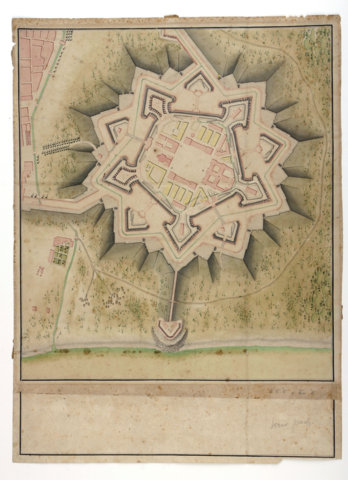
In 1751, the renowned military engineer Juan Martín Cermeño was commissioned to modernize Montjuïc Castle's defenses. He implemented the star-shaped design principles popularized by the French engineer Vauban, demolishing older fortifications and constructing new bastions, a deep surrounding moat, and essential infrastructure such as potable water cisterns. Over the following decades, from 1779 to 1799, the castle was expanded to house a garrison of approximately 3,000 soldiers, including the addition of large kitchens and ovens, and the installation of at least 120 cannons. Some artillery pieces from this era, including 152-millimeter Vickers guns and 305-millimeter De Bange howitzers, remain preserved on site, illustrating the fortress's formidable firepower.
Role during the Napoleonic Wars and 19th-century uprisings
During the Napoleonic Wars, French troops occupied Montjuïc Castle from 1808 to 1814 without resistance, underscoring its strategic importance. In the nineteenth century, the castle was instrumental in suppressing civil unrest in Barcelona, serving as an artillery base during the bombardments of 1842 and 1843 under generals Espartero and Prim. These events highlight Montjuïc Castle's continued role as a military stronghold controlling the city.
From fortress to prison: political repression and executions
From the late nineteenth century onwards, Montjuïc Castle's function shifted toward incarceration. It became a prison for political and social detainees, notably anarchists during the Montjuïc trials of the 1890s and workers involved in the 1919 La Canadenca strike. Its use as a prison intensified during the Spanish Civil War, where it was a site of military imprisonment and executions for both Republican and Nationalist factions. Among the notable figures executed here were generals Manuel Goded and Álvaro Fernández Burriel in 1936.
Under Francisco Franco's dictatorship, Montjuïc Castle remained a military prison until 1960. It became infamous as the execution site for over 4,000 prisoners linked to republican and Catalan nationalist movements, including the former Catalan president Lluís Companys, who was shot in 1940 at the nearby Fossar de la Pedrera. This dark chapter cements the castle's symbolic association with repression and resistance in Catalonia's modern history.
Modern restoration and transformation into a peace center
Following renovations, Franco inaugurated the castle as a military museum in 1963. Although managed by the city of Barcelona, the museum remained under military administration until the early twenty-first century. In 2007, full control of Montjuïc Castle was transferred to the municipal government, initiating extensive restoration and reinterpretation efforts. These included the removal of Franco's equestrian statue in 2008 and the closure of the military museum in 2009. The site was repurposed as the International Peace Center, reflecting a commitment to remembering the castle's complex past while promoting dialogue and reconciliation.
Architectural features and archaeological findings
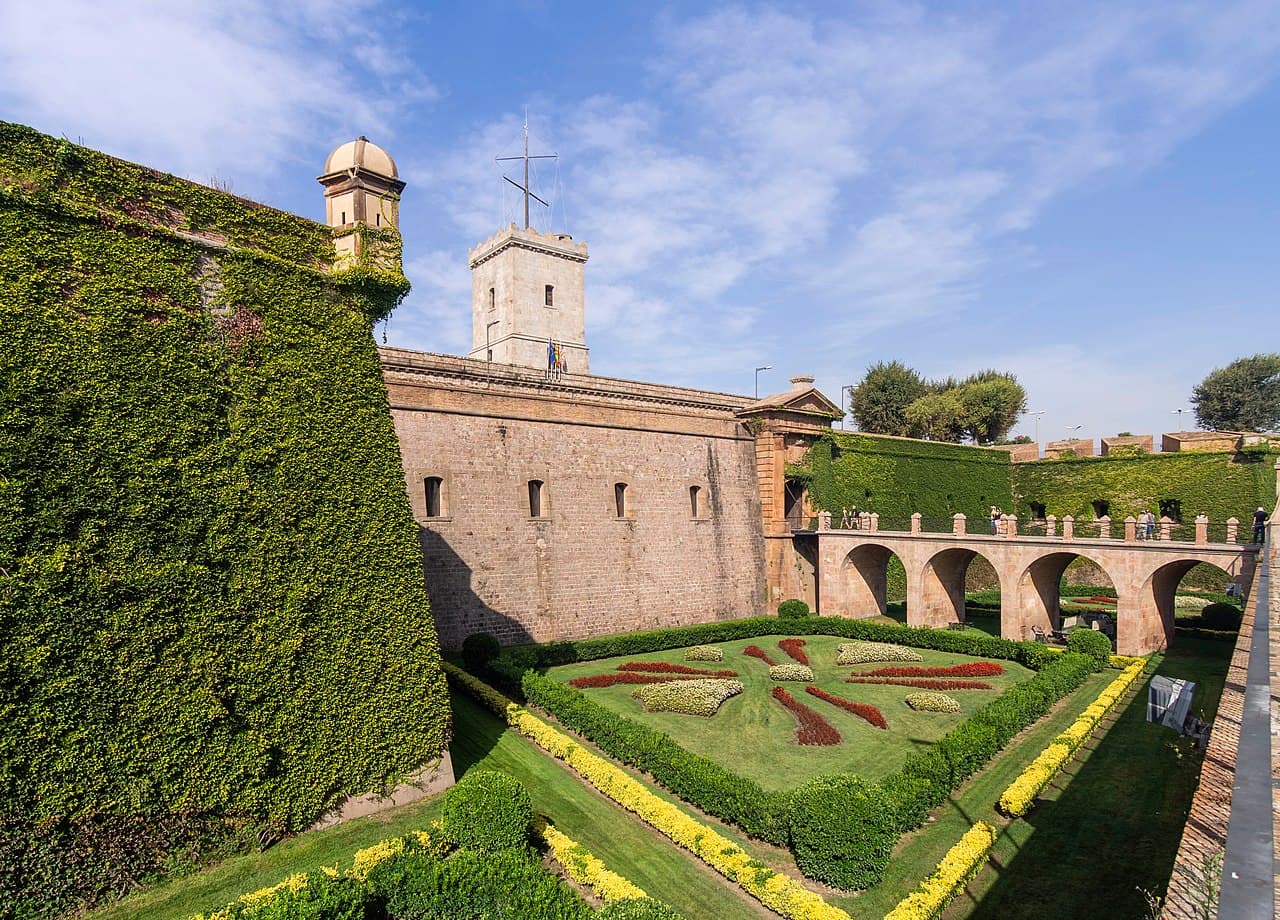
Montjuïc Castle is situated on a rocky terrace approximately 170 to 175.5 meters above sea level. Its current star-shaped layout, designed by Cermeño, features multiple bastions projecting outward, surrounded by a deep moat excavated to deter attackers. The main structure is arranged around a porticoed courtyard, with rooms covered by semicircular vaults that provide both structural integrity and aesthetic appeal.
The castle's three bastions face inland, while the battlements overlooking the sea have a distinctive serrated, toothlike pattern, enhancing defensive coverage. The preserved inner redoubt from the mid-seventeenth century fortification serves as a fortified core within the larger complex. Exterior bastions and outworks, including the Santa Amàlia bastion on the northern perimeter, add layers of defense and are accessible to visitors via a path encircling the fortress and a modern access road.
Between 1779 and 1799, expansions added kitchens and ovens capable of feeding a large garrison, alongside extensive artillery installations. Several coastal artillery pieces remain on display, including four 152-millimeter Vickers guns aimed toward the sea and port, and four large 305-millimeter De Bange howitzers defending the landward entrance.
Service areas such as potable water cisterns were incorporated during the eighteenth century to improve the fortress's self-sufficiency. Archaeological excavations during recent rehabilitation have uncovered bastion remains dating back to 1650, providing tangible evidence of the castle's layered construction history.
Previously, a military communications tower was part of the castle complex but was removed in 2009 during restoration. Since the transfer to city management, restoration efforts have included waterproofing roofs and the watchtower and refurbishing fourteen rooms around the main courtyard, preserving the castle's historic fabric.
The castle's proximity to the Fossar de la Pedrera, a significant execution site, connects its physical presence to the poignant history of political repression and memory in Barcelona.
Visiting Montjuïc Castle today
Today, Montjuïc Castle serves as a cultural and historical landmark open to the public. Visitors can explore its extensive fortifications, bastions, and the porticoed courtyard while learning about its multifaceted history through exhibitions and interpretative displays. The castle's elevated position offers panoramic views of Barcelona and the Mediterranean Sea, enhancing the visitor experience.
The transformation into the International Peace Center underscores the castle's evolving role from a military fortress and prison to a place dedicated to peace, memory, and education. This shift invites reflection on the complex history of conflict and reconciliation that defines Barcelona and Catalonia.
Frequently asked questions (FAQ)
- What is Montjuïc Castle?
- Montjuïc Castle is a historic fortress located on Montjuïc Hill in Barcelona, Spain. Originally built in the 17th century, it has served various purposes throughout its history, including a military fortress and a prison. Today, it stands as a significant cultural monument, offering stunning views of the city and the sea.
- When was Montjuïc Castle built?
- Montjuïc Castle was constructed in 1640, during the Catalan Revolt against Spanish rule. It has undergone several modifications and expansions over the years, reflecting the changing military needs and architectural styles. The castle has played a pivotal role in Barcelona's history, particularly during times of conflict.
- Can I visit Montjuïc Castle?
- Yes, Montjuïc Castle is open to the public, allowing visitors to explore its historic grounds and exhibits. Visitors can take guided tours or enjoy self-guided exploration to learn more about the castle's rich history. The surrounding gardens and views from the hilltop are also highlights of the visit.
- What are the opening hours of Montjuïc Castle?
- Montjuïc Castle is typically open from 10:00 AM to 8:00 PM during the summer months and 10:00 AM to 6:00 PM during the winter. It is advisable to check the official website for any changes in hours or special closures. Arriving early can help you avoid crowds and enjoy a more peaceful experience.
- Is there an admission fee for Montjuïc Castle?
- Yes, there is an admission fee to enter Montjuïc Castle, with discounts available for students, seniors, and children. Free entry is often offered on specific days or for certain groups, so it’s worth checking the official website for current ticket prices and special offers. The fee contributes to the maintenance and preservation of this historic site.
- What is the best time to visit Montjuïc Castle?
- The best time to visit Montjuïc Castle is during the spring and fall when the weather is mild and pleasant. These seasons generally see fewer tourists than the summer months, allowing for a more relaxed experience. Early mornings or late afternoons are ideal for enjoying the views and capturing great photographs.
- What nearby attractions can I visit while at Montjuïc Castle?
- While visiting Montjuïc Castle, you can also explore several nearby attractions, including the Montjuïc Park, the Magic Fountain, and the Olympic Stadium. The Joan Miró Foundation and the National Art Museum of Catalonia are also within a short distance. Each site offers its own unique cultural and historical significance, enhancing your visit to the area.
- Is Montjuïc Castle accessible for visitors with disabilities?
- Yes, Montjuïc Castle is accessible for visitors with disabilities, featuring ramps and designated paths for easier navigation. However, some areas may have limited accessibility due to the castle's historic nature and terrain. It is recommended to check with the staff for specific accommodations and assistance during your visit.
Photo gallery

Information
Loading map...
Visitor reviews
No reviews yet. Been here? Write the first review and help other travelers!
Write the first reviewVisited this castle? Share your experience
Your review helps other travelers and adds first-hand knowledge to our encyclopedia.