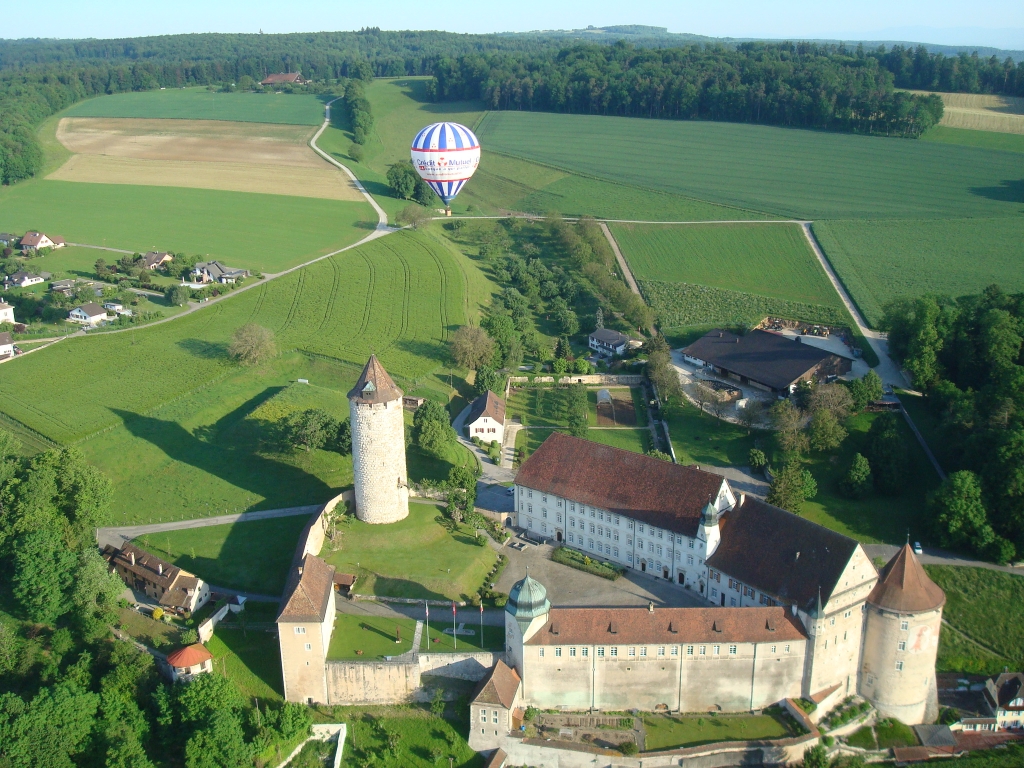
Montjoie Castle
Montjoie Castle, also known locally as Château de Montjoie-le-Château, is a significant medieval fortress situated above the hamlet of Montjoie-le-Château in the Doubs department of Hauts-de-France, France. This hill castle occupies a strategic rocky spur overlooking the narrow passage of the Doubs River valley, a location that has been of military and settlement importance since Neolithic times. Constructed in the early 13th century by the noble Glère family, most likely under the direction of Richard I of Glère, the castle was designed to control and monitor vital trade and military routes through the region.
Historical significance and military engagements
The castle's history is marked by a series of military confrontations reflecting the turbulent politics of medieval and early modern Europe. In 1428, Jean de Thierstein, the bailiff of Ferrette, led an unsuccessful siege against Montjoie Castle, underscoring its defensive strength. Subsequently, in 1444, the fortress was captured by imperial troops, indicating its strategic value during the conflicts of the Holy Roman Empire.
Later, during the Burgundian Wars in 1475, the castle was besieged by forces of the Old Swiss Confederacy, again highlighting its ongoing military importance in regional power struggles. The final major siege occurred in 1635 during the Ten Years' War, when a Lorraine captain named Saint-Balmont sought refuge in the castle with approximately 500 soldiers. The French forces under Marshal Jacques-Nompar de Caumont, duc de La Force, laid siege to Montjoie for nearly three weeks, subjecting it to over 200 cannon volleys before the garrison surrendered. The subsequent destruction by French troops left the castle largely in ruins, a state in which it remains today.
Architectural features and layout
The castle is situated on a roughly trapezoidal rocky promontory covering about 85 ares. It is enclosed by two robust defensive walls, including a distinctive semi-circular front wall approximately eleven meters across. Within this fortified perimeter were essential components such as the seigneurial lodgings (the lord's living quarters), garrison accommodations, a chapel, and multiple towers.
The keep
At the highest point of the castle stands a pentagonal keep, likely dating from the early 13th century. This main tower is remarkably well-preserved compared to other parts of the castle and offers valuable insights into medieval military architecture. The keep's interior includes fireplaces for heating, a hand-washing basin, and facilities connected to a latrine, demonstrating attention to comfort and hygiene within the fortress.
The chapel
The castle chapel is a notable surviving structure, probably constructed in the 12th century, making it slightly older than the main castle buildings. Dedicated to Saint George, the chapel survived the 1635 destruction and remains in use today. Architecturally, it embodies a blend of Romanesque and flamboyant Gothic styles, featuring three interior bays with simple capitals and column bases. Its windows include one Romanesque and two Gothic, reflecting the transitional nature of its design.
Inside the chapel lies the tomb of Claudine de Montjoie (died 1612), providing a tangible link to the castle's noble past. The chapel's preservation and continued religious use underscore its cultural and historic significance.
Ruins and preservation
Today, Montjoie Castle remains largely a ruined site, with remnants including bits of walls, foundations, the ruined keep, and the chapel. The walls near the chapel show finely cut bossage stones and corbels from former towers. Collapsed vaults reveal entrances to old cellars, offering glimpses into the castle's storage and daily operations.
The site is accessible to visitors via small, unmarked paths, though it is somewhat overgrown, which adds to the sense of exploration and discovery. While the castle's architecture is not considered spectacular compared to larger fortresses, its layered history and surviving features provide valuable insights into medieval fortification and noble life in the region.
Cultural heritage and recognition
Montjoie Castle was officially listed as a protected historic monument in 1934, with protections extended in 1985 to include the surviving structures, chapel, and archaeological remains. This designation helps preserve the site for ongoing study and public education, highlighting its importance as a cultural and historical landmark in the Hauts-de-France region.
Frequently asked questions (FAQ)
- How do I get to Montjoie Castle and is it easily accessible?
- Montjoie Castle is located above the hamlet of Montjoie-le-Château in Hauts-de-France, France. It is accessible by small unmarked paths that may be overgrown, so visitors should be prepared for a moderate hike and wear appropriate footwear.
- What is the historical significance of Montjoie Castle?
- Montjoie Castle was built in the early 13th century by the Glère family to control the Doubs valley. It witnessed several sieges during medieval conflicts, including the Burgundian Wars and the Ten Years' War, reflecting its strategic importance.
- Can I visit the castle chapel and what can I expect to see?
- The castle chapel, dedicated to Saint George, is one of the few surviving structures and remains in use today. Visitors can see its blend of Romanesque and Gothic architectural elements, as well as the tomb of Claudine de Montjoie from 1612.
- Is Montjoie Castle suitable for families and children?
- While the castle ruins offer an interesting historical experience, the site is somewhat overgrown and lacks marked trails, which may not be ideal for very young children or those with limited mobility. Supervision and caution are advised.
- When is the best time to visit Montjoie Castle?
- The best time to visit Montjoie Castle is during late spring to early autumn when the weather is favorable and the surrounding landscape is more accessible. Winter visits might be challenging due to weather and path conditions.
Information
Website
Visit websiteSources & official resources
Verify the information above using these authoritative references.
Loading map...
Visitor reviews
No reviews yet. Been here? Write the first review and help other travelers!
Write the first reviewVisited this castle? Share your experience
Your review helps other travelers and adds first-hand knowledge to our encyclopedia.