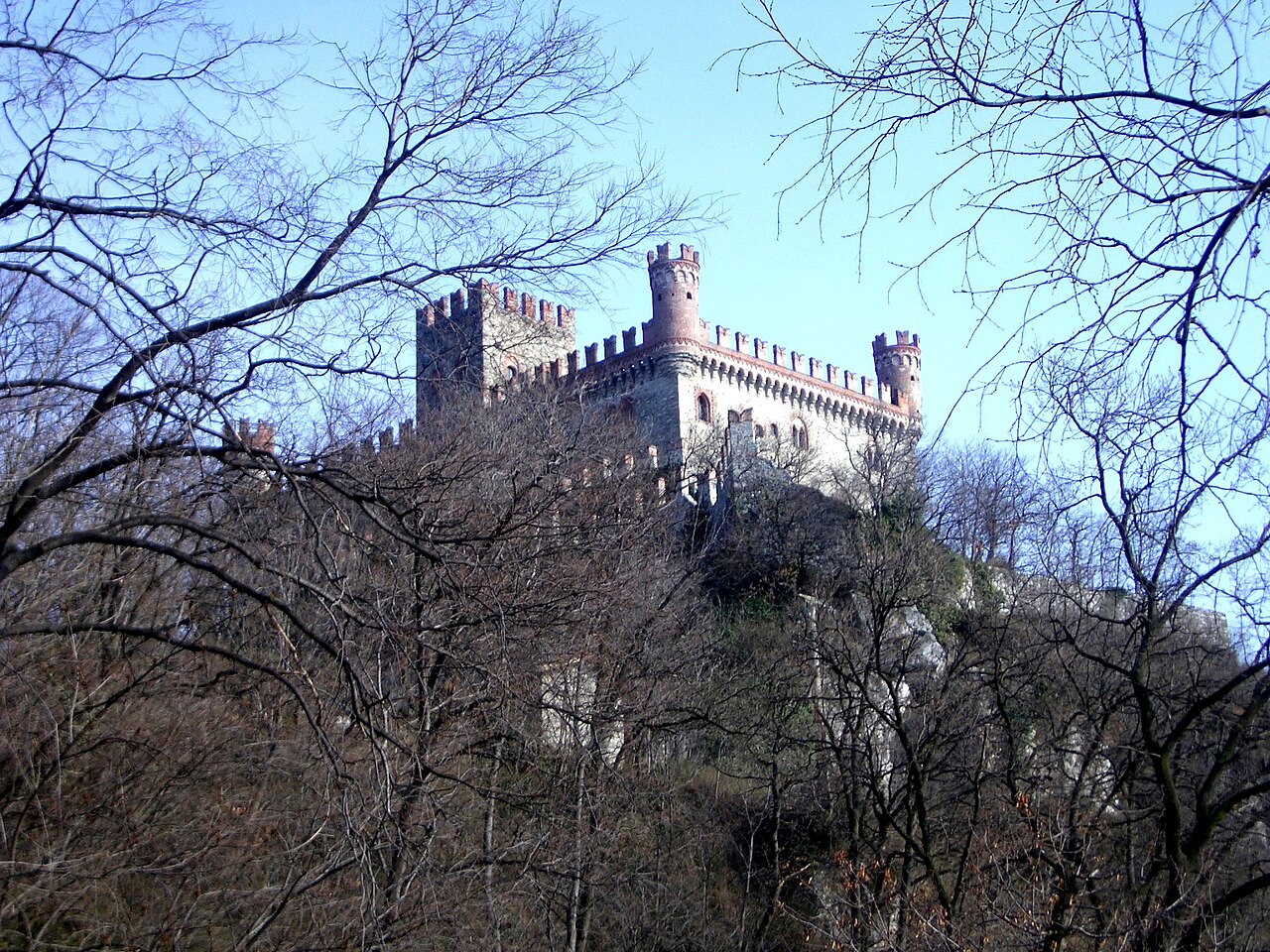
Montestrutto Castle
Montestrutto Castle is a remarkable example of a hill castle located in the municipality of Settimo Vittone, Italy. Its strategic position on a rocky outcrop overlooking the east bank of the Dora Baltea river commands the entrance to the Aosta Valley. This vantage point was historically significant for controlling access to the valley and the broader Alpine region, especially given its proximity to an ancient Roman road that formed part of the Via Francigena pilgrimage route.
Early origins and medieval significance
The castle's origins date back to the 9th century, when it was initially established as a defensive tower by local Benedictine monks. This early structure served primarily to protect the nearby monastic community, emphasizing the castle's religious and defensive roles from its inception.
Throughout the 11th to mid-13th centuries, control of Montestrutto Castle passed to the bishop-counts of Ivrea. These figures wielded both religious and political authority in the region, and under their stewardship, the castle's role expanded to include governance and regional defense. This period solidified the castle's importance as a center of ecclesiastical power and military strength.
By the 14th century, the castle became part of the extensive holdings of the House of Savoy. It was integrated into the defensive network overseen by the larger fortress at Settimo Vittone, situated about two kilometers to the north. This arrangement allowed for coordinated control over the surrounding territory, enhancing the castle's strategic value within the region.
Destruction and military conflicts
The mid-16th century marked a period of significant upheaval for Montestrutto Castle. Between 1553 and 1565, Duke Charles III of Savoy ordered the castle's destruction. This drastic measure was taken to facilitate French military movements during the protracted conflicts between France and Spain in northern Italy. The castle's demolition was a tactical decision to remove obstacles that could hinder troop deployments.
Despite requests for reconstruction by the castle's owners in 1577, there is limited evidence to confirm a comprehensive restoration during this time. The castle later suffered further damage during a French attack in 1704, compounded by flooding shortly thereafter, which contributed to its decline.
In the early 19th century, around 1800, partial rebuilding efforts took place. However, these were again interrupted when Napoleon Bonaparte ordered the castle's destruction to clear the way for his invasion of Italy, underscoring the site's ongoing military significance.
20th-century restoration and neo-Gothic transformation
The castle's revival began in the early 20th century under the ownership of the Pecco family, notably General Cavaliere Fernando Pecco. They rebuilt the tower on the original foundations and added an extension, marking the start of a new chapter in the castle's history.
A more extensive reconstruction was undertaken after 1919 when the Broglio family acquired the property. This renovation embraced a neo-Gothic architectural style, inspired by medieval castles from Piedmont, Liguria, Lombardy, and parts of France. The restoration was completed by 1926 and included richly decorated interiors featuring frescoes by the Turin-based artist Carlo Gaudina.
The early 20th-century reconstruction involved the removal of the Pecco family's earlier extension and was led by architect Vittorio Mesturino. Skilled local artisans contributed to melding historical inspiration with modern craftsmanship, resulting in a castle that honors its medieval heritage while reflecting contemporary artistic trends of the period.
Architectural features and artistic elements
Montestrutto Castle showcases stone construction typical of hill castles, with its exterior displaying the characteristic elements of the neo-Gothic style. The design includes pointed arches, battlements, and towers that evoke the romanticized medieval aesthetic popular in early 20th-century restorations.
Inside, the castle's decoration draws heavily on the late medieval fortress traditions of the region, with stylistic references to nearby castles such as Issogne, Fenis, and Montalto. The frescoes by Carlo Gaudina add significant artistic value, illustrating scenes and motifs that enrich the castle's historical ambiance.
An integral part of the castle complex is the ancient church of San Giacomo, which remains closely connected to the castle grounds. This church underscores the site's longstanding religious associations dating back to its monastic origins.
Cultural legacy and modern significance
Following its restoration, Montestrutto Castle became a cultural hub in the 20th century. After acquisition by the daughters of Rosario Scalero, a renowned violinist and composer, the castle served as both a residence and a music teaching venue. Scalero's daughters, Alessandra and Liliana, who were noted translators, inherited the property after his death in 1954.
Today, Montestrutto Castle stands as a testament to centuries of strategic military importance, religious influence, and cultural evolution. Its layered history is reflected in the architectural adaptations and artistic embellishments that span from its early medieval origins through its neo-Gothic revival, making it a significant heritage site in northern Italy.
Frequently asked questions (FAQ)
- How do I visit Montestrutto Castle?
- Montestrutto Castle is located in Settimo Vittone, Piedmont, Italy. Visitors should check local tourism websites or contact the municipality for current visiting hours and access details, as the castle may have limited public opening times.
- What is the historical significance of Montestrutto Castle?
- Montestrutto Castle has a rich history dating back to the 9th century, serving as a defensive tower for Benedictine monks and later playing a strategic role under the bishop-counts of Ivrea and the House of Savoy.
- What architectural style is Montestrutto Castle?
- The castle features a neo-Gothic architectural style from its early 20th-century restoration, inspired by medieval castles in Piedmont, Liguria, Lombardy, and France, combined with original medieval stone construction.
- Can I see frescoes inside Montestrutto Castle?
- Yes, the interior of Montestrutto Castle includes frescoes painted by Carlo Gaudina, completed by 1926, which depict medieval themes and add artistic depth to the castle's historic interiors.
- Is Montestrutto Castle accessible for people with mobility issues?
- Due to its hilltop location and historic structure, accessibility may be limited. Visitors with mobility concerns should inquire in advance about facilities and assistance options.
Information
Architect
Vittorio Mesturino
Loading map...
Visitor reviews
No reviews yet. Been here? Write the first review and help other travelers!
Write the first reviewVisited this castle? Share your experience
Your review helps other travelers and adds first-hand knowledge to our encyclopedia.