Monterreal Fortress
Monterreal Fortress, located on the Monte Boi peninsula near Baiona in the province of Pontevedra, Spain, is a remarkable example of a hill castle with a continuous history of occupation and military significance spanning over two millennia. The fortress stands on a strategic promontory overlooking the Atlantic Ocean and the Ría de Vigo, commanding sweeping views that were vital for defense and maritime control.
Historical background and strategic importance
The site of Monterreal Fortress has been inhabited since pre-Christian times, with archaeological evidence indicating the presence of Celtic, Phoenician, and Roman settlements. The area was significant in antiquity, with the first recorded military event dating back to 60 BC when Julius Caesar conquered Baiona during his campaigns in the Iberian Peninsula. Over the centuries, the site saw successive occupations by the Visigoths and later Muslim forces, each leaving their imprint on the fortifications and local culture.
The name "Monterreal" was bestowed by the Catholic Monarchs (Isabella I of Castile and Ferdinand II of Aragon) during the late 15th century, highlighting the fortress's role in defending the coast from corsair raids and pirate incursions. The village of Baiona was granted a royal charter to establish a defensive settlement around the fortress, ensuring the protection of the important maritime approaches to the Ría de Vigo.
Architecture and fortifications
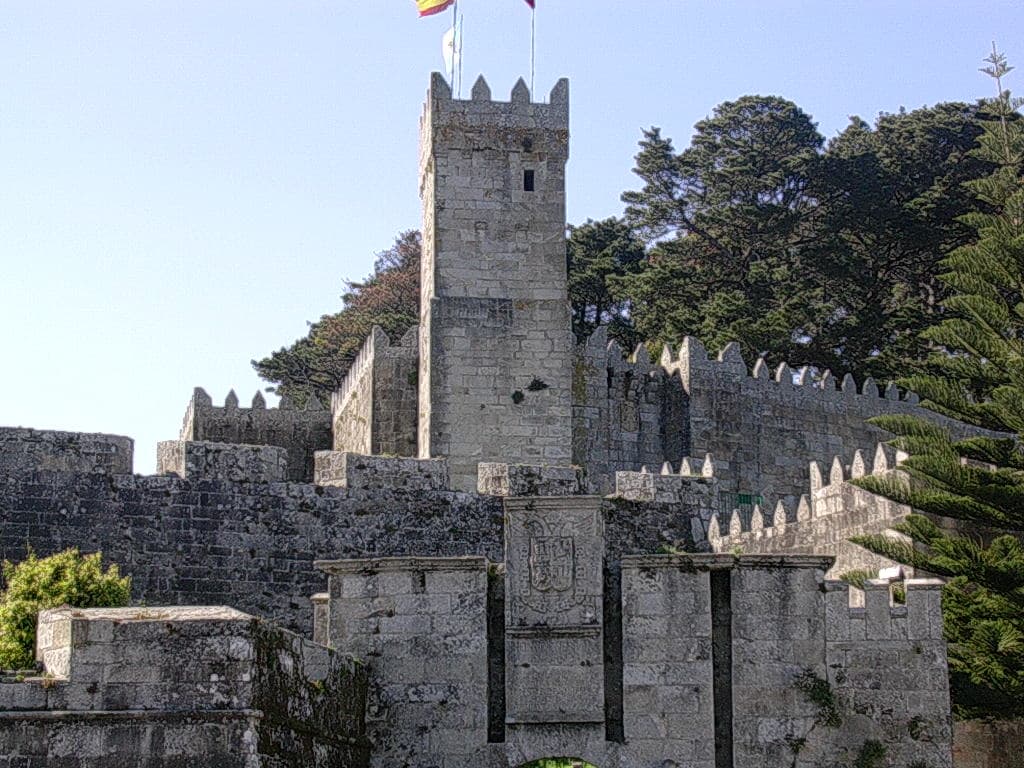
The fortress covers an area of approximately 18 hectares and is surrounded by nearly 3 kilometers of crenellated battlement walls constructed and modified from the 11th to the 17th centuries. These walls were designed to withstand artillery and naval attacks, reflecting the evolution of military architecture over several centuries.
The fortress's defensive system includes three principal towers, each with distinct functions and architectural features:
- The Tower of the Clock (Reloj tower): Located near the main entrance, this tower housed a concealed warning bell used to alert the inhabitants of approaching enemies. Its position allowed control over access to the fortress and served as an early warning system.
- The Tower of the Tenaille (Tenaza tower): Situated to the east, this tower has a heptagonal base and was equipped with artillery to defend the adjacent port and coastline. Its design reflects advancements in fortification techniques to counter cannon fire and naval threats.
- The Tower of the Prince (Príncipe tower): The westernmost and probably the oldest tower, it overlooks the bay and historically functioned as a lighthouse for incoming vessels. The tower bears three coats of arms: those of the House of Austria, the Sotomayor family, and the town of Baiona. It is named after Prince Afonso Enriques of Portugal, who was imprisoned there in 1137.
The fortress's main gate, known as the Puerta del Sol, is defended by a steep ramp and a lifting bridge, enhancing its defensive capabilities against siege attempts. The layout and construction techniques illustrate a blend of medieval military architecture adapted to the challenges posed by artillery warfare.
Later history and current use
Throughout its history, Monterreal Fortress changed hands multiple times, reflecting the shifting political and military landscape of the region. In 1963, the Spanish Ministry of Information and Tourism acquired the site and transformed it into the Parador Conde de Gondomar, a luxury hotel that integrates the historic fabric of the fortress with modern amenities.
Today, Monterreal Fortress is open to visitors year-round. The fortress offers spectacular views of the Ría de Vigo and the nearby Cíes Islands, especially at sunset. The site is not only a significant cultural and historical monument but also a popular destination for tourists seeking to explore Galicia's medieval heritage and coastal landscapes.
Visiting experience and cultural significance
Visitors to Monterreal Fortress can explore its well-preserved walls, towers, and battlements, gaining insight into the defensive strategies employed over centuries. The fortress's location on the Monte Boi peninsula provides access to scenic coastal walks along Baiona's shoreline. The combination of historical architecture and natural beauty makes Monterreal a unique site for both history enthusiasts and nature lovers.
The fortress's role in regional defense, its architectural evolution from the High Medieval period through the Renaissance, and its adaptation to modern uses exemplify the dynamic history of Spanish coastal fortifications. Monterreal Fortress remains a testament to the enduring strategic importance of Baiona and the broader Galician coast.
Frequently asked questions (FAQ)
- When was Monterreal Fortress built?
- Monterreal Fortress was originally constructed in the 11th century, with significant modifications continuing through the 17th century.
- What are the main towers of Monterreal Fortress?
- The fortress features three main towers: the Tower of the Clock near the entrance, the Tower of the Tenaille to the east defending the port, and the Tower of the Prince overlooking the bay.
- Can visitors stay overnight at Monterreal Fortress?
- Yes, Monterreal Fortress houses the Parador Conde de Gondomar hotel, allowing guests to experience staying within the historic fortress walls.
- What defensive features does Monterreal Fortress have?
- The fortress is surrounded by nearly 3 kilometers of crenellated battlement walls and is defended by the Puerta del Sol gate with a lifting bridge, designed to resist artillery and naval attacks.
- Is Monterreal Fortress open to the public year-round?
- Yes, the fortress is open for visitors throughout the year, offering access to its walls, towers, and scenic views of the Ría de Vigo and Cíes Islands.
Photo gallery

Information
Current owner
Ministry of Information and Tourism
Loading map...
Visitor reviews
No reviews yet. Been here? Write the first review and help other travelers!
Write the first reviewVisited this castle? Share your experience
Your review helps other travelers and adds first-hand knowledge to our encyclopedia.