Mocioni-Teleki Castle
The Mocioni-Teleki castle stands as a remarkable example of 19th-century aristocratic residences in Romania, located in the commune of Căpâlnaș. Established in the mid-1800s by the noble Mocioni family, whose origins trace back to Aromanian roots from Macedonia, the castle embodies a blend of cultural heritage and architectural elegance. The family's ennoblement under Emperor Joseph II and their subsequent rise in Hungarian nobility set the stage for the castle's creation as a symbol of status and refinement.
In 1853, the estate was acquired by Ioan Mocioni de Foeni from the Zichy counts, marking a pivotal expansion of the Mocioni family's landholdings. The union of family branches through the marriage of Mihai Mocioni (1811–1890) and Ecaterina de Foeni in 1836 further consolidated their influence. The couple commissioned the castle's construction, designed in an elegant French architectural style, which became the family's principal residence in the region.
Architectural design and features
The castle's design was realized in 1867 by the renowned Viennese architect Otto Wagner, whose precise and refined plans brought to life a two-level structure comprising a ground floor and an upper floor. The building's hill castle classification reflects its elevated position within the village, offering commanding views of the surrounding landscape.
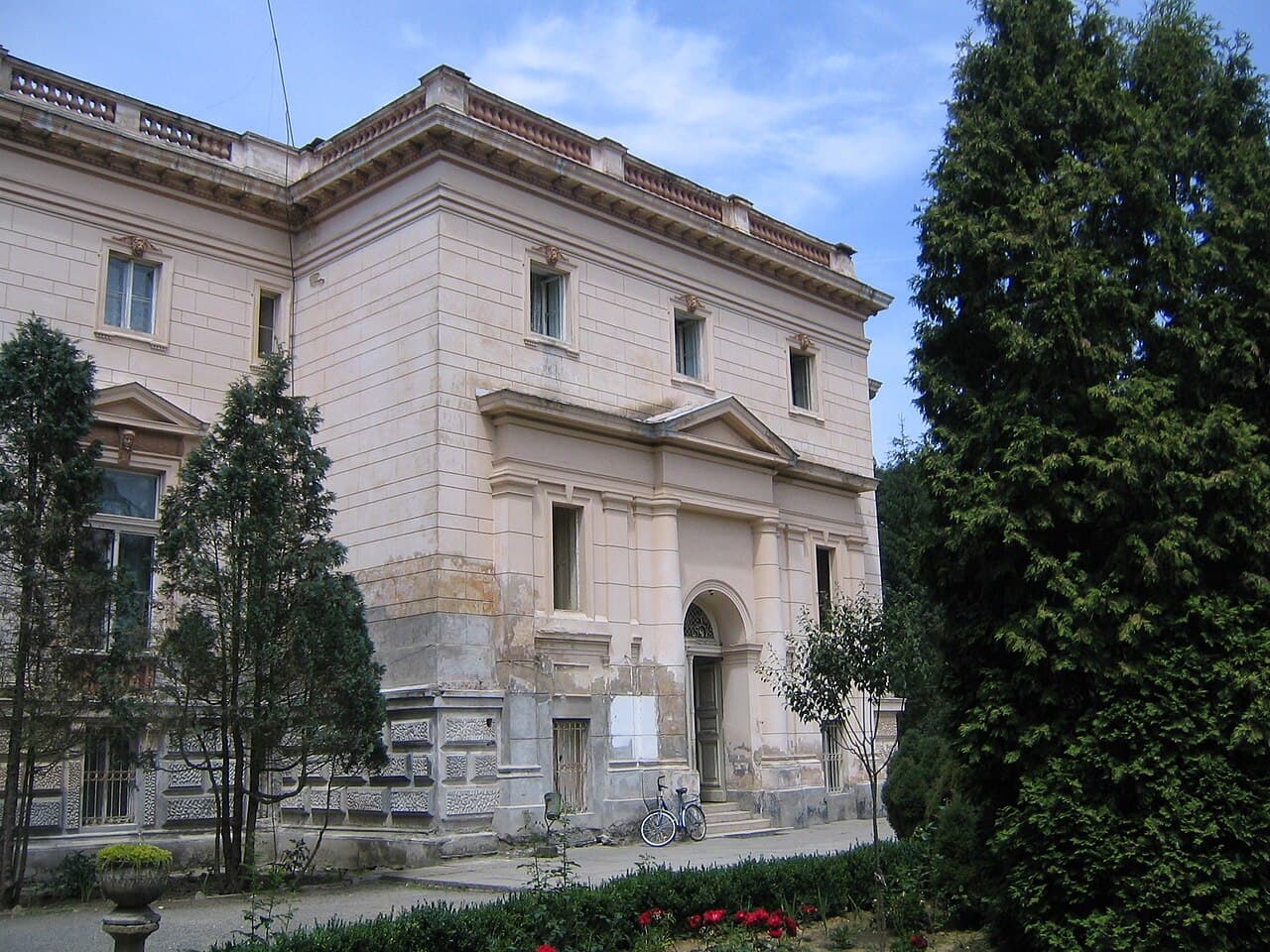
The main façade is distinguished by its four stone columns topped with Corinthian capitals, featuring stylized acanthus leaves that exemplify classical decorative motifs. Each façade section integrates a large door surmounted by a square window, allowing natural light to permeate the interior spaces. An ornamental cornice with delicate, lace-like patterns runs along the top edge, enhancing the refined aesthetic of the exterior.
Inside, the main salon opens onto a broad terrace, which is accessed externally by two semicircular marble steps. This design creates a harmonious transition between the interior and the extensive parkland surrounding the castle. The park includes a notable statue of a deer positioned prominently in front of the building, integrating art and nature within the estate grounds.
Historical significance and cultural impact
The Mocioni-Teleki castle is not only architecturally significant but also culturally important due to the family's active role in local society. Ecaterina de Foeni was a prominent community figure, managing estate affairs and supporting Romanian cultural initiatives. Her operation of a pharmacy within the castle walls to provide medicines to peasants highlights the family's social engagement and humanitarian efforts.
In the 20th century, the castle gained international recognition when the English traveler Patrick Leigh Fermor visited in the 1930s. In his travelogue, Between the Woods and the Water, Fermor described the castle's distinctive atmosphere, the Teleki family's extensive rare book collection, and the count's impressive butterfly collection. These details underscore the castle's role as a center of intellectual and cultural life.
Later uses and preservation
Following its aristocratic phase, the castle was repurposed as a medical facility and currently functions as a sanatorium. This adaptive reuse has allowed the building to remain in active use while preserving its historical character. The castle underwent restoration in 1964, which carefully maintained its original architectural features and ensured the structure's longevity.
Today, the Mocioni-Teleki castle is registered as a historic monument in Arad County, reflecting its cultural and architectural value. Its well-preserved condition allows visitors to appreciate the harmonious blend of French architectural style with the natural beauty of its parkland setting.
Architectural context and legacy
The castle exemplifies the 19th-century trend among European nobility to adopt and adapt French architectural elements, symbolizing prestige and cultural sophistication. The involvement of Otto Wagner, a figure associated with Viennese architectural innovation, adds further significance to the building's design pedigree.
Its location in a rural Romanian village, combined with its aristocratic heritage and cultural contributions, positions the Mocioni-Teleki castle as a unique historical landmark. The estate's ongoing use as a sanatorium demonstrates a successful integration of heritage conservation with modern functionality.
Notable architectural elements
- Corinthian columns on the main façade, showcasing classical influences
- Ornamental cornice with lace-like detailing
- Two-level structure with ground and upper floors
- Broad terrace connected by semicircular marble steps
- Extensive parkland with artistic elements like the deer statue
Preservation efforts
The 1964 restoration preserved the castle's original character, ensuring that its architectural and historical integrity remain intact. The castle's status as a registered historic monument supports ongoing conservation and public awareness of its significance.
Frequently asked questions (FAQ)
- How do I visit Mocioni-Teleki castle in Căpâlnaș?
- Mocioni-Teleki castle is located in the village of Căpâlnaș, Arad County, Romania. Visitors should check local tourism resources for access details, as the castle currently functions as a sanatorium and may have restricted public entry.
- What is the architectural style of Mocioni-Teleki castle?
- The castle was designed in a refined French architectural style by Viennese architect Otto Wagner in 1867, featuring classical elements such as Corinthian columns and ornamental cornices.
- When was Mocioni-Teleki castle built?
- The castle was constructed in the mid-19th century, with building plans drawn up in 1867 by Otto Wagner.
- Can I see the parkland and deer statue around the castle?
- Yes, the castle is surrounded by extensive parkland that includes a notable statue of a deer in front of the building, providing a scenic and artistic environment.
- Why is Mocioni-Teleki castle historically significant?
- The castle reflects the heritage of the noble Mocioni family, their social and cultural contributions, and was noted by traveler Patrick Leigh Fermor for its unique atmosphere and collections.
Photo gallery

Information
Sources & official resources
Verify the information above using these authoritative references.
Loading map...
Visitor reviews
No reviews yet. Been here? Write the first review and help other travelers!
Write the first reviewVisited this castle? Share your experience
Your review helps other travelers and adds first-hand knowledge to our encyclopedia.