Mikulov Castle
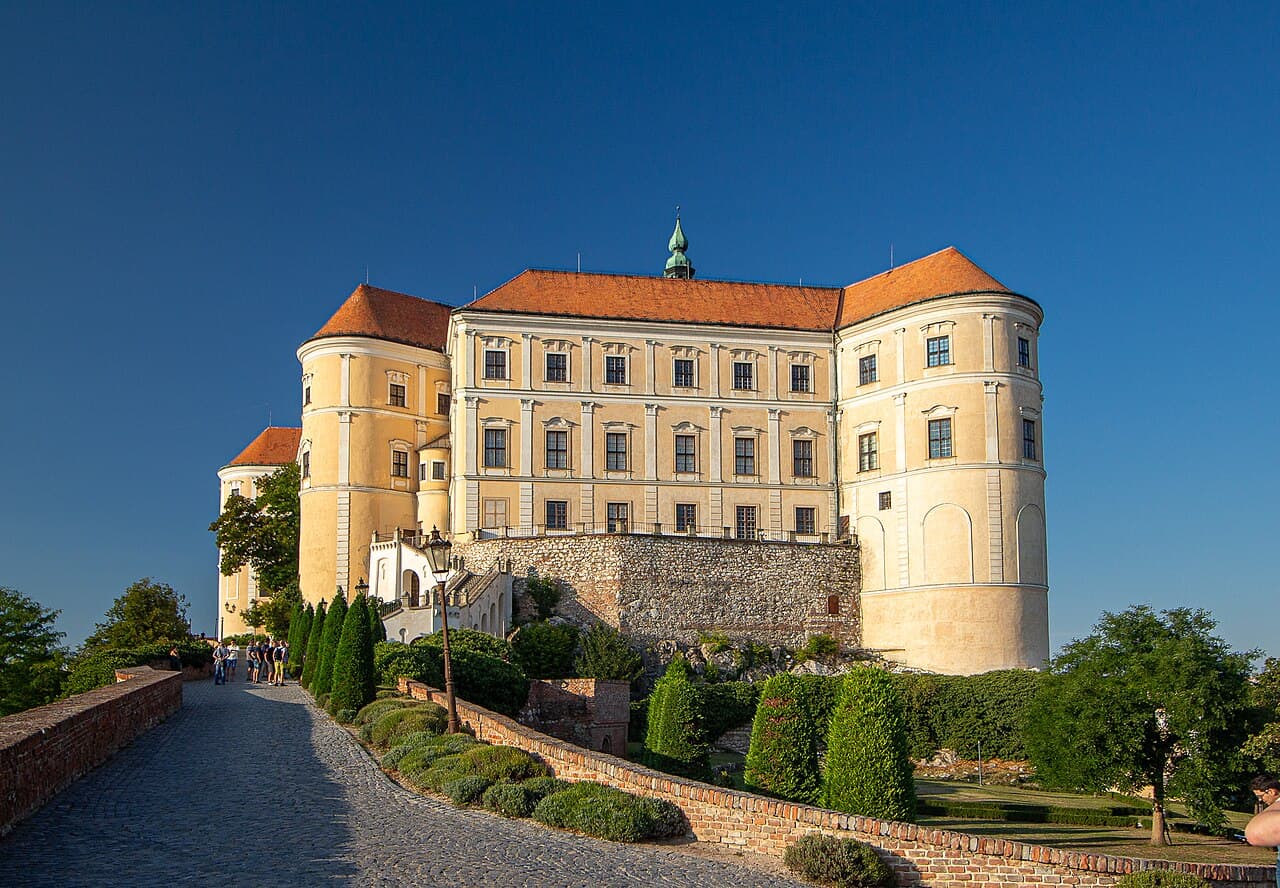
Mikulov Castle stands prominently on a rocky hill known as Zámecký vrch, overlooking the town of Mikulov in the Czech Republic. This hill castle has been a dominant feature of the region for centuries, serving as a defensive fortress, noble residence, and cultural landmark. Its location near the Austrian border made it a strategic stronghold throughout its history, contributing to its layered architectural evolution from medieval fortification to Renaissance and Baroque chateau.
The castle's origins trace back to the early medieval period, with archaeological evidence suggesting defensive use of the site as early as the 10th century. Initially, a wooden stronghold likely occupied the hill during the 11th or 12th century, replaced by a substantial stone castle in the early 13th century. This early stone construction, probably commissioned by King Přemysl Otakar I or his brother Vladislav Jindřich, was designed in the late Romanesque style. The first written record dates to 1249, when King Přemysl Otakar II granted the castle and town to Henry I of Liechtenstein, marking the beginning of the Liechtenstein family's ownership.
Medieval foundations and liechtenstein era
During the Liechtenstein tenure, which lasted until 1560, the castle was a key defensive and residential site. The family expanded the fortress, adding a cylindrical defensive tower and bastions to strengthen its military capabilities. The castle's layout was elongated from east to west, with a main entrance approached from the town square. Its northern courtyard served ceremonial purposes and featured a Gothic well dating from the 13th century. A passage cut into the rock connects this courtyard with the forecourt, dominated by a stone tower with battlements guarding the entrance.
The castle's core included a stone donjon palace with thick walls up to two meters, measuring roughly 11 by 16.5 meters. By the late 13th century, a cylindrical tower with a pointed roof was added, designed to deflect cannon fire, a rare defensive innovation for its time. A slender circular tower incorporating an octagonal chapel dedicated to the Virgin Mary and John the Evangelist was built in 1380, adding religious significance to the fortress.
Renaissance transformation under the dietrichstein family
In 1560, financial difficulties forced the Liechtensteins to sell the castle to Ladislav Kereczenyi, who began transforming it into a Renaissance chateau. After his death and the extinction of his family line, Emperor Rudolf II granted the castle to Adam of Dietrichstein in 1575. The Dietrichstein family would own Mikulov Castle until 1945, overseeing significant architectural and cultural developments.
Cardinal Franz von Dietrichstein (1570–1636) was instrumental in Renaissance renovations, including the creation of the Hall of Ancestors, adorned with portraits celebrating the family's lineage. He also added a theater and extensive wine cellars, reflecting the castle's role as a noble residence and cultural center. Around 1640, an enormous wine barrel with a capacity exceeding one thousand hectoliters was installed in the cellar, showcasing advanced woodworking craftsmanship and the region's viticultural heritage.
Impact of the thirty years' war and baroque remodeling
The castle suffered during the Thirty Years’ War when Swedish forces captured and looted it in 1645, resulting in the loss of much of its library and damage to its collections. In the late 17th century, Prince Ferdinand Dietrichstein remodeled the castle in the Baroque style, adding a terrace pavilion and stables. These Baroque additions enhanced the castle's grandeur but were later dismantled in the 19th century.
18th-century fire and reconstruction
A devastating fire in 1719 severely damaged Mikulov Castle. The reconstruction, led by architect Christian Alexander Oedtl, lowered the number of floors from three to two while maintaining the original wall heights. This restoration unified the interior floor levels and added new terraces and stables. Stone statues were placed along the access road, and a wrought iron gate was installed leading into the castle garden, enhancing the castle's aesthetic appeal.
Historical events and modern restoration
Mikulov Castle has been the site of several important historical events. In 1753, the Moravian estates paid homage to Empress Maria Theresa in its throne hall. The castle also hosted peace negotiations led by Napoleon Bonaparte in 1805 and was the venue for the signing of the Mikulov Armistice between Austria and Prussia in 1866.
In April 1945, the castle was again damaged by fire during World War II battles. Restoration efforts in the 1950s, led by Otakar Oplatek and supported by the Association for the Reconstruction of Mikulov Castle, carefully repaired the damage. The castle now serves as the seat of the Regional Museum in Mikulov, hosting permanent exhibitions on regional history and viticulture.
In 2007, a cave was discovered beneath the castle’s courtyard, adding to the archaeological interest of the site. The castle's preservation allows visitors to explore its richly layered history, architectural evolution, and cultural significance.
Architectural features and layout
The castle complex is divided into two main courtyards connected by a corridor between the western and eastern wings. The northern courtyard, once a ceremonial space, contains remnants of sculptural decoration and the Gothic well. The forecourt features the distinctive cylindrical tower with the octagonal chapel and the battlemented stone tower guarding the entrance.
Adjacent to the forecourt is a secondary forecourt with a wine cellar, former economic buildings, and a riding hall. The giant wine barrel in the cellar remains one of the castle's most remarkable artifacts, reflecting the region's long-standing wine production tradition.
Mikulov Castle's architectural styles span late Romanesque, Renaissance, and Baroque periods, illustrating its continuous adaptation to changing tastes and functional needs. The castle's preservation and museum function make it a vital cultural and historical landmark in the South Moravian region.
Frequently asked questions (FAQ)
- What is the historical significance of Mikulov Castle?
- Mikulov Castle has a rich history dating back to the 13th century and has served various roles, including a fortress, residence, and administrative center. It played a vital role in the region's history, particularly during the Thirty Years' War and the Habsburg Monarchy. Today, it stands as a testament to the architectural and cultural heritage of the Czech Republic.
- When was Mikulov Castle built?
- Mikulov Castle was originally constructed in the 13th century, with significant renovations occurring during the Renaissance period in the 16th century. The castle has undergone various modifications over the centuries, reflecting different architectural styles and historical influences. Its current appearance showcases a blend of styles that highlight its long and storied past.
- Can I visit Mikulov Castle year-round?
- Yes, Mikulov Castle is open to visitors throughout the year, although the opening hours may vary by season. It’s advisable to check the official website for the most current visiting hours and any seasonal events. Guided tours are available, providing insights into the castle's fascinating history and architecture.
- What are the opening hours for Mikulov Castle?
- The opening hours for Mikulov Castle typically vary by season, with longer hours during the summer months. Generally, the castle opens around 9 AM and closes in the late afternoon or early evening. Visitors should check the official website for specific hours, especially during holidays or special events.
- Is Mikulov Castle accessible for visitors with disabilities?
- Mikulov Castle strives to accommodate all visitors, including those with disabilities. There are accessible routes available within the castle grounds, although some historical areas may have limitations due to their age and design. It's recommended to contact the castle administration in advance to ensure a comfortable visit.
- When is the best time to visit Mikulov Castle?
- The best time to visit Mikulov Castle is during the spring and fall when the weather is mild and the surrounding landscapes are particularly beautiful. Summer can be busy with tourists, but it also offers vibrant outdoor activities and events. Visiting during weekdays can help avoid larger crowds.
- What are the ticket prices for Mikulov Castle?
- Ticket prices for Mikulov Castle vary depending on the type of tour you choose, with discounts available for students, seniors, and families. Typically, adult tickets are reasonably priced, ensuring that the castle remains accessible to a wide audience. It's best to check the official website for up-to-date pricing and any special offers.
- Are there any nearby attractions to Mikulov Castle?
- Yes, Mikulov Castle is surrounded by several attractions, including the picturesque town of Mikulov itself, known for its charming streets and local wine cellars. The nearby Palava Hills offer stunning views and hiking opportunities, while other historical sites like the Mikulov Jewish Cemetery are also worth exploring. Visitors can easily spend a full day enjoying the rich history and natural beauty of the area.
Photo gallery

Information
Website
Visit websiteSources & official resources
Verify the information above using these authoritative references.
Loading map...
Visitor reviews
No reviews yet. Been here? Write the first review and help other travelers!
Write the first reviewVisited this castle? Share your experience
Your review helps other travelers and adds first-hand knowledge to our encyclopedia.