Dívčí hrady
Dívčí hrady, historically known as Maidenburg, is a remarkable Gothic castle ruin perched on a limestone peak within the municipality of Pavlov-Mikulov na Moravě in the Czech Republic. This hill castle stands at an elevation of 428 meters above sea level on the Děvín massif, offering commanding views of the surrounding landscape and the Pálava Protected Landscape Area. Originally constructed during the High Medieval period, the castle played a vital role as a royal fortress securing the southern borders of Moravia.
The castle's earliest documented mention dates back to 1222, where it was referred to as Dewiczky. Initially built as a wooden stronghold, a common practice in the early 13th century, it was strategically positioned to oversee and defend the border region. The first recorded burgrave was Štěpán z Medlova, who died in 1235 and is noted as the progenitor of the noble Pernštejn family. Štěpán also administered the nearby Veveří Castle, highlighting his significant regional influence. Subsequent administrators included notable figures such as Lipolt of Hardegg, an Austrian nobleman, and Crha of Ceblovice, famed for his staunch defense against Austrian forces despite losing an eye in battle.
Medieval origins and architectural evolution
The original wooden castle likely suffered destruction during the Cuman raids around 1253, a period marked by widespread incursions into Central Europe. In response, King Wenceslaus II initiated a reconstruction in the late 13th century, replacing timber structures with more enduring stone fortifications. This transition from wood to stone was a significant architectural advancement, enhancing the castle's defensive capabilities.
By 1334, the castle was granted by King John of Luxembourg to the influential Liechtenstein family, who further fortified the site. They are credited with adding a small outer bailey, an enclosed courtyard outside the main walls, providing an additional defensive layer and space for auxiliary buildings or livestock. This expansion reflected evolving military architecture trends in the 14th century.
Renaissance transformation and military significance
The castle retained military importance into the 16th century, particularly during the 1529 Turkish siege of Vienna, when fortifications were reinforced to withstand potential Ottoman attacks. In 1572, ownership passed to Adam of Dietrichstein, lord of the Mikulov estate, who initiated extensive renovations. His son, Sigismund of Dietrichstein, transformed the castle into an irregular rectangular structure approximately 65 meters long, with walls up to two meters thick, constructed mainly of brick.
One of the most notable additions from this period is a Renaissance-style bastion built on a neighboring limestone rock. This bastion featured firing slits (embrasures) designed to allow defenders to repel attackers while remaining protected. Its strategic placement on a prominent cliff provided clear sightlines and enhanced the castle's defensive posture during times of conflict.
Conflicts, decline, and preservation
The Thirty Years’ War brought significant turmoil to Dívčí hrady. Following the Battle of Jankau, Swedish forces occupied the castle. Upon their withdrawal, the troops plundered and set fire to the fortress, causing extensive damage. The Dietrichstein family conducted only limited repairs afterward. Despite this, the castle remained in use as a guard post for some time.
In 1744, another fire further damaged the structure. Subsequently, the castle was repurposed as a fire watch station until the early 19th century, after which it was abandoned. Over time, the castle fell into gradual decay, becoming the ruin that visitors see today.
Recognizing its cultural and historical value, Dívčí hrady has been protected as a cultural monument since 1964. Conservation efforts led by the volunteer organization Památky Pálavy have included clearing vegetation, cleaning the ruins, and planning stabilization to preserve the site for future generations. These initiatives aim to maintain the castle’s structural integrity while respecting its historical character.
Architectural features and site layout
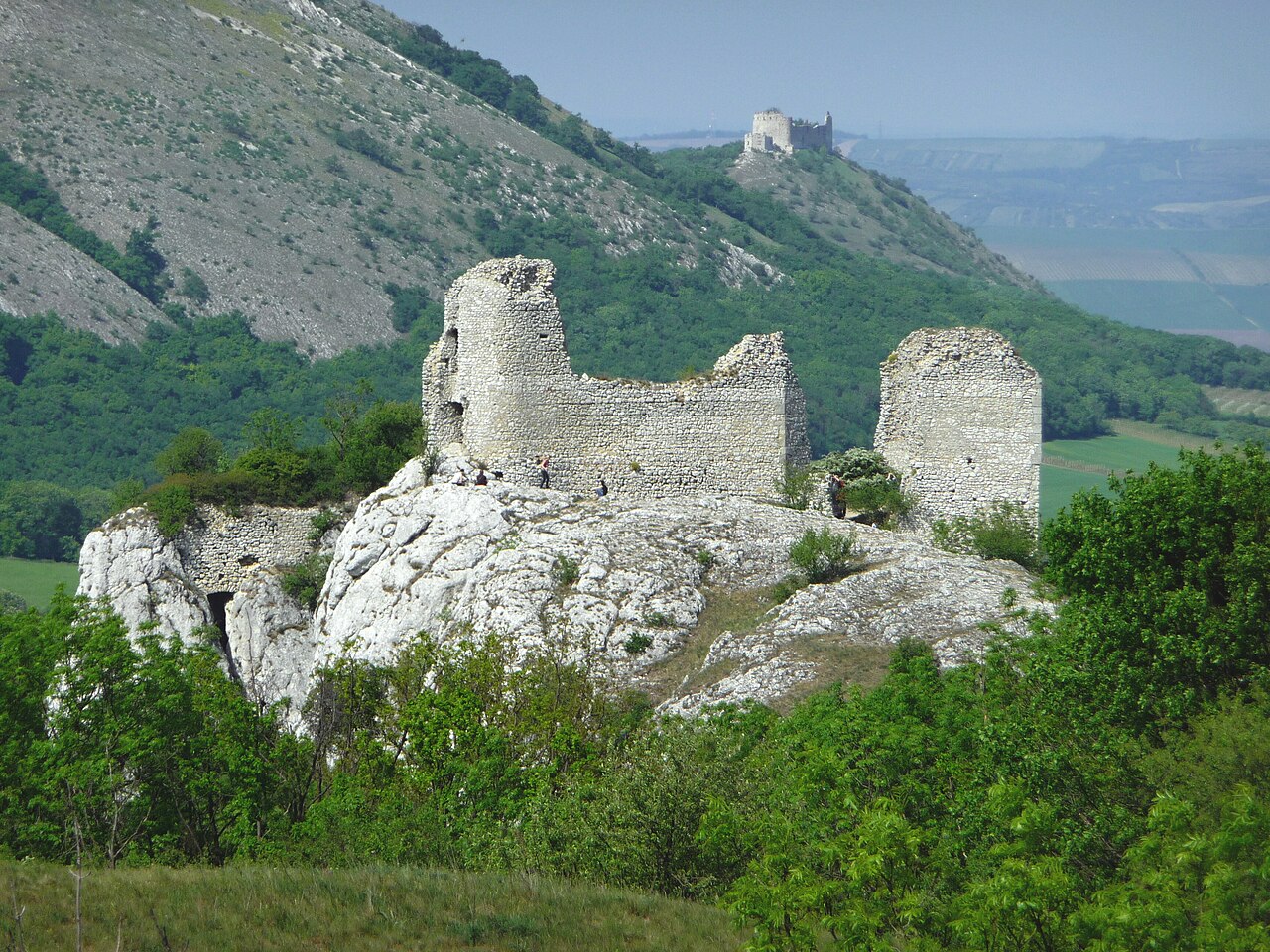
The ruins of Dívčí hrady reveal an irregular rectangular layout extending approximately 65 meters in length. The surviving walls predominantly date from the 16th-century renovations under Sigismund of Dietrichstein and are notable for their substantial thickness of up to two meters. The use of brick construction during this period marked a departure from earlier stone and wooden elements, reflecting Renaissance architectural influences.
The castle is situated on a limestone rock outcrop at the northern edge of the Děvín massif, providing a natural defensive advantage and contributing to its distinctive silhouette within the landscape. The Renaissance bastion on the adjacent rock is a key defensive feature, equipped with firing slits that allowed for effective protection against attackers.
The outer bailey, likely constructed in the 14th century by the Liechtenstein family, remains partially visible. This courtyard served as the first line of defense and offered space for support facilities, enhancing the castle’s overall defensive system.
Strategic location and natural defenses
Dívčí hrady’s placement on a high limestone peak at 428 meters elevation was a deliberate strategic choice. The castle overlooked important trade routes and borderlands between Moravia and Austria, enabling surveillance and control over the region. The natural steep cliffs and rocky terrain augmented the man-made fortifications, making direct assaults challenging for enemies.
Current condition and visitor experience
Today, the castle stands as a well-preserved ruin that offers visitors a glimpse into several centuries of architectural evolution and regional history. Conservation work has improved accessibility and safety, though some sections remain fragile. Visitors can explore the remains of the thick defensive walls, the outer bailey, and the Renaissance bastion while enjoying panoramic views of the surrounding countryside.
Dívčí hrady’s combination of medieval origins, Renaissance adaptations, and its dramatic setting within the Pálava Protected Landscape Area make it a significant cultural and historical landmark in Czechia. Its story reflects broader themes of border defense, noble lineage, and architectural innovation spanning from the High Middle Ages through the early modern period.
Frequently asked questions (FAQ)
- How do I get to Dívčí hrady?
- Dívčí hrady is located near Pavlov-Mikulov na Moravě in Czechia, easily accessible by car or public transportation. If traveling by car, follow local road signs, and there is parking available nearby. Public buses from Mikulov also serve the area, making it convenient for visitors.
- What is the historical significance of Dívčí hrady?
- Dívčí hrady, often referred to as the "Maiden's Castle," is a Gothic castle dating back to the 13th century, symbolizing the region's rich medieval history. It played a crucial role in the protection of trade routes and was a site of various historical events. The castle’s legends and stories enhance its charm and appeal to history enthusiasts.
- When was Dívčí hrady built?
- Dívčí hrady was constructed in the 13th century, with its first historical mentions occurring around 1230. Over the centuries, it has undergone several renovations and restorations, reflecting various architectural styles. Today, it stands as a testament to the medieval history of the region.
- Can I visit Dívčí hrady year-round?
- Yes, Dívčí hrady is open to visitors throughout the year, but the best time to visit is during the warmer months from April to October. During this period, guided tours and events are often organized, enriching the visitor experience. Check the official website for any seasonal activities and potential closures during winter.
- Why is Dívčí hrady known as the "Maiden's Castle"?
- The nickname "Maiden's Castle" derives from local legends that tell tales of a noblewoman who lived there, symbolizing love and sacrifice. This romantic narrative adds to the castle's allure and attracts many visitors interested in folklore. The name reflects both the castle's history and its enchanting atmosphere.
- Is it possible to access Dívčí hrady with limited mobility?
- While Dívčí hrady is a historical site, it may present challenges for visitors with limited mobility due to its elevated location and uneven terrain. Efforts have been made to improve accessibility, but it’s advisable to contact the site ahead of your visit for specific information on available accommodations. Visitors are encouraged to plan accordingly to enjoy their experience fully.
- What are the ticket prices for visiting Dívčí hrady?
- Ticket prices for Dívčí hrady vary depending on the season and the type of tour selected. Generally, adult tickets are reasonably priced, with discounts available for students and seniors. Family tickets and group rates may also be offered, so it’s best to check the official website for the latest pricing information.
- What are the opening hours for Dívčí hrady?
- Dívčí hrady typically operates from 9 AM to 6 PM during the peak season, with shorter hours in the off-season. It is advisable to verify the current opening hours before planning your visit, as they can vary based on the time of year and special events. Checking the official website will provide the most accurate information.
- Are there any nearby attractions to visit while at Dívčí hrady?
- Yes, there are several attractions near Dívčí hrady that enhance your visit, such as the picturesque town of Mikulov and the beautiful Pálava Hills. Wine tasting tours in the region are also popular among visitors, showcasing the local vineyards. Exploring these nearby sites can provide a well-rounded experience of the Moravian landscape and culture.
Information
Website
Visit websiteSources & official resources
Verify the information above using these authoritative references.
Loading map...
Visitor reviews
No reviews yet. Been here? Write the first review and help other travelers!
Write the first reviewVisited this castle? Share your experience
Your review helps other travelers and adds first-hand knowledge to our encyclopedia.