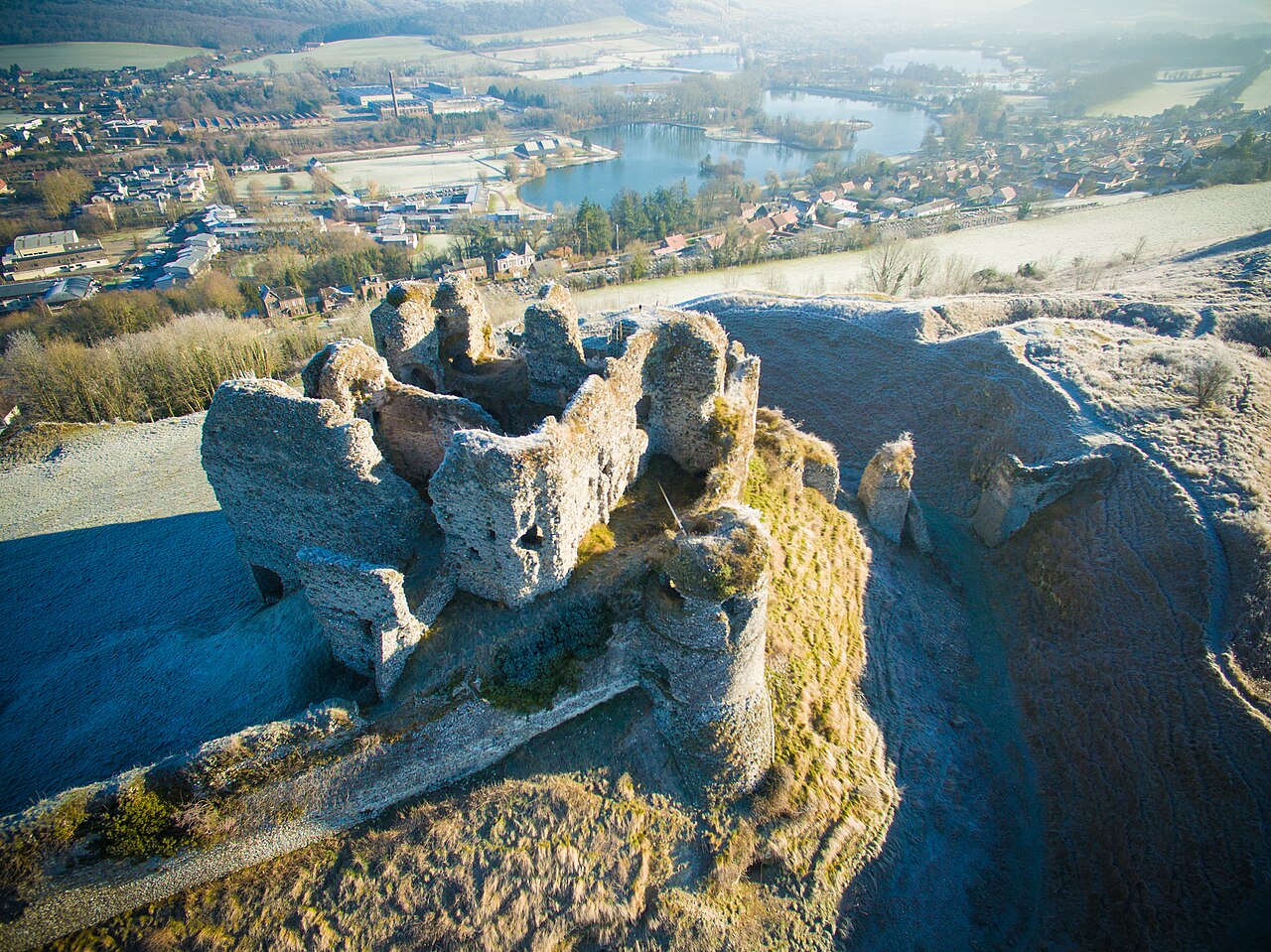
Mesnières Castle
Mesnières Castle, also known as Château de Mesnières-en-Bray, is a remarkable example of Renaissance architecture located in the village of Mesnières-en-Bray, in the Seine-Maritime department of Hauts-de-France, France. This hill castle stands on a site with a rich history dating back to the 11th century, originally fortified by a wooden fortress built by Robert de Mesnières. Strategically positioned to control a Roman road and oversee the Béthune valley, the site has witnessed centuries of noble lineage, conflict, and architectural evolution.
The early history and medieval origins
The earliest known fortification on the site was a wooden fortress enclosed by a palisade, established in the 11th century by Robert de Mesnières. This initial structure was documented in a 1043 land donation ratified by William the Conqueror, highlighting the site's early strategic importance. Over the following centuries, the estate passed through several noble families, including the Valliquerville family around 1200 and later Henri de Bailleul in the mid-14th century. By the late 14th century, ownership transferred by marriage alliance to the Boissay family, who would play a pivotal role in the castle's Renaissance transformation.
Renaissance transformation under the Boissay family
In the early 16th century, the original wooden fortress was dismantled by English forces during the Hundred Years' War. Around 1500, Louis de Boissay initiated the construction of the current Renaissance château, inspired by the grand castles of the Loire Valley. His son, Charles de Boissay, continued this ambitious project, aiming to rival the nearby Etelan Castle, the residence of his wife's family. The château was completed by 1550, with Charles's sister, Suzanne de Gouvis, overseeing its final stages after his death.
The château's design elegantly blends medieval defensive features with Renaissance aesthetics. It features a central main building flanked by cylindrical towers, equipped with machicolations—overhanging parapets with openings for defensive measures. The façades are adorned with classical elements such as Greek-inspired pilasters, large windows, decorative busts, and coats of arms, reflecting the noble status of its owners. The seigneurial chapel, consecrated in 1546, was a significant religious addition, richly decorated with stained glass windows depicting biblical scenes.
Ownership changes and historical events
By the late 16th century, the château passed to the Fautereau family, with François de Fautereau, a gentleman of King Charles IX's chamber, and his son Nicolas, who supported Henry IV during the Wars of Religion. The château suffered damage at the hands of the Catholic League during this turbulent period. In the mid-17th century, Louis de Fautereau elevated the estate to a marquisate in 1650 and undertook significant expansions and decorative enhancements, particularly to the chapel and interior rooms around 1660.
The 18th century saw financial difficulties and disputed inheritance, leading to sales among noble families, including the Durey de Vieuxcourt and Biencourt de Poutrincourt families. Notably, King Louis XV exchanged the property with Michel-Charles-Louis de Biencourt in a deal involving the Tuileries Palace stables. During the French Revolution, the château was seized and converted into a prison, holding up to 150 detainees during the Reign of Terror.
19th and 20th-century transformations and uses
After the Revolution, the château was restored to the Biencourt family but was eventually sold to Abbé Charles Eude, who saved it from destruction by establishing a religious educational institution. In 1835, the Community of the Brothers of Mercy transformed the château into an orphanage and boarding school. Financial difficulties led to the Spiritans taking over in 1878, who added significant outbuildings and a new chapel near the main structure, further shaping the château's complex.
Throughout the 19th and early 20th centuries, the château served various educational and religious purposes. Its extensive grounds include gardens designed by the famed landscape architect André Le Nôtre, known for his work at Versailles, which adds to the château's refined aesthetic environment.
Damage and restoration in the 21st century
On February 20, 2004, a devastating fire destroyed large parts of the château, including three-quarters of the roof and two chapels. The fire also consumed the historic stained glass windows, a significant loss to the château's artistic heritage. Restoration efforts led by Michel Huet took approximately a decade, culminating in 2014 with the château's reopening.
Today, Mesnières Castle houses the Institut Saint-Joseph, an educational institution offering general and technical programs to several hundred students annually. The château and its gardens are open to the public for visits, allowing visitors to appreciate its architectural grandeur and historical significance.
Architectural features and protected status
The château is a prominent example of the Renaissance architectural transition in Upper Normandy, combining medieval fortification elements with Renaissance elegance. Its cylindrical towers, machicolations, and fortified walls recall its defensive origins, while the classical pilasters, large windows, and decorative busts highlight Renaissance influences.
Inside, notable rooms include the Galerie des Cerfs, featuring seven large sculpted stags that celebrate the region's hunting traditions, the Salle des Quatre-Tambours music room, and the Salle des Cartes, adorned with late 19th-century maps of nearby cities. The château's chapel, though damaged by fire, remains a significant historical feature.
Several elements of the château enjoy protected status as historic monuments. The main building was classified in 1862, while other features such as two polygonal dovecotes, enclosing walls, and the large school chapel have been listed since 1995. These protections ensure the preservation of the château's architectural and cultural heritage for future generations.
Frequently asked questions (FAQ)
- What is the historical significance of Mesnières Castle?
- Mesnières Castle, built in the 17th century, is a prime example of classical French architecture and reflects the grandeur of its time. It has been home to several notable families and played a role in the region's history, showcasing the evolution of French nobility.
- When was Mesnières Castle built?
- Construction of Mesnières Castle began in 1640 and was completed in 1655. The castle has undergone various renovations over the centuries, preserving its historical charm while adapting to modern needs.
- What are the opening hours for Mesnières Castle?
- Mesnières Castle is open to visitors from April to October, typically between 10 AM and 6 PM. It is advisable to check the official website or contact the castle for specific opening dates and any seasonal variations.
- Can I visit Mesnières Castle year-round?
- While the castle is mainly open to the public from April to October, special tours or events may be held during the off-season. It’s best to verify availability in advance to ensure a visit outside of regular hours.
- How do I get to Mesnières Castle?
- Mesnières Castle is located in Mesnières-en-Bray, easily accessible by car and public transport from nearby cities. Visitors can use GPS coordinates or local transport schedules to plan their journey effectively.
- Is it possible to take guided tours of Mesnières Castle?
- Yes, guided tours are available and provide deeper insights into the castle's history and architecture. These tours are often conducted in multiple languages, making them accessible to a wide range of visitors.
- What are the ticket prices for visiting Mesnières Castle?
- Ticket prices for Mesnières Castle vary depending on the type of tour and age of the visitor, with discounts available for students and seniors. It's recommended to check the official website for the most current pricing information before your visit.
- What is the best time to visit Mesnières Castle?
- The best time to visit Mesnières Castle is during the spring and summer months when the gardens are in full bloom and the weather is pleasant for outdoor exploration. Additionally, special events and exhibitions are often held during this time, enhancing the visitor experience.
- Are there any nearby attractions to visit after Mesnières Castle?
- Yes, there are several attractions near Mesnières Castle, including beautiful parks, historical towns, and local markets. Exploring the surrounding area can provide a wonderful opportunity to experience the rich culture and history of the Normandy region.
Information
Sources & official resources
Verify the information above using these authoritative references.
Loading map...
Visitor reviews
No reviews yet. Been here? Write the first review and help other travelers!
Write the first reviewVisited this castle? Share your experience
Your review helps other travelers and adds first-hand knowledge to our encyclopedia.