Arques-la-Bataille Castle
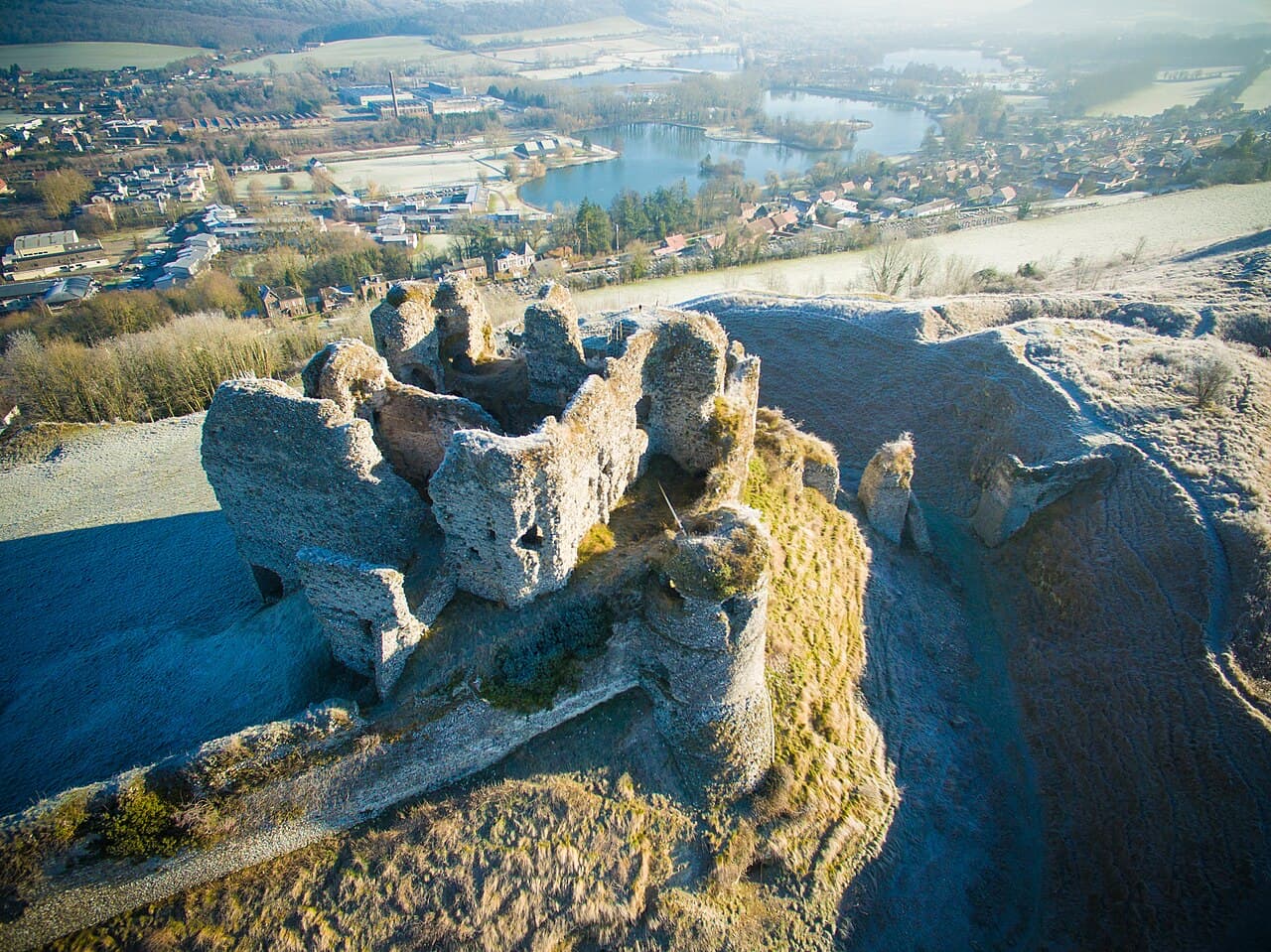
Arques-la-Bataille Castle, also known as Château d'Arques-la-Bataille, is a remarkable medieval fortress located near the village of Arques-la-Bataille in the Seine-Maritime department of Hauts-de-France, northern France. This 12th-century castle stands on a strategic chalk promontory overlooking the valleys where the Varenne, Béthune, and Eaulne rivers converge, providing commanding views toward the sea and natural defensive advantages. Its long history of military significance, architectural evolution, and association with notable historical figures make it a key heritage site in the region.
The origins of Arques-la-Bataille Castle date back to the early 11th century, around 1037-1040, when William of Talou, Count of Talou and uncle to William the Conqueror, established the first fortifications. This initial structure was a motte-and-bailey castle, consisting of a wooden keep atop a raised earthwork (motte), surrounded by an ovoid stone enclosure and a deep defensive ditch. The castle's strategic location made it a focal point during regional power struggles, notably during William's revolt against his nephew in 1052, which resulted in a year-long siege led by Walter Giffard, Lord of Longueville. The siege ended with the castle's capture following the starvation of its defenders.
Norman reconstruction and medieval conflicts
In approximately 1123, under the reign of King Henry I of England (Henry Beauclerc), the castle underwent significant reconstruction. The wooden defenses were replaced by a substantial Norman-style stone keep, rectangular in plan and reinforced with strong buttresses, alongside the construction of a fortified gatehouse. The castle's curtain walls were extended and strengthened, featuring a series of towers that provided enhanced defensive capabilities. This period marked the transformation of Arques-la-Bataille into a formidable stone fortress, typical of High Medieval military architecture.
Throughout the 12th and 13th centuries, the castle was repeatedly contested during the ongoing conflicts between the Plantagenet rulers of England and the Capetian kings of France. It withstood several sieges but ultimately fell in 1204 to Philip II of France (Philip Augustus), becoming the last Norman stronghold to surrender during his campaign to reclaim Normandy.
Role during the Hundred Years' War and Joan of Arc
During the Hundred Years' War, Arques-la-Bataille Castle maintained its strategic importance. After the Treaty of Troyes in 1420, it came under English control as part of the territory ceded by the French crown. The castle served as a military base and refuge during this turbulent period. Notably, in 1431, Joan of Arc stayed at the castle shortly before her trial and sentencing in Rouen, linking the site to one of France's most celebrated historical figures.
The French regained control of the fortress in 1449, and it became royal property. The castle endured further military action, including a siege by Charles the Bold, Duke of Burgundy, in 1472, which was unsuccessful. This period saw the castle's defenses tested repeatedly, reflecting its ongoing military relevance.
Adaptations for artillery and the Wars of Religion
In the early 16th century, under the reign of Francis I of France, the castle was adapted to the evolving nature of warfare, particularly the increasing use of firearms and artillery. A bastion was constructed facing the original 12th-century gate, featuring thick brick-faced walls and supported by four large towers. This bastion was strategically positioned to cover the plateau about 200 meters away, where artillery threats could emerge, demonstrating the castle's modernization to meet contemporary military challenges.
During the French Wars of Religion in the late 16th century, Arques-la-Bataille Castle played a significant role. In 1562, the Duke of Bouillon sought refuge within its walls. The most famous military engagement associated with the castle occurred in September 1589 during the Battle of Arques. Here, Henry IV of France, commanding a force of 7,000 men, successfully defended the castle against a vastly superior Catholic League army of 30,000. This victory was pivotal in securing Henry's position and contributed to the castle's renaming as Arques-la-Bataille, commemorating the battle.
Decline, partial demolition, and preservation efforts
By 1688, the castle had lost its military garrison and purpose. In 1708, Louis XIV officially declared it unfit for service, and by the mid-18th century under Louis XVI, it was decommissioned and used as a stone quarry. The dismantling led to significant loss of the original fabric, though the site remained a prominent ruin.
During the French Revolution, the castle was sold as national property in 1792 to a private owner who halted further demolition. In the 19th century, amid fears of destruction by groups such as the speculative "Black Band," the castle was purchased by a coalition including antiquarians and politicians dedicated to its preservation. A museum was established within the castle, operating until after World War I, reflecting the site's cultural importance.
During World War II, German forces occupied the castle, installing anti-aircraft guns and using it as an ammunition depot. The retreating troops detonated explosives that caused additional damage to the already fragile ruins.
In the late 20th century, public access was restricted due to safety concerns over falling stones, with the gates closing permanently in 2000. Currently, visitors can freely explore the exterior grounds and admire the castle's imposing silhouette, while restoration efforts by dedicated foundations aim to stabilize and eventually reopen the site.
Architectural features and layout
Site and defensive structures
The castle occupies a narrow, elongated chalk promontory, naturally defended by a steep ravine on the west side, which isolates it from easy assault. The fortress's layout follows the rocky spur, with a lengthy, oblong curtain wall encircling the site. This wall is notable for its distinctive herringbone stone pattern and is reinforced by approximately twelve towers of mixed round and square designs, providing overlapping fields of defense.
A deep dry moat, excavated in the 16th century and measuring 15 to 20 meters in depth, surrounds the curtain wall. This moat, devoid of water, served as a formidable obstacle, supplemented by a wooden palisade along its outer edge. The moat's scale and depth highlight the castle's adaptation to gunpowder-era defensive needs.
Main gate and bastion
The principal entrance until the late 14th century was the northwestern Porte de Dieppe, featuring a triple-arched stone gate and a drawbridge. In 1845, a bas-relief depicting Henry IV on horseback was added above this gate, commemorating the castle's historical significance during the Wars of Religion.
The early 16th-century bastion, commissioned by Francis I, is a massive artillery fortification with walls faced in brick and supported by four large towers. Positioned strategically to cover the approach plateau, this bastion exemplifies the transition from medieval to early modern fortification techniques.
The Romanesque donjon
The castle's centerpiece is the imposing Romanesque donjon or keep, located on the southeast side. This square tower measures approximately 20.20 meters on each side, with walls up to 3.5 meters thick, supported by large square buttresses. Internally, the donjon housed essential facilities such as a bread oven, mill, well, storerooms, guardrooms, and living quarters.
Its internal design includes two large rooms separated by a thick partition wall about 1.20 meters wide, with separate staircases leading to each floor. This layout was a defensive measure to slow attackers who might penetrate the keep. At the end of the 15th century, a platform was added atop the donjon to accommodate artillery, reflecting adaptations to changing military technology.
Secondary gate and additional features
A second gate, constructed in 1367 under Charles V, provided a more direct access route to the donjon. Remnants of this gate include traces of a drawbridge pier still visible within the moat, illustrating the castle's complex defensive arrangements.
Heritage status and current condition
The ruins of Château d'Arques-la-Bataille have been officially protected as a classified historic monument since the 19th century, with initial listings in 1862 and further designations in 1875. Additional protections were established in 1942, ensuring the preservation of this significant medieval fortress within the landscape of northern France.
Today, the castle remains in a state of ruin, with substantial portions of the curtain walls, towers, and the donjon still standing. Safety concerns have limited visitor access to the interior, but the exterior can be freely explored. Ongoing restoration and conservation efforts by dedicated foundations aim to stabilize the structure and eventually reopen the site to the public, preserving its rich history and architectural legacy for future generations.
Frequently asked questions (FAQ)
- How do I get to Arques-la-Bataille Castle?
- Arques-la-Bataille Castle is located in the picturesque village of Arques-la-Bataille, France. You can reach the castle by car, with ample parking available nearby, or by taking public transportation from nearby towns and cities. The nearest major city is Dieppe, which is approximately 20 kilometers away.
- What is the historical significance of Arques-la-Bataille Castle?
- Arques-la-Bataille Castle dates back to the 11th century and played a crucial role in the region's defense during the Middle Ages. It is known for its strategic location overlooking the Arques River, which was essential for controlling trade routes. The castle's history is intertwined with various historical events, including conflicts during the Hundred Years' War.
- When was Arques-la-Bataille Castle built?
- Construction of Arques-la-Bataille Castle began in the early 11th century, with significant additions and modifications made over the centuries. The castle's architecture reflects various styles, showcasing its evolution through different historical periods. Its enduring structure makes it a fascinating site for history enthusiasts.
- Can I visit Arques-la-Bataille Castle?
- Yes, Arques-la-Bataille Castle is open to visitors, offering guided tours that provide insights into its rich history and architectural features. It's advisable to check the castle's official website for specific visiting hours and any seasonal variations. Be sure to explore the surrounding grounds, which offer beautiful views of the landscape.
- Why is Arques-la-Bataille Castle considered an architectural gem?
- The castle is regarded as an architectural gem due to its unique blend of Romanesque and Gothic styles, which reflect the evolution of castle construction over centuries. Its imposing towers, thick walls, and intricate details showcase the craftsmanship of the era. The castle's strategic design highlights its purpose as a fortress while also serving as a residence.
- Is it possible to access Arques-la-Bataille Castle with mobility aids?
- While Arques-la-Bataille Castle is an ancient structure with historical significance, some areas may pose challenges for visitors with mobility aids. However, the castle management strives to accommodate all guests and provides information on accessible routes. It's recommended to contact the castle staff in advance to discuss any specific accessibility needs.
- What are the opening hours for Arques-la-Bataille Castle?
- Arques-la-Bataille Castle typically opens to visitors from late spring to early autumn, with varied hours depending on the season. Generally, the castle is open from 10 AM to 6 PM, but it's best to check their official website for the most accurate and up-to-date information regarding opening hours. Special events or holidays may also affect access.
- What are the ticket prices for visiting Arques-la-Bataille Castle?
- Ticket prices for Arques-la-Bataille Castle can vary based on age and group size, with discounts often available for students and seniors. Typically, adult tickets range from €5 to €10, while children under a certain age may enter for free or at a reduced rate. Be sure to check the official website for the latest pricing and any special promotions.
- What are some nearby attractions to visit while at Arques-la-Bataille?
- While visiting Arques-la-Bataille Castle, you can explore the nearby historic town of Dieppe, known for its beautiful beaches and vibrant market. The picturesque village of Arques-la-Bataille itself features charming streets and local eateries. Additionally, the scenic landscapes of the Normandy countryside offer plenty of opportunities for hiking and photography.
Photo gallery

Information
Loading map...
Visitor reviews
No reviews yet. Been here? Write the first review and help other travelers!
Write the first reviewVisited this castle? Share your experience
Your review helps other travelers and adds first-hand knowledge to our encyclopedia.