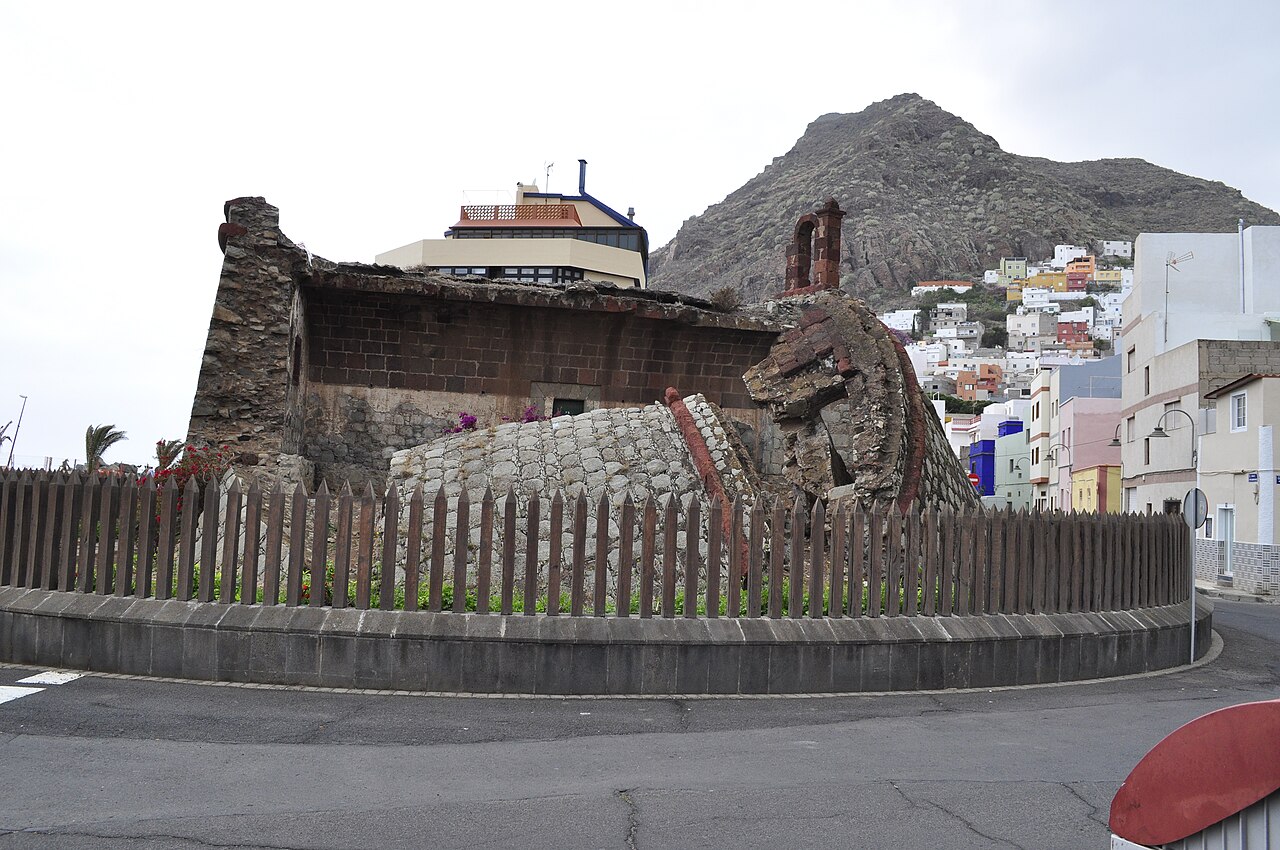
Mesa Roldán Tower
Mesa Roldán Tower, locally known as Torre de la Mesa Roldán, is a notable example of an 18th-century coastal artillery tower located on a mountain east of the village of Agua Amarga in the province of Almería, Spain. Its strategic position atop a rocky promontory was intended to provide a defensive vantage point over the Mediterranean coastline, although its effectiveness was later questioned due to its elevation and distance from the sea.
Construction and architectural design
Built between 1764 and 1766 during the reign of King Charles III of Spain, Mesa Roldán Tower was designed as a horseshoe-shaped artillery tower, a style common among coastal defense structures of that period in southern Spain. This architectural form allowed for a broad field of fire and was employed in similar towers such as the Macenas Tower and Cristal Tower in the Almería region.
The tower was originally armed with two 24-pounder cannons positioned on its roof, intended to defend against naval threats. Its entrance was uniquely placed on the first floor, accessible only by a rope ladder, enhancing its defensibility against attackers. The interior was functionally divided: the lowest level housed rooms for gunpowder storage and supplies, the first floor contained a kitchen and living quarters for the garrison, while the roof served as the artillery platform.
Historical events and uses
Shortly after its completion, in 1768, the tower suffered damage from a lightning strike during a severe storm, which likely affected its structural integrity. Despite its intended military purpose, the tower's elevated position and distance from the coastline rendered it less effective for coastal defense.
In the second half of the 19th century, the tower was repurposed by the Carabineros Corps, a Spanish law enforcement agency focused on customs and border control. During this period, it was used as a makeshift lighthouse until the construction of a nearby official lighthouse in 1863.
Later, in 1941, the tower was transferred to the Guardia Civil, Spain's national gendarmerie. It was adapted for telecommunications purposes, with an antenna installed on its structure. This use continued until 2002, when the tower was decommissioned and the antenna removed, leaving the tower abandoned.
Damage and preservation status
Adjacent to Mesa Roldán Tower is a disused quarry that operated from 1978 until the 1990s. The quarry's use of dynamite caused additional damage to the tower's structure, further contributing to its current state of disrepair.
Today, the tower stands as a well-preserved historic monument in terms of its exterior, although its interior remains inaccessible to visitors. It is freely accessible for exterior viewing, allowing visitors to appreciate its robust stone construction and unique horseshoe shape.
Cultural significance and modern recognition
Mesa Roldán Tower gained modern cultural attention when it was used as a filming location for a season 6 episode of Game of Thrones in 2015, highlighting its dramatic and historic appearance suitable for a fantasy setting.
The tower remains an important heritage site in the Almería region, reflecting the military architecture and coastal defense strategies of 18th-century Spain. Its survival through centuries of varied use and environmental challenges offers valuable insights into the evolution of coastal fortifications.
Frequently asked questions (FAQ)
- What is the historical significance of Mesa Roldán Tower?
- Mesa Roldán Tower was built in the 18th century as a coastal artillery tower to defend the Mediterranean coast near Almería, Spain. It reflects the military architecture and coastal defense strategies of the period.
- Can visitors enter Mesa Roldán Tower?
- Currently, the interior of Mesa Roldán Tower is inaccessible to visitors. However, the exterior can be freely visited and viewed from close proximity.
- When was Mesa Roldán Tower built and by whom?
- The tower was constructed between 1764 and 1766 during the reign of King Charles III of Spain, designed as a horseshoe-shaped artillery tower for coastal defense.
- Why was Mesa Roldán Tower considered ineffective for coastal defense?
- Due to its elevated position and distance from the sea, Mesa Roldán Tower was not ideally located for effective artillery defense against naval attacks.
- What other uses has Mesa Roldán Tower had besides military defense?
- In the 19th century, it served as a makeshift lighthouse for the Carabineros Corps and later as a telecommunications site for the Guardia Civil until 2002.
Information
Address
South of the AL-5106 road, Agua Amarga, Almería, Spain
Loading map...
Visitor reviews
No reviews yet. Been here? Write the first review and help other travelers!
Write the first reviewVisited this castle? Share your experience
Your review helps other travelers and adds first-hand knowledge to our encyclopedia.