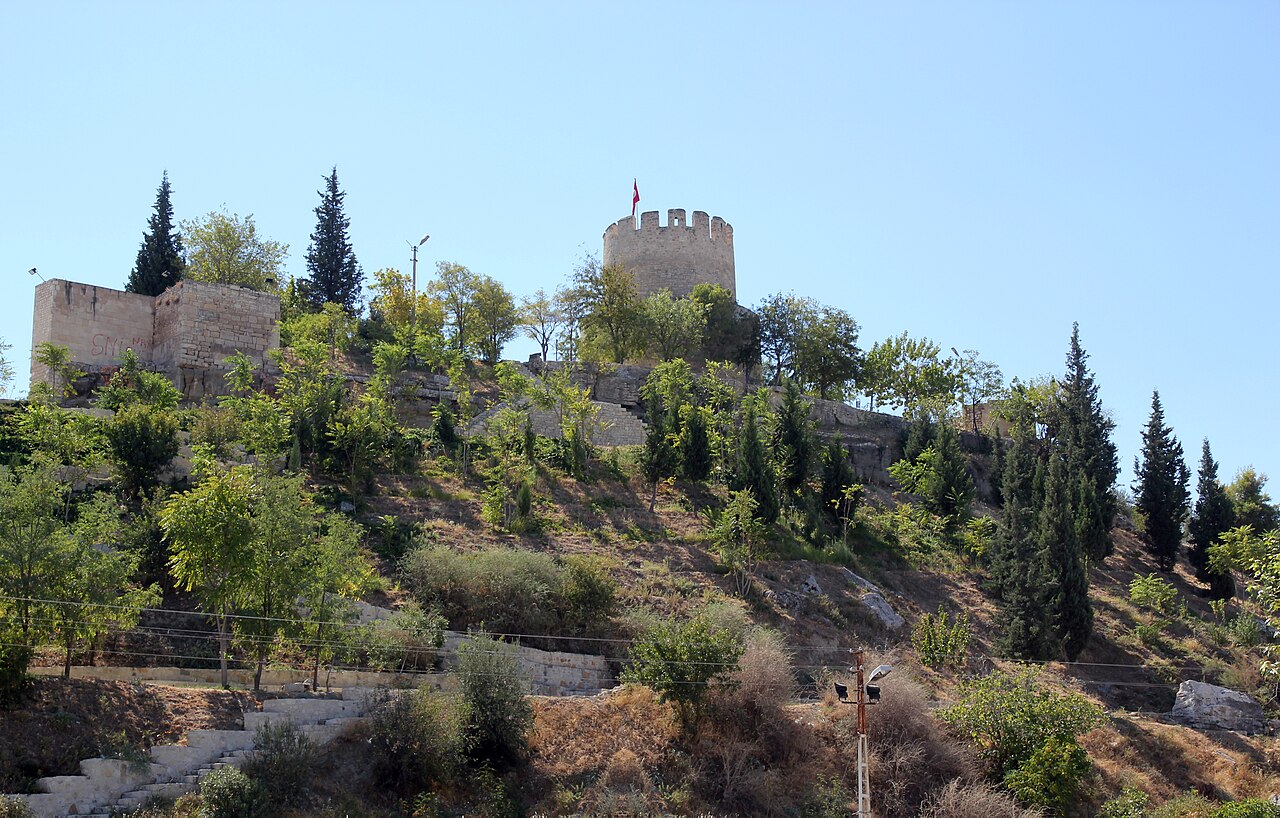
Mavga Castle
Mavga Castle, also known locally as Mavga Kalesi and sometimes spelled as Maghva, is a distinctive medieval fortress located on a limestone mountain north of the village of Topluca in the Mersin province of Turkey. This high medieval castle stands out due to its unique castle-mountain construction, where most of its chambers, passageways, and shelters are carved directly into the rock, rather than built as freestanding structures. This form of fortification relies heavily on the natural isolation and steepness of the mountain for defense, rather than extensive walls or towers.
Historical context and origins
The exact date of Mavga Castle's foundation remains uncertain, with some speculation about its use during the Byzantine era. However, there is no archaeological evidence supporting occupation during the Hittite period (17th to 12th century BC), despite occasional claims. The most concrete historical indication comes from a preserved Arabic inscription bearing the name of Kayqubad I, the Seljuk Sultan of the Sultanate of Rûm, who ruled from 1220 to 1237. This plaque, dated to around 1230, alongside the surviving round tower constructed in Seljuk style, suggests significant Seljuk involvement in the castle's construction or refurbishment during the early 13th century.
Another theory proposes that the castle, referred to as Maghvaberd in some sources, was originally built by the Armenian Kingdom of Cilicia around 1190. The etymology of the name "Maghva" possibly derives from the Armenian word "megava," meaning "bee's," combined with "-berd," meaning "fortress." This theory gains some credibility given the region's historical Armenian presence and the castle's architectural features. According to this account, the castle was later conquered and destroyed by the Seljuks in 1368.
Architectural features and layout
Mavga Castle exemplifies a rock castle or castle-mountain typology, where the natural topography is integral to its defense. The castle is perched on an isolated pinnacle of limestone rock, providing commanding views over the surrounding plain far below. Its natural steep cliffs create formidable barriers, making direct assault difficult.
Entrance and defenses
The only known approach to the castle is a narrow limestone shelf approximately 5 meters wide. At its narrowest point, a gap about 2 meters across and 2.5 meters deep was cut into the rock, flanked on both sides by sheer drops of approximately 245 meters, creating a natural moat-like obstacle. Historically, the entrance was guarded by a tower that commanded this approach, leading into a bent entrance passage that opened into a vaulted chamber. The arched doorway was notably decorated with carved rosettes on either side, indicating a degree of artistic detail uncommon in purely military structures.
Historical records also mention a bastion with a door on the castle side of the gap, which has since disappeared. This bastion would have served as an additional defensive feature controlling access across the narrow approach.
Interior spaces
The interior of Mavga Castle consists mainly of rooms and corridors hewn from the rock itself. This includes shelters and possibly storage or living quarters, although detailed archaeological surveys are limited. The rock-cut nature of the castle means that conventional walls and towers are minimal or absent, with the natural rock face providing most of the defense.
Significance and preservation status
Mavga Castle is an important example of medieval military architecture in the region, illustrating the use of natural topography in fortification design. Its association with both the Seljuk Sultanate of Rûm and the Armenian Kingdom of Cilicia reflects the complex history of Cilicia during the medieval period, marked by shifting control between various powers.
Currently, the castle is in a partially preserved state, with some structures like the Seljuk round tower still standing, while others such as the bastion have been lost. The site is freely accessible, but there is no clearly marked path from the nearest road, and the approach is challenging and potentially unsafe, limiting visitor access.
Visiting Mavga Castle
Visitors interested in exploring Mavga Castle should be prepared for a difficult ascent, as the terrain is steep and no formal trails are maintained. The castle's remote location and rugged access route mean that it is best suited for experienced hikers or those with local guides. Despite these challenges, the castle offers a unique glimpse into medieval fortification techniques and the historical landscape of the Cilician region.
Unfortunately, the lack of visitor infrastructure and the castle's precarious position mean that many areas remain inaccessible or unsafe to explore fully. The Seljuk plaque mentioned in historical accounts is not readily visible, and further archaeological work would be required to uncover more details about the castle's interior and history.
Frequently asked questions (FAQ)
- How do I access Mavga Castle?
- Mavga Castle is located on a limestone mountain north of Topluca village. There is no marked path from the nearest road, and the approach is steep and challenging, suitable only for experienced hikers.
- What is the historical significance of Mavga Castle?
- Mavga Castle reflects the medieval military architecture of the Cilicia region, with connections to the Seljuk Sultanate of Rûm and the Armenian Kingdom of Cilicia, illustrating the area's complex history.
- Can I see the Seljuk plaque at Mavga Castle?
- The Seljuk plaque inscribed with Sultan Kayqubad I's name is reported to exist at the castle, but due to difficult access and preservation issues, it is not easily visible to visitors.
- When was Mavga Castle built?
- The castle likely dates back to the 12th century, with possible construction or significant modifications by the Seljuks in the early 13th century and possible Armenian origins around 1190.
- Is Mavga Castle safe to explore?
- The castle's location on a steep limestone pinnacle and lack of maintained paths make exploration risky. Visitors should exercise caution and consider local guidance for safety.
Information
Loading map...
Visitor reviews
No reviews yet. Been here? Write the first review and help other travelers!
Write the first reviewVisited this castle? Share your experience
Your review helps other travelers and adds first-hand knowledge to our encyclopedia.