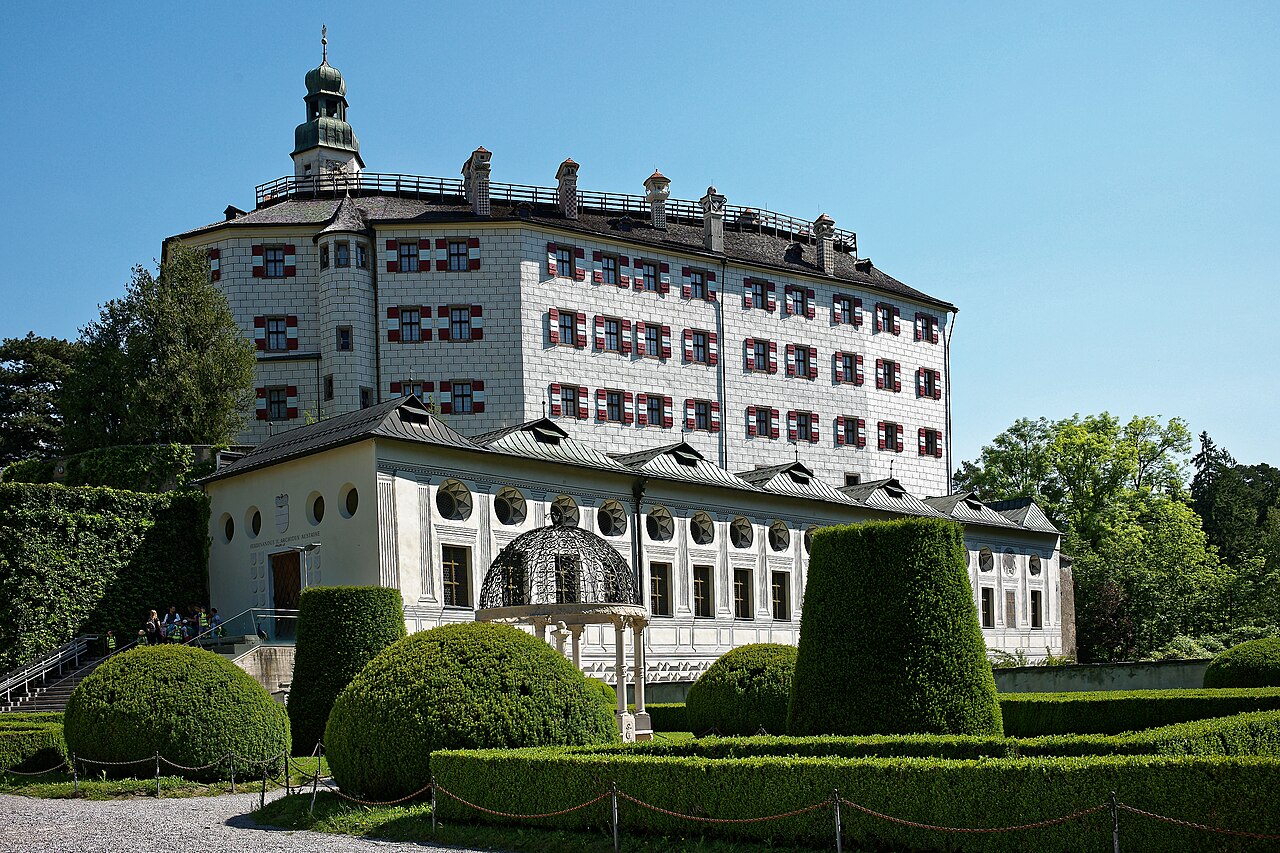
Martinsbühel
Martinsbühel castle stands as a remarkable example of a hilltop fortress with a history that spans from ancient times through the medieval period and into modernity. Located in the municipality of Zirl in Austria, this castle occupies a strategic position overlooking vital transport routes and river crossings in the Tyrol region. Its origins trace back to the La Tène period, indicating early settlement activity, and later it became the site of a significant Roman fortification known as Teriolis. This Roman fort underscored the site's importance as a military and strategic hub in antiquity, controlling access along the Inn River and adjacent roadways.
In the early Middle Ages, the medieval castle was constructed directly above the remains of the late Roman fort, capitalizing on the existing defensive advantages. The castle's location allowed for control over a key ferry crossing on the Inn River and the road connecting Innsbruck to the Upper Inn Valley and the Seefeld Saddle, a crucial Alpine pass. The earliest documented reference to the castle dates to 1290, when Heinrich von Aufenstein granted it to Ludwig, described as "of sant Marteinsberg bei Zierlen." Ownership later passed to Meinhard II, Count of Tyrol, following the extinction of the original noble family associated with the castle.
Medieval and early modern history
Following the transfer of Tyrol to the Habsburg dynasty in 1363, Martinsbühel was designated as a residence for Margarete Maultasch, widow of Meinhard III. Despite her initial retention of the castle, her influence in the region waned under the authority of Rudolf IV of Habsburg. The 15th century marked a significant shift in the castle's function, as it was transformed into a hunting lodge. This adaptation was undertaken by notable figures such as Duke Frederick IV, "the Empty Pockets", and Archduke Sigismund, "the Rich in Coin", who modified the complex to support recreational hunting activities in the nearby Martinswand forested area.
Emperor Maximilian I further enhanced the estate by adding a game park, stables, and auxiliary buildings, reinforcing the castle's role as a noble hunting retreat. During this period, the estate was managed by noble vassals, including the Mentlberger family around 1450. However, by the 17th century, the castle fell into neglect and was eventually sold by government authorities.
Modern era and social institutions
In 1888, Benedictine Father Edmund Hager acquired Martinsbühel with the vision of establishing a monastery and vocational training center for boys, inspired by the educational principles of Don Bosco. From 1895 onwards, the facility provided neglected youth with training in practical trades such as tailoring, shoemaking, locksmithing, and gardening, reflecting a social mission that extended the castle's historic legacy into the realm of education and care.
The 20th century brought further transformations. During the Nazi era (1938-1945), the castle served multiple roles: a school for children with behavioral difficulties, a shelter for South Tyrolean emigrants, and a prisoner-of-war camp. After World War II, beginning in 1947, Benedictine nuns operated a confessional girls’ home and a special school for mentally and physically disabled girls. A new school building was completed in 1988 to support these activities. Unfortunately, this period was also marked by allegations of physical and sexual abuse involving some members of the religious community.
The girls’ household school remained operational until 2008, after which the last nuns departed. Since then, the complex has been largely unoccupied, with partial maintenance overseen by an estate administrator and artist, Ferdinand Lackner. Ownership remains with the Archabbey of St. Peter in Salzburg, preserving the site's ecclesiastical ties.
Architectural features and preservation
The palas and defensive structures
The castle's main residential building, or palas, is a rectangular structure primarily dating from the first half of the 14th century. It is constructed with regular courses of finely cut stone blocks, demonstrating precise masonry techniques. The exterior walls retain their unplastered ashlar surfaces, including a distinctive bricked-up round-arched entrance on the south side's second floor. Architectural details include Romanesque-style windows and a pointed arch gate with two moldings, added during the era of Archduke Sigismund. The facade prominently features a decorative emblem of a double-headed eagle on a yellow background, symbolizing imperial connections.
Remnants of the original defensive walls survive in fragmentary form around the site. These vestiges attest to the castle's original role as a fortified stronghold guarding vital transport routes and river crossings, although much of the fortifications have not endured intact.
St. Martins Chapel
Adjacent to the palas stands the late Gothic St. Martins Chapel, dating mainly from the 15th century. The chapel is renowned for its intricate net rib vault, a hallmark of Gothic ceiling architecture. The presbytery was added during the reign of Emperor Maximilian I, likely under the direction of Niklas Türing the Elder, Maximilian's court master builder.
The chapel's origins may extend back to a 6th-century church, possibly built on the site of an earlier religious structure. It is believed to have been the seat of the Rhaetian bishop Martinus-Marcianus around 570 AD, which could make it the oldest surviving church building in North Tyrol. The 17th century brought architectural modifications, including a Baroque-style bell turret atop the steeply pitched gabled roof.
The interior features frescoes with zigzag patterns, symbolic depictions of the Heavenly Jerusalem, and a portrayal of a holy bishop dating from the 12th century. The chapel underwent its most recent renovation in 1965, preserving many of these historic artistic and architectural elements.
Later adaptations and current use
Within the castle complex, the former special school building, which once housed educational programs for disabled girls, now functions as a media and publishing office. This adaptive reuse reflects the site's evolving role from a medieval fortress to a center of social care and education, and now to cultural and administrative purposes.
Martinsbühel’s cultural and historical significance
Martinsbühel castle embodies a rich tapestry of Tyrolean history, from its ancient roots through medieval fortification, noble residence, hunting lodge, and social institution. Its architectural features provide tangible links to various historical periods, including Roman military engineering, medieval masonry, Gothic ecclesiastical design, and Baroque modifications.
The castle's association with prominent historical figures such as Meinhard II, Margarete Maultasch, and Emperor Maximilian I highlights its importance within the political and cultural landscape of Tyrol. Moreover, the St. Martins Chapel stands as a significant religious monument, potentially the oldest church building in North Tyrol, linking the site to early Christian history in the region.
Today, although the castle is mostly unoccupied, its preservation under the ownership of the Archabbey of St. Peter in Salzburg ensures that Martinsbühel remains a vital heritage site. Its layered history and architectural complexity continue to attract interest from historians, architects, and visitors seeking to explore Tyrol's multifaceted past.
Frequently asked questions (FAQ)
- How do I get to Martinsbühel Castle?
- Martinsbühel Castle is located in Zirl, Austria, easily accessible by car or public transportation. The nearest train station is in Innsbruck, from where you can take a bus or taxi to reach the castle.
- What is the historical significance of Martinsbühel Castle?
- Martinsbühel Castle dates back to the 13th century and played a crucial role in the defense of the region. Its strategic location allowed it to serve as a lookout point and military stronghold throughout various historical conflicts.
- When was Martinsbühel Castle built?
- Construction of Martinsbühel Castle began in the early 1200s, making it one of the oldest castles in the area. Over the centuries, it has undergone several renovations and restorations to preserve its historical integrity.
- Can I visit Martinsbühel Castle year-round?
- Yes, Martinsbühel Castle is open to visitors year-round, but it’s advisable to check specific opening hours as they may vary by season. Guided tours are available, providing insights into the castle's rich history and architecture.
- Why is the architecture of Martinsbühel Castle unique?
- The architecture of Martinsbühel Castle reflects a blend of Gothic and Romanesque styles, showcasing its evolution over the centuries. Its imposing stone walls and charming towers not only served defensive purposes but also offer a picturesque view of the surrounding landscape.
- Is it possible to host events at Martinsbühel Castle?
- Yes, Martinsbühel Castle is available for private events such as weddings and corporate gatherings. The stunning backdrop and historical ambiance make it a popular choice for memorable celebrations.
- What are the ticket prices for visiting Martinsbühel Castle?
- Ticket prices for Martinsbühel Castle are generally affordable, with discounts available for children and seniors. It’s best to check the official website for the most current pricing and any special offers.
- When is the best time to visit Martinsbühel Castle?
- The best time to visit Martinsbühel Castle is during the spring and early autumn months when the weather is pleasant and the surrounding nature is in full bloom. These seasons also attract fewer crowds, allowing for a more enjoyable experience.
- Are there nearby attractions to visit after touring Martinsbühel Castle?
- Yes, there are several nearby attractions, including the picturesque town of Zirl and the stunning mountain landscapes of the Tyrolean Alps. Visitors can also explore hiking trails and local museums that showcase the rich history of the region.
Information
Loading map...
Visitor reviews
No reviews yet. Been here? Write the first review and help other travelers!
Write the first reviewVisited this castle? Share your experience
Your review helps other travelers and adds first-hand knowledge to our encyclopedia.