Ambras Castle
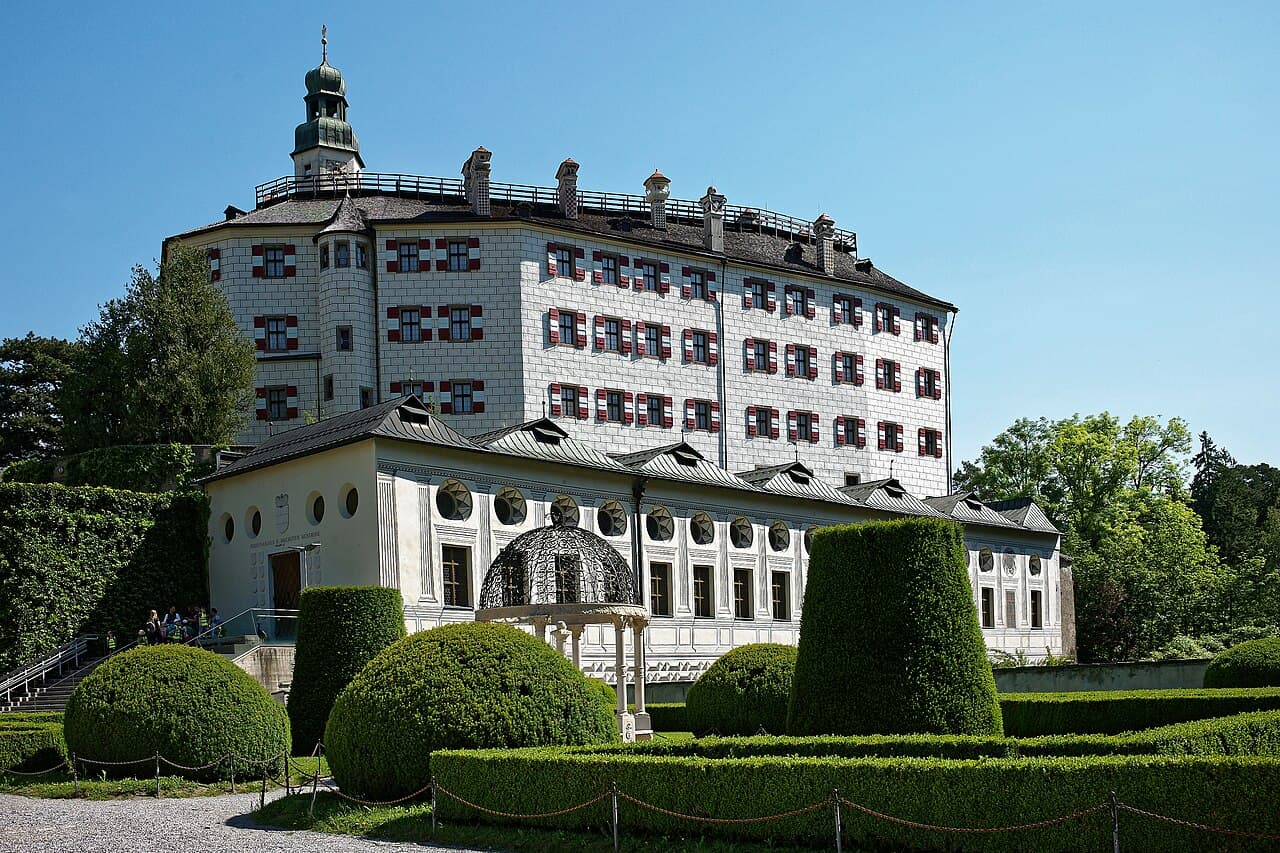
Ambras Castle is a distinguished Renaissance castle and palace perched on a hill above the city of Innsbruck, in the Austrian region of Tyrol. Its location commands a strategic view about 100 meters above the valley floor carved by the river Inn. The castle's origins trace back to the 10th century, when it was first established as a medieval fortress and seat of power for the Counts of Andechs. Although the original medieval structure was destroyed in the early 12th century, the site was later transformed into the Renaissance masterpiece known today.
The castle is most famously associated with Archduke Ferdinand II (1529–1595), a member of the House of Habsburg and a prominent patron of the arts. Ferdinand II made Ambras Castle his residence from 1563 until his death in 1595. He commissioned the transformation of the medieval fortress into a splendid Renaissance-style residential castle as a gift for his wife, Philippine Welser, whom he had secretly married. This transformation included the construction of the Spanish Hall—a grand hall built between 1570 and 1572, renowned for its impressive wood-inlay ceiling and walls decorated with 27 full-length portraits of Tyrolean rulers.
Historical background and architectural evolution
The site originally housed a castle belonging to the Counts of Andechs, a powerful family from Upper Bavaria. This medieval castle was destroyed in 1133, and no physical remains survive today. The property passed through inheritance to the Tyrolean princes, who retained it as a strategic stronghold. The surviving structure known as the Hochschloss (Upper Castle) preserves elements of this medieval phase, though much of its current form results from Renaissance remodeling.
In the late 16th century, Archduke Ferdinand II undertook extensive construction projects that reshaped the castle complex. Besides the Hochschloss, he built the Unterschloss (Lower Castle) between 1570 and 1583, which housed his famous collections. The Lower Castle includes the armouries that display masterpieces of European armor from the era of Emperor Maximilian I to Emperor Leopold I. This collection remains one of the finest preserved of its kind, showcasing the evolution of military craftsmanship.
The Spanish Hall
The Spanish Hall is a highlight of Ambras Castle and a significant example of late Renaissance architecture in the German-speaking world. Its elaborate wood-inlay ceiling and richly decorated walls create a majestic atmosphere. The portraits lining the hall depict a dynastic lineage of Tyrolean rulers, emphasizing the castle's role as a seat of power and cultural heritage.
Archduke Ferdinand II and the birth of the museum
Archduke Ferdinand II was not only a ruler but also a passionate collector and humanist. His extensive collections included armour and weapons, portraits, natural curiosities, scientific instruments, musical instruments, and various treasures. He established the Chamber of Art and Curiosities (Kunst- und Wunderkammer) within the castle, which is considered the oldest museum in the world still housed in its original location.
His wife, Philippine Welser, played a significant role in the castle's history. Their secret marriage was controversial due to her non-noble status, but she gained popularity in Tyrol for her helpfulness and was eventually recognized with the respectful title of "most serene princess." The castle served as a symbol of their union and cultural patronage.
Collections and cultural significance
The Lower Castle contains the renowned armoury, featuring exquisite examples of European armor craftsmanship spanning from the reign of Emperor Maximilian I to Emperor Leopold I. The Chamber of Art and Curiosities is unique as a Renaissance art cabinet preserved in situ, offering invaluable insights into the collecting practices and intellectual interests of the late 16th century.
The Upper Castle houses an extensive portrait gallery displaying numerous paintings of the House of Habsburg, reinforcing the castle's historical role as a dynastic residence and cultural center.
Later history and preservation
After Archduke Ferdinand II's death in 1595, his son Karl von Burgau inherited the castle and collections but showed little interest in their upkeep. In 1606, the entire collection was sold to Emperor Rudolf II of Prague, a notable Habsburg collector himself. Although the castle ceased to be a residence, the collections remained largely intact, though some losses occurred due to neglect, moisture, and insect damage.
In the 17th century, valuable manuscripts and books from the collection were moved to Vienna's National Library for safekeeping. During the Napoleonic Wars, the collection was temporarily endangered but was ultimately secured in Vienna in 1806 after Emperor Napoleon I acknowledged its private status.
In the 19th century, Ambras Castle was transformed into the summer residence of Archduke Karl Ludwig, governor of Tyrol. This period saw significant changes to the castle and its park, including the addition of a romantic ivy-covered ramp and the redesign of the gardens into an English-style park. These modifications altered the original Renaissance character of the grounds.
Current status
Today, Ambras Castle is a well-preserved cultural monument and a major tourist attraction in Tyrol. It offers visitors a unique glimpse into Renaissance art, architecture, and collecting culture. The castle's preserved armouries, the Spanish Hall, and the Chamber of Art and Curiosities remain focal points for scholars and tourists alike, representing an unrivalled heritage of European Renaissance history.
The castle's position on a rocky promontory overlooking Innsbruck adds to its dramatic appeal, combining natural beauty with rich historical significance. Its collections continue to be a source of fascination, illustrating the cultural ambitions of the Habsburg dynasty and the legacy of Archduke Ferdinand II's enlightened patronage.
Frequently asked questions (FAQ)
- What is the historical significance of Ambras Castle?
- Ambras Castle is a Renaissance castle in Innsbruck, Austria, known for its extensive art collection and historical importance. Built in the 16th century, it served as a residence for Archduke Ferdinand II, who transformed it into a cultural center for art and science.
- When was Ambras Castle built?
- Ambras Castle was originally constructed in the 10th century, but it underwent significant renovations and expansions in the 16th century under Archduke Ferdinand II. The castle reflects a blend of medieval and Renaissance architecture, showcasing the evolution of style during that period.
- Can I visit Ambras Castle during the winter?
- Yes, Ambras Castle is open to visitors year-round, although some areas may have restricted access during winter months. It's advisable to check the official website for any seasonal changes in opening hours and tours.
- What are the opening hours for Ambras Castle?
- Ambras Castle typically opens at 10:00 AM and closes at 5:00 PM, with extended hours during the summer months. Visitors should verify current opening hours before their visit to ensure they have the latest information.
- Is it possible to access Ambras Castle via public transport?
- Yes, Ambras Castle is accessible by public transport from Innsbruck city center. Visitors can take a bus or tram that stops nearby, making it convenient to reach the castle without a car.
- What is the ticket price for Ambras Castle?
- Tickets for Ambras Castle are generally priced around €10 for adults, with discounts available for students and seniors. Children under a certain age may enter for free, so it’s best to check the official site for current pricing and any available family packages.
- When is the best time to visit Ambras Castle?
- The best time to visit Ambras Castle is during the spring and early autumn months when the weather is mild and the surrounding gardens are in full bloom. This is also when the castle hosts various cultural events and exhibitions, enhancing the visitor experience.
- Are there nearby attractions to visit after Ambras Castle?
- Yes, after visiting Ambras Castle, you can explore the beautiful gardens and the nearby Alpine Zoo, which is home to a variety of native wildlife. The castle is also close to the historic center of Innsbruck, where visitors can enjoy shopping, dining, and other cultural landmarks.
Photo gallery

Information
Website
Visit websiteSources & official resources
Verify the information above using these authoritative references.
Loading map...
Visitor reviews
No reviews yet. Been here? Write the first review and help other travelers!
Write the first reviewVisited this castle? Share your experience
Your review helps other travelers and adds first-hand knowledge to our encyclopedia.