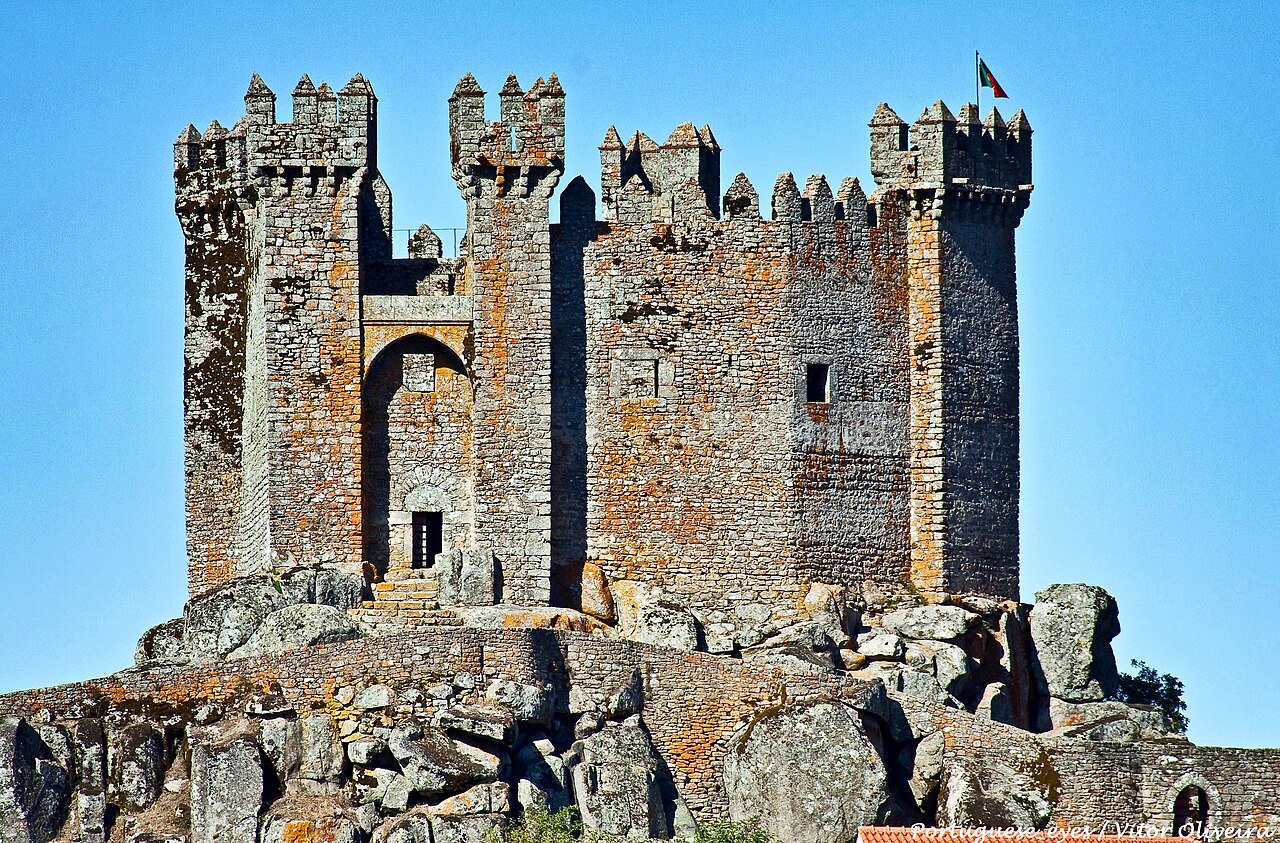
Castelo de Ranhados
Castelo de Ranhados is a medieval hill castle located in the municipality of Mêda, Portugal. This fortress occupies a strategic position on a mountaintop approximately 840 meters above sea level, overseeing the surrounding village and the confluence of the Torto River and the Teja stream. Its location on a ridge, reflected in its name derived from "ranh," meaning crest or ridge of a hill, was chosen for its commanding views and defensive advantages.
Origins and early history
The site of Castelo de Ranhados has a history extending back to proto-historic times, initially serving as a castro, a type of fortified settlement common in the Iberian Peninsula before Roman occupation. Archaeological findings, including ceramic artifacts, attest to Roman influence during their occupation, indicating the site’s long-standing strategic importance.
Medieval construction and ownership
The castle’s medieval phase began under the reign of King Dinis (1279–1325). In 1286, the king granted a charter to the local settlement to encourage growth and fortify the area. During this period, it is believed that the Knights Templar and Knights Hospitaller, both holding lands nearby, contributed to the castle’s construction, reflecting their military and religious influence in the region.
Later, during the reign of King Ferdinand I (1367–1383), the village and castle were granted in 1381 to two brothers from the noble House of Távoras. This gift was confirmed in 1384 by the Master of Avis, an important figure in Portuguese history. Some historians suggest that the castle’s simple design and the lack of a keep tower protecting the main gate may indicate that the main construction occurred during this late 14th-century period.
Architecture and defensive features
The castle’s layout is irregular and oval-shaped, typical of Gothic architectural influence. It is primarily constructed from granite ashlar masonry, a durable material that has helped preserve the walls despite their incomplete state and the loss of original battlements.
Two square towers reinforce the defensive walls. One tower stands at the southeast corner, opposite the main entrance, serving as a key defensive feature of the perimeter. The second tower is located within the courtyard near a smaller eastern gate known as the "Porta da Traição" or Traitor’s Gate. This gate is protected by a double layer of walls, emphasizing its role as a secondary access point.
The inner tower features a pointed arch doorway leading into a vaulted chamber with ribbed cross vaulting, a ceiling construction where intersecting rib arches form a structural framework. The curtain wall once included a walkway, locally called an adarve, accessible by stairs near the main gate, allowing defenders to patrol the ramparts.
Notably, the absence of a keep tower at the entrance suggests the castle may have functioned as a secondary fortification rather than a primary stronghold. This architectural detail distinguishes Castelo de Ranhados from many contemporaneous castles that featured prominent keeps as central defensive structures.
Later history and decline
Despite its initial strategic importance, the castle and surrounding village experienced a gradual decline over the centuries. Although King Manuel I renewed the settlement’s charter in 1512, the area had already begun to lose inhabitants and significance.
By the 18th century, the village was incorporated into the Casa do Infantado, serving as a rectory under royal oversight and functioning as a commandery of the Order of Christ. These changes reflect the shifting political and religious landscape of Portugal during this period.
The process of abandonment continued, culminating in the dissolution of the municipality of Ranhados in 1836, when it was absorbed into Mêda. Following the suppression of religious orders in 1834, the castle’s courtyard was repurposed as the village cemetery, a function it maintains to this day.
Preservation and current condition
In recognition of its cultural and historical value, Castelo de Ranhados was officially designated a Site of Public Interest in 1977. Structural reinforcements have been applied to one of the outer walls due to its continuous use as a burial ground. These interventions have partially altered the original medieval fabric but have been necessary to maintain the castle’s integrity.
Today, the castle remains a significant historical monument, offering insight into medieval military architecture and the complex history of the region. Its surviving walls, towers, and architectural features provide a tangible connection to Portugal’s medieval past and the roles played by religious military orders and noble families in shaping local fortifications.
Frequently asked questions (FAQ)
- What is the historical significance of Castelo de Ranhados?
- Castelo de Ranhados is a medieval castle that reflects the rich history of the region. It played a crucial role in the defense against invasions and showcases the architectural styles that evolved over centuries in Portugal.
- When was Castelo de Ranhados built?
- The exact date of construction is not precisely known, but it is believed that Castelo de Ranhados dates back to the 12th century. This period coincides with the Reconquista, when many castles were built to protect against Moorish invasions.
- Can I visit Castelo de Ranhados year-round?
- Yes, Castelo de Ranhados is open for visitors throughout the year. However, it is advisable to check local holidays and events, as these may affect opening hours.
- What are the opening hours of Castelo de Ranhados?
- The castle is typically open from 9 AM to 6 PM during the high season and may have reduced hours in the off-season. It's best to verify the current schedule on the official website before planning your visit.
- Is it possible to access Castelo de Ranhados with a wheelchair?
- Access to Castelo de Ranhados may present some challenges due to its historical architecture and terrain. While efforts have been made to accommodate visitors, it is recommended to contact the site in advance for specific accessibility options.
- What is the best time to visit Castelo de Ranhados?
- The best time to visit Castelo de Ranhados is during the spring and fall when the weather is mild, and the tourist crowds are smaller. This allows for a more enjoyable experience as you explore the castle and its surroundings.
- Are there any nearby attractions to explore?
- Yes, there are several nearby attractions, including the charming town of Mêda and beautiful natural landscapes in the surrounding area. Visitors can also explore other historical sites and enjoy local cuisine in the region.
- How much do tickets to Castelo de Ranhados cost?
- Ticket prices for Castelo de Ranhados are generally affordable, with discounts available for children, students, and seniors. It is recommended to check the official website for the latest pricing and any special promotions.
Information
Loading map...
Visitor reviews
No reviews yet. Been here? Write the first review and help other travelers!
Write the first reviewVisited this castle? Share your experience
Your review helps other travelers and adds first-hand knowledge to our encyclopedia.