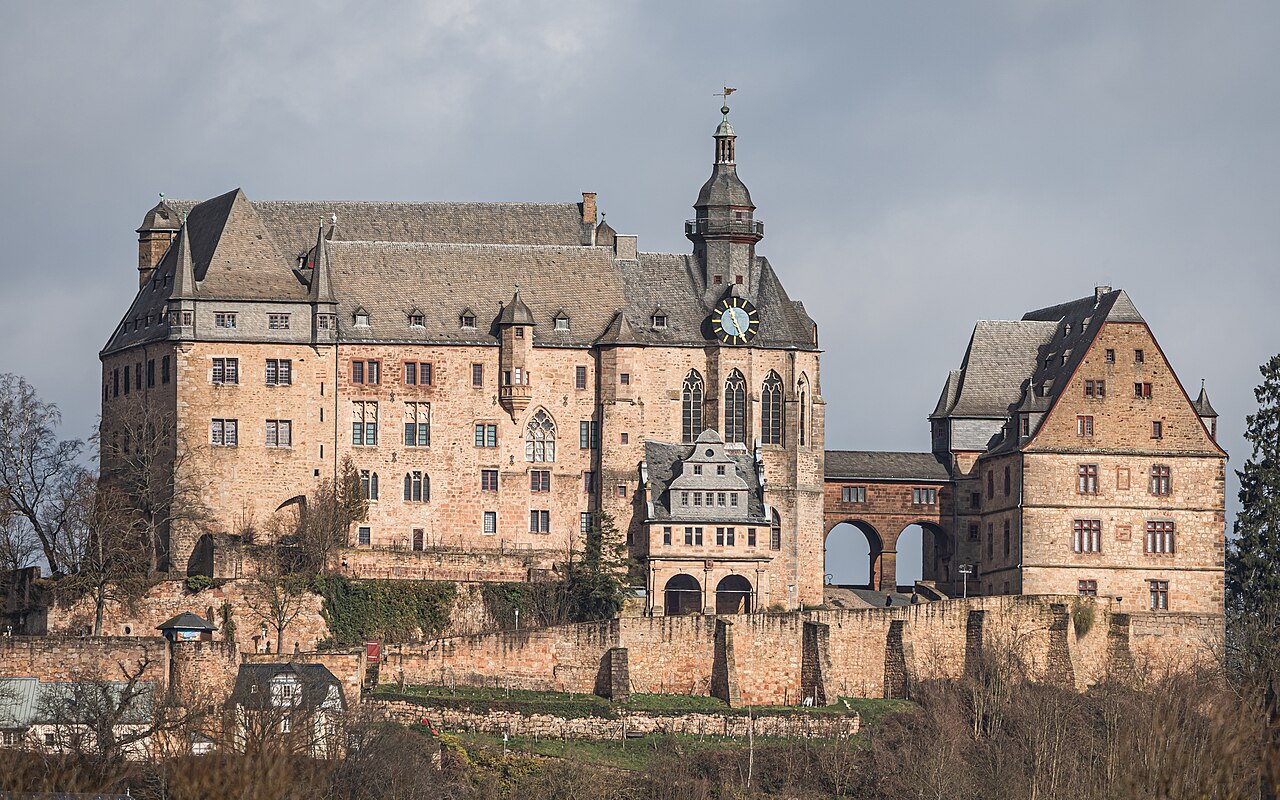
Frauenberg Castle
Frauenberg Castle stands as a significant medieval fortress located in the municipality of Ebsdorfergrund in modern-day Germany. Constructed around 1250 under the direction of Duchess Sophie of Brabant, acting on behalf of her son, the young Landgrave Heinrich I of Hesse, the castle played a crucial role in securing strategic control over the surrounding region during the High Medieval period. Its primary purpose was to protect the nearby town of Marburg and to counterbalance the influence of Burg Amöneburg, which was controlled by the Archbishopric of Mainz.
The castle's location on a prominent basalt hill rising approximately 370 meters above sea level provided commanding views over the Ebsdorfer Grund valley and the Amöneburger Basin. This vantage point underscored its strategic importance in overseeing the vital medieval routes, particularly the Langen Hessen, a key pathway for trade and military movement. Frauenberg Castle's existence is documented as early as 1296, with management entrusted to Burgmannen—castle tenants or knights—who adopted the name von Frauynberg, likely descending from the local noble family Rau von Holzhausen.
Historical significance and administrative role
Throughout the 14th century, Frauenberg Castle evolved beyond its military function to become an important administrative center. The establishment of the Frauenberg court led to the creation of an Amt (administrative district) by approximately 1350. This Amt operated independently until 1604, when it was merged with the neighboring Amt Kirchhain. The castle's ownership changed hands multiple times during this period, often pledged to noble families such as the Riedesel and von Dernbach. One notable figure was Count Volprecht von Dernbach, who served as Ober-Schultheiß (chief magistrate) in Marburg from 1329.
Decline in strategic importance
The castle's strategic significance began to wane in the 15th century following the military victories of the Hessian Landgraves over Mainz in 1427 and their acquisition of the County of Ziegenhain in 1450. These successes diminished the need for Frauenberg as a frontier fortress. Despite this, the castle suffered two destructive events in 1470 and 1489, though the exact causes remain undocumented. Partial habitation continued until 1528, after which Frauenberg gradually fell into ruin. Over subsequent centuries, local villagers quarried the ruins for building materials, further reducing the castle's remains.
Architectural features and remains
The ruins of Frauenberg Castle occupy a volcanic basalt hill, a durable stone that was extensively used in the castle's construction. Today, visitors can observe two concentric ring walls—the inner and outer defenses—each rising up to approximately seven meters in height. These walls, built from locally quarried basalt, were supplemented by defensive ditches (known as Wallgräben in German) that encircled parts of the castle, enhancing its defensive capabilities by hindering enemy advances.
Interestingly, Frauenberg Castle does not appear to have featured a traditional bergfried (a tall main tower typical of medieval German castles), which served both defensive and residential purposes. Due to the limited surviving structures, the castle's exact original layout and appearance cannot be definitively reconstructed, but the remaining fortifications clearly indicate its role as a fortified noble residence and local administrative center.
The castle's walls and fortifications survive in fragmented form, with some elements still in situ while others were removed or repurposed over time. Quarrying of basalt from the site continued until 1913, impacting the preservation of the ruins. Despite the absence of decorative elements, inscriptions, or archaeological finds such as tools or pottery, the site remains a valuable historical and cultural landmark.
Cultural legacy and conservation efforts
From the late 18th century onward, Frauenberg Castle attracted interest for its historical significance. Intellectuals such as Caroline Schelling visited the ruins, drawn by their romantic and cultural appeal. Conservation efforts began in the 19th century, with notable restoration work on the castle gate in 1873. These initiatives aimed to preserve the remaining structures and protect the site from further degradation.
Today, Frauenberg Castle stands as a testament to the medieval history of the Hesse region and offers visitors insight into the architectural and administrative functions of a High Medieval hill castle. Its commanding location near historic travel routes like the Langen Hessen road and the Balderscheidweg trail highlights its enduring importance in controlling regional movement during the Middle Ages.
Visitor experience and significance
Although Frauenberg Castle is now a ruined hill castle, its remains provide a tangible connection to the past. The site's elevated position offers panoramic views of the surrounding landscape, allowing visitors to appreciate the strategic considerations that influenced its original construction. Interpretive signage and conservation work help contextualize the castle's history, making it an engaging destination for those interested in medieval architecture, regional history, and cultural heritage.
Frequently asked questions (FAQ)
- When was Frauenberg Castle built and by whom?
- Frauenberg Castle was built around 1250 under the direction of Duchess Sophie of Brabant on behalf of her son, Landgrave Heinrich I of Hesse.
- What was the primary purpose of Frauenberg Castle?
- The castle was constructed to protect the town of Marburg and to counterbalance the influence of Burg Amöneburg, controlling strategic medieval trade and military routes.
- What remains can be seen at Frauenberg Castle today?
- Visitors can see two concentric basalt ring walls up to seven meters high, defensive ditches, and remnants of the castle's fortifications on a basalt hill.
- Is there a main tower or bergfried at Frauenberg Castle?
- Frauenberg Castle does not appear to have had a traditional bergfried, which is uncommon for medieval German castles.
- How did the strategic importance of Frauenberg Castle change over time?
- Its importance declined in the 15th century after Hessian victories over Mainz and territorial acquisitions, leading to its gradual abandonment and ruin.
Information
Loading map...
Visitor reviews
No reviews yet. Been here? Write the first review and help other travelers!
Write the first reviewVisited this castle? Share your experience
Your review helps other travelers and adds first-hand knowledge to our encyclopedia.