Malcesine Castle
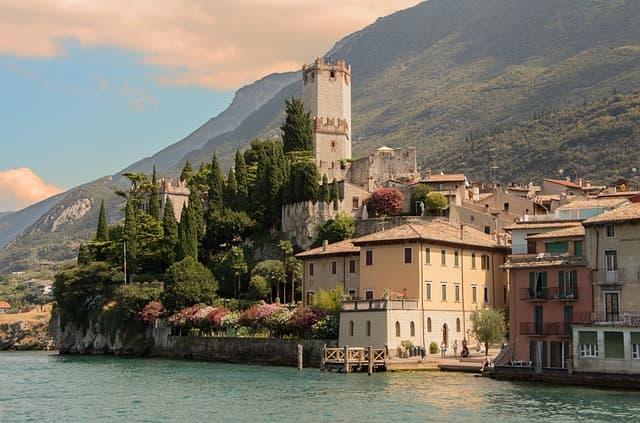
Malcesine Castle, also known as the Castello Scaligero of Malcesine, stands prominently on a rocky promontory in the center of the town of Malcesine, within the province of Verona in the Veneto region of Italy. This historic hill castle overlooks the northern shores of Lake Garda, offering commanding views of the lake and the dramatic cliffs of Mount Baldo. Its strategic location and imposing silhouette have made it a defining landmark of the area for centuries.
The origins of Malcesine Castle trace back to the Early Medieval period, with the first fortifications believed to have been established by the Lombards. According to local tradition, the castle was destroyed by the Franks in 590 AD and subsequently rebuilt. Historical anecdotes suggest that King Pepin of Italy, son of Charlemagne, visited the castle in 803, highlighting its early significance in the region.
Medieval origins and scaliger reconstruction
Following the turbulent period marked by Hungarian raids in the 10th century, the castle became part of the Veronese episcopal properties. Its fortunes changed dramatically in the late 13th century when it came under the control of the powerful Scaliger family, also known as the Della Scala dynasty. The Scaliger lordship, which ruled Verona and its surroundings, undertook extensive reconstruction and fortification of the castle, giving it much of its present-day form.
Malcesine Castle was a key element in the Scaligers' network of fortresses around Lake Garda, which included castles at Sirmione, Lazise, Torri del Benaco, and Riva. These castles enabled the Scaligers to exert military and administrative control over the entire lake region. Malcesine served as a residence for the Scaliger family from 1277 until their fall in 1387.
Architectural features from the scaliger period
The castle exhibits classic medieval military architecture typical of the Scaliger period, characterized by its swallow-tail Ghibelline merlon crenellations, which are visible on the battlements. The defensive walls and towers were designed to withstand sieges and provide vantage points for surveillance of the lake and surrounding lands. The castle's prominent white natural stone medieval tower is a distinctive feature, rising above the rocky outcrop and dominating the town's skyline.
Later history: visconti, venetian, and austrian rule
After the Scaligers, the castle passed to the Visconti Dukes of Milan until 1403, after which its ownership became contested between the Venetian Republic and the German Empire. The castle was besieged and captured by Venetian forces in 1513, and it remained under Venetian control until the late 18th century.
During Venetian rule, Malcesine Castle was an important military and administrative site. The castle's strategic location continued to make it a valuable asset, particularly as part of the Venetian defense system around Lake Garda. In 1786, the castle was famously visited by the German writer Johann Wolfgang von Goethe, who sketched the castle and recounted his experiences in his travelogue Italienische Reise (Italian Journey).
The castle briefly experienced French occupation in 1797 during the Napoleonic wars, followed by Austrian control in 1798. From 1805 to 1815, it was part of the Napoleonic Kingdom of Italy, before returning to Austrian rule after the Congress of Vienna. The Austrians fortified the castle further, converting it into a military garrison and ammunition depot. During this period, significant renovations and structural reinforcements were carried out to adapt the castle for modern military needs.
Austrian renovations and military use
The Austrian period saw the castle's transformation into a fortified military installation within the strategic province of Verona, part of the so-called "quadrilateral" of fortresses. The Austrians constructed a powder magazine within the castle, which was later repurposed as a prison by the Italian Guardia di Finanza after Italy's unification in 1866. The bell cast in 1442 remains in use to this day, serving as a historical artifact connecting the castle's medieval past to the present.
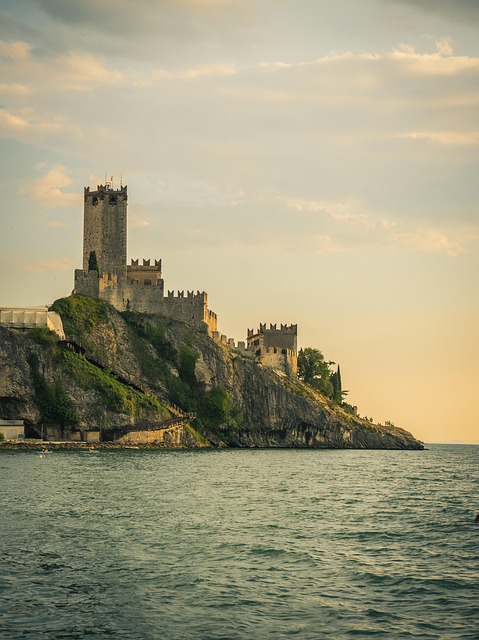
Photo by Leonhard_Niederwimmer
Modern era and cultural significance
Since 1902, Malcesine Castle has been recognized as a national monument of Italy. It is currently owned by the municipality of Malcesine and functions as a museum dedicated to the natural history of Lake Garda and the nearby Monte Baldo mountain range. The museum offers visitors insights into the region's geological, botanical, and zoological heritage, enriching the cultural experience of the castle beyond its architectural and historical importance.
The castle grounds also host an open-air theater, sheltered by white tents adjacent to the structure, which serves as a venue for cultural events and performances, further integrating the castle into the community's cultural life.
Visitor experience and accessibility
Visitors to Malcesine Castle can explore its well-preserved medieval fortifications, climb the high tower for panoramic views of the lake and mountains, and tour the museum's exhibits. The castle is open to the public for a modest entrance fee, with visiting hours typically accommodating tourists during the warmer months. Its location in the picturesque town of Malcesine, with its charming streets and lakeside promenade, makes it a popular destination for history enthusiasts and travelers seeking to experience the rich heritage of northern Italy.
The castle's dramatic setting on a rocky outcrop overlooking the lake, combined with its layered history from Lombard origins through Scaliger dominance, Venetian and Austrian military use, to its current role as a cultural monument, makes Malcesine Castle a fascinating example of the evolution of medieval fortifications in Italy.
Archaeological and historical findings
Within the castle walls, remnants of an Etruscan tomb have been discovered, indicating the site's long-standing strategic and cultural importance predating the medieval period. This archaeological evidence enriches the narrative of the castle, linking it to ancient civilizations that once inhabited the region.
The castle's continuous adaptation over more than a millennium reflects the shifting political and military landscape of northern Italy, from Lombard and Frankish control through the rise and fall of regional powers like the Scaligers and Visconti, to the dominance of Venice and Austria.
Frequently asked questions (FAQ)
- What is the historical significance of Malcesine Castle?
- Malcesine Castle, dating back to the 10th century, played a crucial role in the defense of Lake Garda. It has witnessed various historical events, including the struggles between the Scaliger family and the Venetians, making it an important symbol of the region's medieval heritage.
- When was Malcesine Castle built?
- The construction of Malcesine Castle began in the 10th century, with significant renovations occurring over the centuries. Its strategic location and architectural features reflect the evolution of military architecture in the region.
- What are the opening hours for Malcesine Castle?
- Malcesine Castle is generally open to visitors year-round, with varying hours depending on the season. Typically, it opens at 9:00 AM and closes at 7:00 PM from April to October, while winter hours may vary, so it's best to check the official website before visiting.
- Can I access Malcesine Castle with limited mobility?
- Malcesine Castle has certain accessibility features; however, due to its historical architecture and terrain, some areas may be challenging for visitors with limited mobility. It's advisable to contact the castle staff in advance to inquire about specific accommodations.
- What are the ticket prices for Malcesine Castle?
- The ticket prices for Malcesine Castle are quite reasonable, with discounts available for students and seniors. As of the latest information, general admission is approximately €6, while reduced tickets cost around €4.
- When is the best time to visit Malcesine Castle?
- The best time to visit Malcesine Castle is during the spring and fall months when the weather is mild and tourist crowds are smaller. Visiting during these times allows you to enjoy the stunning views of Lake Garda and the surrounding mountains without the peak season rush.
- Are there any nearby attractions to Malcesine Castle?
- Yes, Malcesine Castle is close to several attractions, including the beautiful shores of Lake Garda and the Monte Baldo cable car. Visitors can enjoy hiking, water sports, and exploring the charming town of Malcesine, making it an ideal location for a full day of sightseeing.
Photo gallery

Photo by 6742595


Information
Address
Via Castello, Italy
Loading map...
Visitor reviews
No reviews yet. Been here? Write the first review and help other travelers!
Write the first reviewVisited this castle? Share your experience
Your review helps other travelers and adds first-hand knowledge to our encyclopedia.