Avio Castle
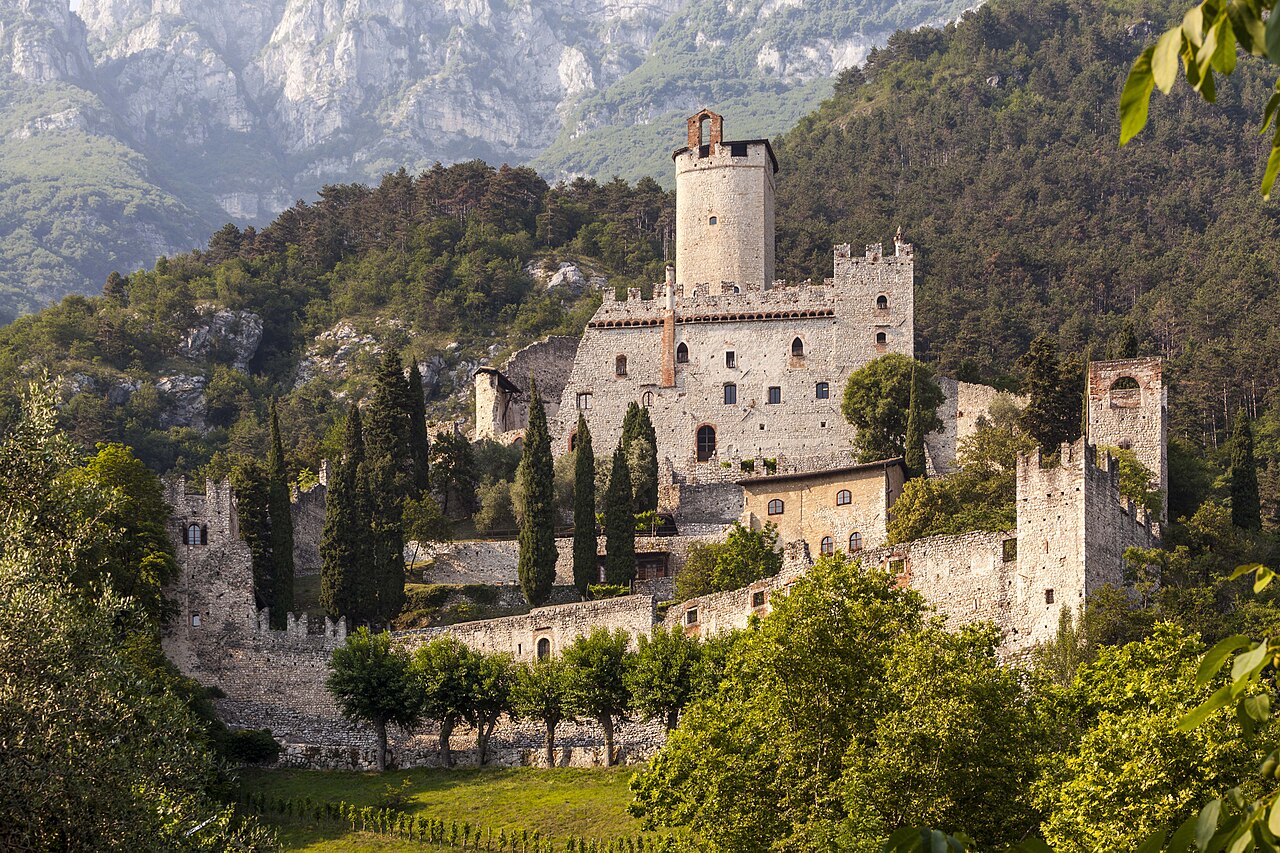
Avio Castle, also known as the Castle of Sabbionara, is a striking medieval fortress perched atop a rocky outcrop overlooking the village of Sabbionara and the scenic Vallagarina valley traversed by the Adige River in northern Italy. This imposing structure commands a strategic position, dominating the surrounding landscape with its robust defensive architecture and historical significance dating back to the 11th century.
First documented in 1053 as Castellum Ava, the castle has witnessed centuries of regional power struggles and architectural evolution. Initially owned by the Castelbarco family in the 12th century, it was ceded to the Republic of Venice in 1411, who undertook significant expansions including the addition of a chapel dedicated to St. George and a façade adorned with the doges' coats of arms. In 1509, the fortress fell to the forces of Maximilian I of Austria, who emblazoned his insignia on the castle and granted it to the counts of Arco. The castle changed hands several times before the Castelbarco family reacquired it in the 17th century.
The strategic location and architectural layout
Avio Castle's position on a rocky outcrop provides a commanding view of the Vallagarina valley, a vital corridor along the Adige River. Its elevated site was crucial for controlling trade routes and military movements in the region. The castle features a complex defensive system comprising three concentric lines of walls fortified with five towers, including the notable Torre della Picadora, historically used for executions by hanging.
The entrance is marked by a door-tower crowned with dovetail battlements, a typical medieval defensive feature designed to protect against invaders. Adjacent to the eastern walls rises the bulk of the Picadora tower, named after its grim function. Within the castle's extensive perimeter, the House of Guards stands near the steep slopes, while the imposing Baronial Palace constructed of gray stone occupies the central area, alongside the massive keep (mastio) which served as the last line of defense and the lord's residence.
Architectural features and defensive elements
The castle's fortifications reflect the military architecture of the high medieval period, with layered walls designed to withstand sieges and assaults. The three lines of walls allowed defenders to retreat inward if outer defenses were breached. The battlements feature dovetail merlons, a distinctive style providing cover for archers and soldiers while allowing them to fire upon attackers.
The five towers distributed along the walls served multiple purposes: observation posts, defensive strongholds, and places of imprisonment or execution. The Torre della Picadora stands out not only for its military function but also for its role in administering justice, where condemned prisoners were hanged on its terrace.
Interior spaces and artistic heritage
Inside, the castle houses a variety of buildings clustered around the mastio, including the Baronial Palace which was the residential and administrative heart of the fortress. The rooms are notable for their rich decoration, particularly the series of frescoes painted during two distinct campaigns in the 14th century.
Chamber of love frescoes
The earliest fresco cycle, dating to around 1330, adorns the so-called Chamber of Love. This room features an intricate painted brocade or curtain through which scenes of courtly love are depicted. The imagery includes Cupid mounted on horseback, pursuing a lover and shooting arrows, followed by scenes of intimacy with a young woman. The style and iconography suggest the work of an anonymous workshop that had previously contributed to the decoration of the Dominican Church in Bolzano.
Later frescoes of battles
A subsequent cycle, painted around 1350, presents less elaborate but thematically significant battle scenes. These frescoes reflect the martial character of the castle and its role in the turbulent political landscape of medieval northern Italy.
Historical significance and ownership transitions
Avio Castle's history mirrors the shifting political dynamics of the region. Its initial establishment in the 11th century marks it as a key defensive and administrative center during the high medieval period. Ownership by the Castelbarco family established it as a noble seat, while its transfer to the Republic of Venice in the early 15th century coincided with Venice's expansionist ambitions in the Alps.
The Venetian enhancements, including the chapel of St. George and heraldic decorations, demonstrate the castle's integration into the Venetian state apparatus. The conquest by Maximilian I and subsequent grant to the counts of Arco reflect the Habsburg influence in the region, which continued to shape the castle's fate for centuries.
Preservation and current status
Today, Avio Castle is well preserved and stands as a testament to medieval military architecture and noble residence in the Trentino-Alto Adige region. Its extensive walls, towers, and interior frescoes attract visitors interested in history, art, and architecture. The castle offers a vivid glimpse into the medieval past of northern Italy and remains a cultural landmark within the Vallagarina valley.
Visitors can explore the castle's defensive structures, admire the frescoed chambers, and appreciate the panoramic views of the surrounding landscape. The castle's combination of military might and artistic refinement makes it a unique site for understanding the complexities of medieval life and governance.
Frequently asked questions (FAQ)
- How do I get to Avio Castle?
- Avio Castle is located in the town of Avio, Italy, easily accessible by car or public transport. If you are traveling by train, the nearest station is in Rovereto, from where you can take a bus or taxi to reach the castle.
- What is the historical significance of Avio Castle?
- Avio Castle dates back to the 12th century and played an important role in the defense of the region. It has been a witness to many historical events, including conflicts between various noble families and the expansion of the Venetian Republic.
- When was Avio Castle built?
- The construction of Avio Castle began in the 12th century, with various modifications and expansions added over the centuries. Its strategic location on a hilltop was chosen to provide an advantageous view of the surrounding valley.
- Can I take guided tours of Avio Castle?
- Yes, guided tours are available for visitors who wish to learn more about the castle's history and architecture. These tours often provide in-depth insights and fascinating stories that enhance the visitor experience.
- Is Avio Castle accessible for visitors with disabilities?
- Avio Castle has made efforts to improve accessibility for all visitors. However, due to its historic nature and uneven terrain, some areas may still pose challenges for those with mobility issues.
- What are the opening hours for Avio Castle?
- Avio Castle is typically open to visitors from March to November, with varying hours depending on the season. It is advisable to check the official website for the most current opening times before planning your visit.
- What is the best time to visit Avio Castle?
- The best time to visit Avio Castle is during the spring and early autumn months when the weather is mild and pleasant. This allows for an enjoyable exploration of the castle and its surrounding landscapes.
- Are there any nearby attractions to visit after Avio Castle?
- Yes, nearby attractions include the beautiful vineyards of the Adige Valley and the historical town of Rovereto. You can also explore natural parks and hiking trails that offer stunning views of the region.
- What are the ticket prices for Avio Castle?
- Ticket prices for Avio Castle vary based on age and group size, with discounts available for children and seniors. It’s best to check the official website for the latest pricing information before your visit.
Information
Loading map...
Visitor reviews
No reviews yet. Been here? Write the first review and help other travelers!
Write the first reviewVisited this castle? Share your experience
Your review helps other travelers and adds first-hand knowledge to our encyclopedia.