Castle of Avio
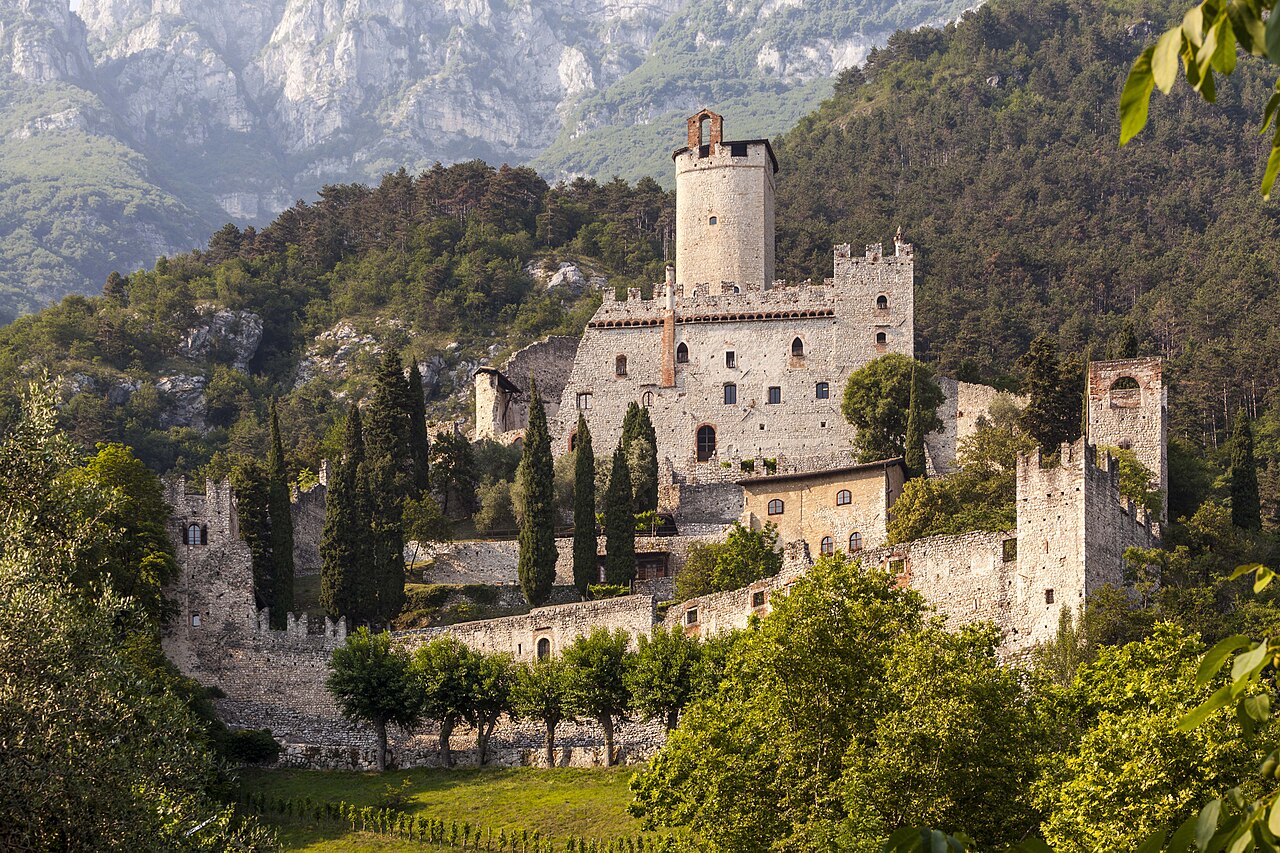
The Castle of Avio stands as a remarkable example of high medieval military architecture in northern Italy, commanding the strategic Vallagarina valley along the Adige River. Perched on a hill in Sabbionara d’Avio, this hill castle boasts a commanding position that historically controlled vital trade and military routes connecting the Mediterranean basin to northern Europe via the ancient Via Claudia Augusta, constructed in 15 BCE. The castle's prominent location and robust fortifications reflect its importance as a feudal stronghold and a key defensive bastion throughout the Middle Ages and Renaissance.
First documented in 1053 as Castellum Ava, the castle's origins trace back to the early medieval period, with its core structures dating from the 11th century. Over the centuries, the castle evolved under various rulers, including the influential Castelbarco family, the Republic of Venice, and the Habsburg Empire. Each phase of ownership left distinct architectural and artistic marks, making the Castle of Avio a palimpsest of northern Italian medieval and Renaissance history.
Architectural layout and defensive features
The castle is renowned for its three concentric defensive walls arranged in a crown-like pattern, enclosing an irregularly shaped complex that follows the natural contours of the hill. These walls are punctuated by five towers, including the infamous Torre della Picadora, historically used for executions by hanging, underscoring the castle's role in feudal justice and authority.
At the heart of the fortress lies the trapezoidal mastio or keep, a distinctive feature dating from the 11th century. This keep is notable for its unusual shape, combining two parallel straight sides with three curved sides of varying lengths. Rising four floors high, the mastio is accessed today via a modern wooden staircase. Its illumination is provided mainly by three windows on the main façade, while the top floor houses the famous "Camera d’Amore" (Chamber of Love), a vaulted, roughly circular room pierced by five small slanted windows, which served both defensive and residential functions.
Surrounding the mastio are several ancillary buildings, including the Guardhouse, the Baronial Palace, and the chapel. These structures contribute to the castle's complex layout and reflect the multifunctional nature of the site as a military, residential, and religious center.
Frescoes and artistic heritage
The Castle of Avio is particularly celebrated for its rich collection of medieval frescoes, painted in two major artistic campaigns during the 14th century. The first campaign, circa 1330, is attributed to an artist or workshop also active in the Dominican Church of Bolzano. These frescoes adorn the Chamber of Love and depict allegories of love alongside scenes of daily life, rendered in pastel colors and highlighted with prominent white bands. This artistic program reflects the cultural milieu of the time and the castle's role as a noble residence.
The second campaign, executed two to three decades later by a local Trentino master influenced by both Veronese and northern European styles, decorates the Guardhouse with vivid battle scenes illustrating the knightly military arts. These frescoes provide valuable insight into the martial culture and chivalric ideals of the late medieval period in this region.
Advanced restoration techniques, including ultraviolet examination, have revealed preparatory drawings beneath the frescoes, offering a rare glimpse into the artistic process of the time. Despite damage from neglect, vandalism, and environmental exposure, many frescoes remain visible, although the vaulted ceiling of the Chamber of Love has suffered significant deterioration.
Historical context and ownership
The castle's history is deeply intertwined with the political and military struggles of the Vallagarina valley. Initially controlled by the Castelbarco family in the 12th century, who were vassals to the Bishop of Trento, the fortress served as a feudal power center under ecclesiastical influence. In 1411, the castle passed to the Republic of Venice, which enhanced its defenses and added a chapel dedicated to either St. Michael or St. George, according to varying sources. Venetian rule is also marked by the addition of dogal coats of arms on the façade, symbolizing the Republic's authority in the region.
Following Venice’s defeat at the Battle of Agnadello in 1509, the castle was seized by imperial forces led by Maximilian I of Austria. Maximilian left his heraldic insignia on the fortress and mortgaged it to the Counts of Arco. Throughout the 16th and 17th centuries, the castle changed hands multiple times before the Castelbarco family reclaimed it in the 17th century, restoring their ancestral seat and preserving its medieval character.
Modern preservation and cultural significance
In 1977, Emanuela Castelbarco Pindemonte Rezzonico, a descendant of the original family and Duchess of Acquarone, donated the castle to the Fondo Ambiente Italiano (FAI). This generous act ensured the castle's preservation and opened it to the public, allowing visitors to explore its rich historical and artistic heritage.
Today, the castle is carefully maintained, with restoration efforts focused on preserving its medieval architecture and the fragile frescoes. The main entrance to the mastio features an arched doorway accessed by a staircase likely added around 1957, blending modern interventions with historical fabric.
Recognizing its cultural importance, the Italian postal service issued an 80-lira stamp in 1981 as part of the "Castelli d’Italia" series, commemorating the Castle of Avio and celebrating its status as a symbol of Italian medieval heritage.
Visitor information and experience
Visitors to the Castle of Avio can explore the extensive defensive walls, the towers including the Torre della Picadora, and the richly frescoed interiors of the mastio and surrounding buildings. The castle offers a unique glimpse into the military, residential, and artistic life of northern Italy's medieval nobility. The frescoes, especially those in the Chamber of Love and the Guardhouse, are highlights of the visit, showcasing rare medieval iconography and artistic techniques.
The castle's hilltop location provides panoramic views of the Vallagarina valley and the Adige River, enhancing the visitor experience with scenic landscapes that complement the historical atmosphere.
Frequently asked questions (FAQ)
- How do I get to the Castle of Avio?
- The Castle of Avio is located in Avio, Italy, and is easily accessible by car or public transport. If you're driving, you can find parking nearby. For those taking public transport, the nearest train station is approximately 3 km away, and local buses can take you closer to the castle.
- What is the historical significance of the Castle of Avio?
- The Castle of Avio dates back to the 11th century and played a strategic role in controlling trade routes in the region. It has a rich history involving noble families and has been well-preserved, showcasing architectural styles from different periods. The castle is a testament to the feudal power and military architecture of medieval Italy.
- When was the Castle of Avio built?
- Construction of the Castle of Avio began in the early 11th century, with significant modifications and expansions occurring over the centuries. Its unique architecture reflects the evolution of defensive structures in Italy throughout the Middle Ages. The castle remains one of the most important examples of medieval military architecture in the area.
- Can I take guided tours of the Castle of Avio?
- Yes, guided tours are available at the Castle of Avio, providing visitors with in-depth knowledge about its history and architecture. Tours are conducted in multiple languages and typically last around an hour. It's recommended to book in advance, especially during peak tourist seasons.
- Why is the Castle of Avio a popular tourist destination?
- The Castle of Avio attracts visitors due to its stunning views of the surrounding landscape, rich history, and well-preserved architecture. It offers a unique glimpse into medieval life and the strategic importance of castles in Italy. Additionally, the castle's picturesque setting makes it a popular spot for photography and exploration.
- Is it possible to explore the castle grounds on my own?
- Yes, visitors can explore the castle grounds independently during opening hours. Informational panels are placed throughout the site to guide you through the various historical features. However, for a more comprehensive understanding, a guided tour is highly recommended.
- What are the opening hours for the Castle of Avio?
- The Castle of Avio is typically open to visitors from March to November, with specific hours depending on the day of the week. During peak season, it may have extended hours, while winter months might have limited accessibility. Always check the official website for the most accurate and up-to-date information.
- What are the ticket prices for visiting the Castle of Avio?
- Ticket prices for the Castle of Avio vary depending on age and whether you're taking a guided tour. Generally, adult tickets are around €8, with discounts available for students and seniors. Children under a certain age can enter for free, making it an affordable destination for families.
- What is the best time to visit the Castle of Avio?
- The best time to visit the Castle of Avio is during the spring and fall when the weather is mild and the crowds are smaller. Summer can be quite hot, and winter may restrict access due to weather conditions. Visiting during the shoulder seasons allows you to enjoy the castle's beauty with fewer tourists around.
- Are there nearby attractions to visit when at the Castle of Avio?
- Yes, there are several nearby attractions, including the charming town of Avio itself, which offers scenic views and local eateries. Additionally, you can explore the surrounding vineyards and enjoy wine tasting experiences. The region is rich in history, with other castles and historical sites located within a short drive.
Information
Website
Visit websiteSources & official resources
Verify the information above using these authoritative references.
Loading map...
Visitor reviews
No reviews yet. Been here? Write the first review and help other travelers!
Write the first reviewVisited this castle? Share your experience
Your review helps other travelers and adds first-hand knowledge to our encyclopedia.