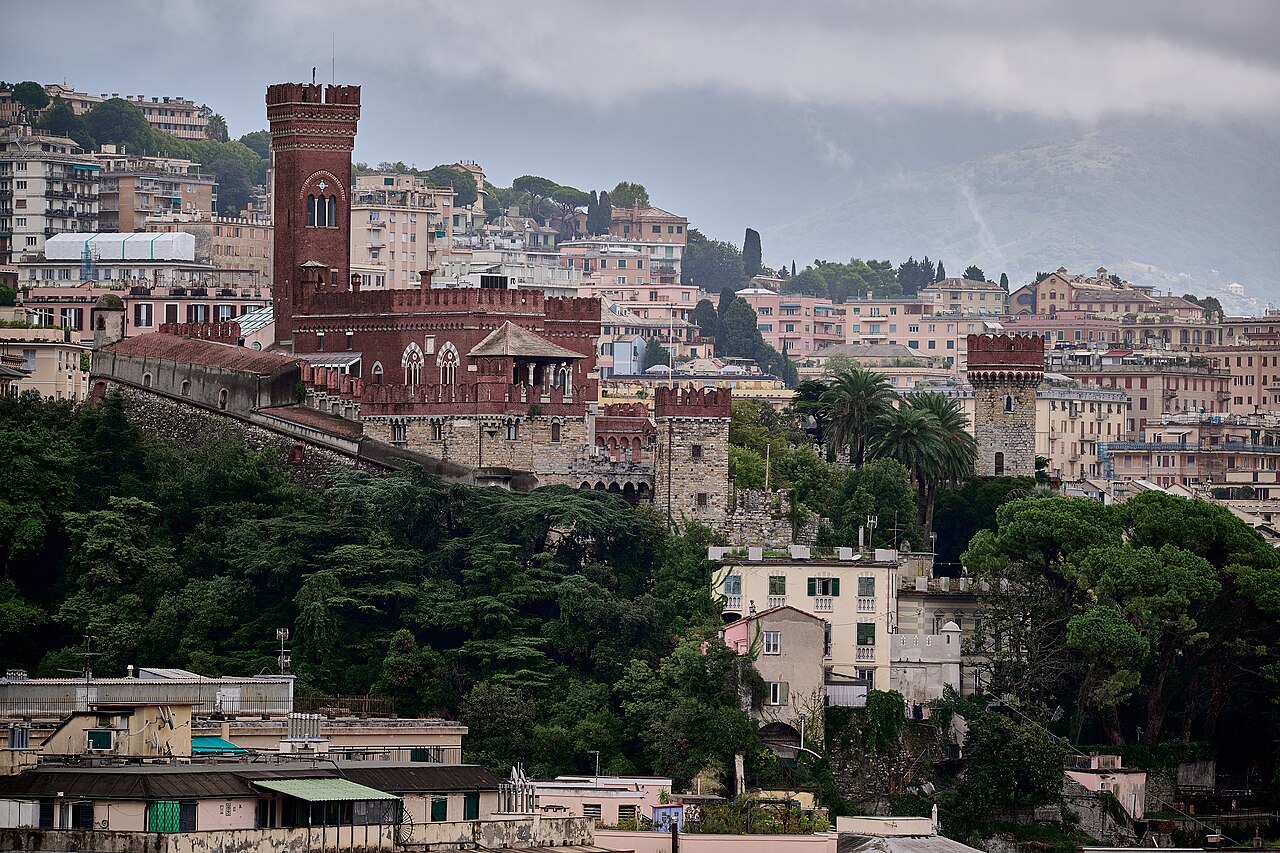
Mackenzie Castle

Mackenzie castle in genoa, italy
Genoa, Liguria, Italy
Modern (19th–20th c.)
Restored

Mackenzie Castle stands as a striking example of Gothic Revival architecture in the Castelletto quarter of Genoa, Italy. Constructed between 1893 and 1905, this historic manor was designed by the renowned Art Nouveau architect Gino Coppedè under the commission of Evan Mackenzie, a Scottish insurance broker. The castle was built upon a pre-existing country villa, itself situated on the site of the 16th-century Genoese walls, connecting the building to the city's rich historical fabric.

The castle’s design reflects the eclectic tastes of the late 19th-century, combining the romanticism of the Gothic Revival style with the decorative flourishes characteristic of Art Nouveau. Mackenzie was a very involved client, influencing many aspects of the castle’s form and interior during the lengthy construction period. The interior is notable for its extensive woodwork, much of which was crafted by a firm owned by Coppedè’s family, showcasing exquisite artisanal craftsmanship.

Architectural features and style

Mackenzie Castle is renowned for its richly detailed Gothic Revival elements, which include pointed arches, ornate windows, battlements, and decorative stonework. The castle’s silhouette is marked by a variety of towers and turrets, contributing to its fairy-tale appearance that contrasts with the urban setting of Genoa. The integration of Art Nouveau motifs adds a unique layer of artistic complexity, blending historicism with contemporary trends of the late 19th century.

The castle’s layout reflects the adaptation of a traditional manor house into a more elaborate and stylistically ambitious residence. The use of local stone and detailed masonry work ties the building to the Ligurian architectural tradition, while the interiors reveal a sophisticated approach to space and decoration.

Historical context and ownership

The castle was commissioned by Evan Mackenzie, a Scottish businessman who settled in Genoa and became a prominent figure in the local insurance industry. His hands-on approach to the design process resulted in a personalized residence that served as the family home for 26 years. After Mackenzie’s death, the property was sold by his daughter, marking the end of the family’s direct association with the castle.

During World War II, the castle’s strategic location and imposing structure led to its occupation by both German and Allied forces. Following the war, the building was used by the Italian Carabinieri until the 1970s. Its military use left the castle in need of significant restoration by the late 20th century.

Restoration and modern use

Declared a national monument in 1956, Mackenzie Castle experienced various phases of neglect and restoration. In 1986, it was partially restored and converted into a private museum, though the restoration was never fully completed. In 2002, the castle was acquired by the Cambi Auction House, which commissioned architect Gianfranco Franchini to complete the restoration works.

Since its reopening to the public in 2004, the castle has been repurposed as a venue for scientific and cultural exhibitions, contributing to Genoa’s cultural life. The castle’s preservation and adaptive reuse highlight the importance of maintaining historical architecture while providing contemporary public value.

Significance and cultural heritage

Mackenzie Castle is a rare example of late 19th-century Gothic Revival architecture in Italy, distinguished by its combination of historical styles and innovative Art Nouveau details. It embodies the cultural exchange between northern European architectural trends and Italian craftsmanship. The castle’s layered history—from a private residence to a military post, and now a public cultural space—reflects the dynamic history of Genoa itself.

Today, it stands as a testament to the artistic vision of Gino Coppedè and the personal legacy of Evan Mackenzie, offering visitors a glimpse into the architectural and social history of late 19th and early 20th-century Genoa.

Frequently asked questions (FAQ)

What is the historical significance of Mackenzie Castle?
Mackenzie Castle has a rich history that dates back to the medieval period, serving as a strategic fortress during various conflicts. Its architecture reflects the blend of military and residential styles, showcasing the evolution of design throughout the centuries. Today, it stands as a symbol of Genoa's heritage and attracts history enthusiasts from around the world.
When was Mackenzie Castle built?
Mackenzie Castle was constructed in the late 12th century, originally serving as a defensive stronghold. Over the years, it underwent several renovations and expansions, adapting to the changing needs of its inhabitants and the times. Its historical layers provide insight into the architectural trends from the medieval era to the Renaissance.
Can I visit Mackenzie Castle year-round?
Yes, Mackenzie Castle is open to visitors year-round, although hours may vary with the seasons. It’s advisable to check the official website for any special events or closures that may affect visiting times. This ensures you have the best experience during your visit to the castle.
What are the opening hours for Mackenzie Castle?
Mackenzie Castle typically opens at 9 AM and closes at 7 PM, with extended hours during the summer months. On certain holidays, the castle may have adjusted hours, so it’s best to verify before your visit. Arriving early can help you avoid crowds and fully enjoy the historical site.
Is Mackenzie Castle accessible for visitors with mobility challenges?
Yes, Mackenzie Castle is committed to being accessible to all visitors, including those with mobility challenges. The site features ramps and designated pathways to facilitate easier navigation throughout the grounds. However, some areas may present challenges due to the castle's historical structure, so it's recommended to inquire about specific accommodations ahead of your visit.
What is the best time to visit Mackenzie Castle?
The best time to visit Mackenzie Castle is during the spring and early fall when the weather is mild, and the surrounding gardens are in full bloom. These seasons also tend to attract fewer tourists, allowing for a more peaceful experience. Additionally, special events and exhibitions may be held during these times, enhancing your visit.
Are there any nearby attractions to visit while in Genoa?
Absolutely! While in Genoa, you can explore the stunning Palazzi dei Rolli, a UNESCO World Heritage site, and the picturesque Genoa Aquarium. The historic old town is also a short walk away, filled with charming streets, shops, and restaurants. Combining these attractions with your visit to Mackenzie Castle makes for a delightful day in the city.
What are the ticket prices for Mackenzie Castle?
Ticket prices for Mackenzie Castle are generally affordable, with discounts available for children, students, and seniors. Adults typically pay around €10, while reduced tickets can be purchased for approximately €5. It's best to check the official website for current prices and any special offers that may be available during your visit.

Information

Hill Castle

Sources & official resources

Verify the information above using these authoritative references.

Loading map...

Visitor reviews

No reviews yet. Been here? Write the first review and help other travelers!

Write the first review

Visited this castle? Share your experience

Your review helps other travelers and adds first-hand knowledge to our encyclopedia.

Write a review

(5/5)

0/2000 characters

Your review will be visible after admin approval

Nearby castles

1.2 km

Castello Bruzzo

Genoa, Italy

Castello Bruzzo stands as a remarkable example of early 20th-century villa architecture in the hills overlooking Genoa, Italy. Originally commissioned by engineer Pietro Micheli and designed by the renowned architect Gino Coppedè, the villa embodies a distinctive blend of historicist and eclectic styles inspired by medieval castles. Built in 1904 and initially named Villa Micheli, the residence reflects the architectural ambitions of Genoa's affluent elite during a period of rapid urban and cultural development. The villa's design draws heavily from Castello Mackenzie, another of Coppedè's celebrated projects, showcasing the architect's signature approach to combining romantic medieval motifs with modern construction techniques. The location in the panoramic hills was favored for its commanding views and prestige, attracting a cluster of similarly grand villas such as Villino Govi and Villino Flavia, constructed in the early 1900s. Architectural design and construction The core of Castello Bruzzo is a central block shaped evocatively like a castle, featuring a prominent tall tower topped with a pavilion roof. This tower serves as a focal point, enhancing the villa's silhouette against the hillside. The structure extends through adjoining wings, expanding the footprint while maintaining a cohesive style. The exterior combines gray ashlar stone blocks with brick inserts, creating a textured and visually striking façade. Decorative elements include marble reliefs and intricate wrought iron details such as torch holders, rings, and flag supports, which enrich the villa's medieval-inspired aesthetic. Interior decoration and artistic features The southern side of the villa features a vaulted loggia adorned with frescoes representing the twelve zodiac signs, each framed by stylized floral motifs. This open yet sheltered space exemplifies the thoughtful integration of art and architecture characteristic of the villa. Inside, the central hall is dominated by a grand stone fireplace inscribed with the Latin phrase "optima pandens" meaning "that shows excellent things." Above the fireplace, a roundel depicts Saint George slaying the dragon, symbolizing valor and protection. The hall's walls are richly decorated with frescoes featuring ribbons, trophies, branches, and grotesque figures, creating a dynamic and ornamental environment. Large stained-glass windows set in carved wooden frames illuminate the hall and connect it to an upper gallery. The coffered wooden ceiling is divided into recessed panels separated by carved beams adorned with gilded circular ornaments called paterae. Frescoes on the ceiling illustrate putti holding festoons and scrolls, with a central panel portraying the Triumph of Industry and Commerce, painted by Luigi Morgari. A bronze chandelier adds to the hall's opulent atmosphere. Notable interior rooms The room of musicians and dances, originally a game room, features a wooden coffered ceiling and frescoes by Enrico Bernardi depicting elegant scenes of musicians and maidens framed by floral and ribbon motifs. This space reflects the villa's role as a cultural and social hub. The room of stylized roses, once used as a library, is distinguished by walls painted with recurring rose motifs on a blue background above green wainscoting. It includes a large pink granite fireplace and a richly decorated ceiling composed of wooden beams and narrow panels in multiple colors. The frescoes in this room feature branches and fruits arranged in a lattice pattern on a dark red background, centered by a stylized griffin. A frieze between ceiling and walls displays garlands, foliage festoons, stylized grids symbolizing the instrument of Saint Lawrence's martyrdom, and roundels inscribed with Latin mottos such as "ferreo labore" ("by iron work") and "ex igni resurgo" ("I rise from the fire"). These elements reflect the symbolic themes chosen by the villa's owners and designers, emphasizing resilience and craftsmanship. Historical context and ownership Constructed during a period of architectural flourishing in Genoa's hillside districts, Castello Bruzzo was initially commissioned by engineer Pietro Micheli, with design collaboration from engineer Giuseppe Predasso. In 1912, the villa was acquired by Lorenzo Bruzzo, who expanded the structure by adding an extra floor, further enhancing its imposing presence. The villa's architectural significance was recognized early, as it was featured in a 1914 publication by Gino Coppedè, highlighting its importance within Genoa's architectural heritage. The design embodies the eclectic and romantic tastes of the time, combining medieval imagery with modern luxury. Artistic and cultural significance Castello Bruzzo exemplifies the early 20th-century trend among Genoa's wealthy residents to build grand villas with castle-like features, blending historicism with modern comfort. Its rich decorative program, including frescoes by prominent artists like Luigi Morgari and Enrico Bernardi, contributes to its unique artistic character. The villa's symbolic frescoes and architectural details reflect themes of protection, industry, resilience, and cultural refinement. The presence of motifs such as Saint George and references to Saint Lawrence's martyrdom connect the villa to broader cultural and religious narratives. Preservation and current status Today, Castello Bruzzo remains a well-preserved example of early 20th-century villa architecture in Genoa. Its combination of castle-like form, rich fresco decoration, and historicist style make it a significant cultural landmark in the region. The villa's architectural and artistic features continue to attract interest from historians, architects, and visitors, offering insight into the cultural and social history of Genoa's hillside elite during a transformative era. Its preservation allows for ongoing appreciation of Gino Coppedè's architectural legacy and the artistic collaborations that defined this unique residence.

Post-Renaissance (17th–18th c.)
Details
1.4 km
Albertis Castle — Italy castle

Albertis Castle

Genoa, Italy

Albertis Castle, also known as Castello d'Albertis, is a remarkable historical residence located on Montegalletto hill in the Castelletto district of Genoa, Italy. This 19th-century hill castle stands as a testament to Genoa’s rich maritime history and architectural evolution, blending medieval fortifications with neo-Gothic revival aesthetics. Originally the home of the sea captain Enrico Alberto d'Albertis, the castle was donated to the city of Genoa upon his death in 1932 and now houses the Museo delle Culture del Mondo (Museum of World Cultures), inaugurated in 2004. Historical background and strategic significance The site of Albertis Castle has a layered history dating back to the 14th century, when it served as a city bastion forming part of Genoa’s extensive defensive system. This bastion was a crucial element in the protection of the city, especially during the 16th century when it was reinforced to adapt to new military technologies. The bastion's strategic importance was underscored in 1747 during the defense of Genoa against Austrian forces, with cannons positioned on the fortifications to repel invaders. Over the centuries, the site witnessed various phases of military use, transitioning from medieval fortifications to Renaissance bastions designed by noted engineers such as Graziani and Francesco Parodi. These layers of construction reflect the evolving military architecture and urban defense strategies employed by Genoa. Construction and architectural design of the castle Between 1886 and 1892, Enrico Alberto d'Albertis undertook a significant transformation of the site, constructing the present-day castle atop the remains of the medieval and Renaissance fortifications. The design was executed with the architectural guidance of Alfredo d’Andrade, a prominent figure in the neo-Gothic revival movement. The castle’s inauguration coincided with the 400th anniversary of Christopher Columbus’s voyage to America, symbolically linking the castle to Genoa’s maritime legacy. The castle's architecture is characterized by a blend of neo-Gothic revival elements, including merlons (notched battlements), poliforas (windows divided into multiple openings), and decorative stonework. These features draw inspiration from medieval Genoese buildings, Valdostan castles, and Florentine palaces, reflecting a romanticized vision of the past. Sculptors Allegro and Marc’Aurelio Crotta contributed artistic details that enhance the castle's aesthetic appeal. One of the castle’s distinctive architectural features is the preservation and display of the underlying medieval and Renaissance masonry. Restoration efforts involved removing earth fill from the original bastion to reveal the stonework and structural elements beneath. A modern glass roofing structure was installed at the bastion’s geometric apex to protect and showcase these historical layers. Interior collections and museum functions Albertis Castle serves as the home to the Museo delle Culture del Mondo, which exhibits the extensive ethnographic and archaeological collections amassed by Enrico Alberto d'Albertis and his cousin Luigi Maria d’Albertis. These collections include a diverse array of weapons from regions such as Sudan and the Zambezi, European arms like halberds, Chinese spears, and indigenous crafts from the North American plains. The museum also features ship models, nautical instruments, historical photographs, and the personal library of d'Albertis. A dedicated section, the Museo delle Musiche dei Popoli, showcases musical instruments from cultures worldwide, highlighting the global scope of the collections and the castle’s role as a cultural hub. Restoration and preservation efforts After a period of semi-abandonment in the 1970s, Albertis Castle underwent significant restoration to make it accessible to the public and suitable for exhibitions. These efforts focused on uncovering and preserving the historical masonry, enhancing the visibility of the castle’s multiple architectural layers, and integrating modern protective elements like the glass roofing over the bastion. The restoration also aimed to maintain the castle’s well-preserved condition, balancing the preservation of original structures with the needs of a modern museum. The site’s integration into the urban fabric of Genoa is facilitated by its location on Montegalletto hill and connections through public transport and an elevator link to Piazza Acquaverde. Cultural significance and local legends Albertis Castle is not only an architectural and historical landmark but also a cultural symbol of Genoa’s maritime heritage and global connections. The castle’s collections and exhibitions celebrate the city’s historical role in exploration and cultural exchange. Local folklore adds an intriguing dimension to the castle’s history, with stories of a mysteriously opening door and a secret tunnel that allegedly connects the castle to the port. This tunnel is said to have been used by the resistance during World War II, adding a layer of wartime legend to the site’s rich narrative. The castle park and surroundings The castle is surrounded by a park and courtyard that offer scenic views over Genoa and the surrounding landscape. The green spaces enhance the visitor experience, providing a tranquil setting that contrasts with the castle’s robust defensive origins. The park is accessible from the city center, making Albertis Castle a popular destination for both tourists and locals interested in history, architecture, and culture.

Modern (19th–20th c.)
Details
1.8 km

Santa Maria di Castello

Genoa, Italy

Santa Maria di Castello is a prominent Romanesque church and religious complex located on the Castello hill in Genoa, Italy. This site occupies the historic location of a bishop's fortified castle dating back to the Early Medieval period. The church itself was constructed before the 9th century AD, making it one of the oldest religious structures in the city. It is closely associated with the medieval history of Genoa and retains significant architectural and artistic features from various centuries.Historical background and architectural contextThe church stands on a strategic elevated position on Castello hill, which was historically fortified to protect the city. The presence of a bishop's castle during the Middle Ages highlights the site's importance as both a religious and defensive stronghold. The church's Romanesque style is evident in its robust construction and characteristic architectural elements, which reflect the style prevalent in Liguria during the early medieval era.Adjacent to the church is the imposing Tower of the Embriaci, a medieval tower that further emphasizes the fortified nature of the complex. This tower is a notable example of Genoese medieval military architecture and forms part of the castle's defensive system.Artistic treasures and interior featuresSanta Maria di Castello houses an extensive collection of artworks commissioned by Genoa's leading noble families, showcasing the city's rich artistic heritage. The interior contains paintings and sculptures by renowned artists such as Francesco Maria Schiaffino, Lorenzo Fasolo, Alessandro Gherardini, Giuseppe Palmieri, Francesco Boccaccino, Pier Francesco Sacchi, Bernardo Castello, Aurelio Lomi, and Tommaso Orsolino.One of the church's highlights is the series of frescoes depicting the Stories of David, which are significant examples of religious narrative art. Additionally, the church features painted majolicas from the 16th-century Genoese school, illustrating the local artistic traditions of that period.Notable chapels and artworksThe high altar is adorned with a marble group titled Assumption by Domenico Parodi, dating from the late 17th century. The chapel to the left of the presbytery contains a Santa Rosa da Lima painting by Domenico Piola and a marble cover crafted by Taddeo Carlone.In the left aisle, the fourth chapel houses a Madonna del Rosario attributed to the workshop of Anton Maria Maragliano, noted for his work in sculpture and polychrome wood. The first chapel features a painting attributed to Giovanni Battista Paggi, an important early 17th-century Genoese painter.The baptistery contains a polyptych created by Lombard masters in the 15th century, reflecting the influence of northern Italian art traditions on Genoa.Architectural elements and decorative detailsThe church's main portal is designed in the Tuscan style and dates to the mid-15th century. Above this portal is a Gothic lunette from the 14th century featuring a depiction of the Crucifixion, which blends Gothic artistic elements with the Romanesque structure.The loggia facing the second cloister is decorated with frescoes of saints and a Madonna, while the first floor contains an Annunciation by Giusto d'Alemagna painted in 1451. This artwork is a valuable example of early Renaissance painting in Genoa.On the upper floor, visitors can find a statue of St. Catherine of Alexandria and a marble tabernacle attributed to Domenico Gagini, a notable 15th-century sculptor. These elements contribute to the church's rich decorative program spanning multiple artistic periods.Significance and preservationSanta Maria di Castello remains a well-preserved example of a Romanesque religious complex that integrates elements from medieval fortification and Renaissance art. Its location on Castello hill and the surviving Tower of the Embriaci provide insight into the defensive strategies of medieval Genoa.The church continues to be an important cultural and historical site, attracting visitors interested in architecture, medieval history, and religious art. The combination of early medieval origins with later artistic additions makes it a unique monument reflecting Genoa's evolving heritage.

Early Medieval (5th–10th c.)
Details