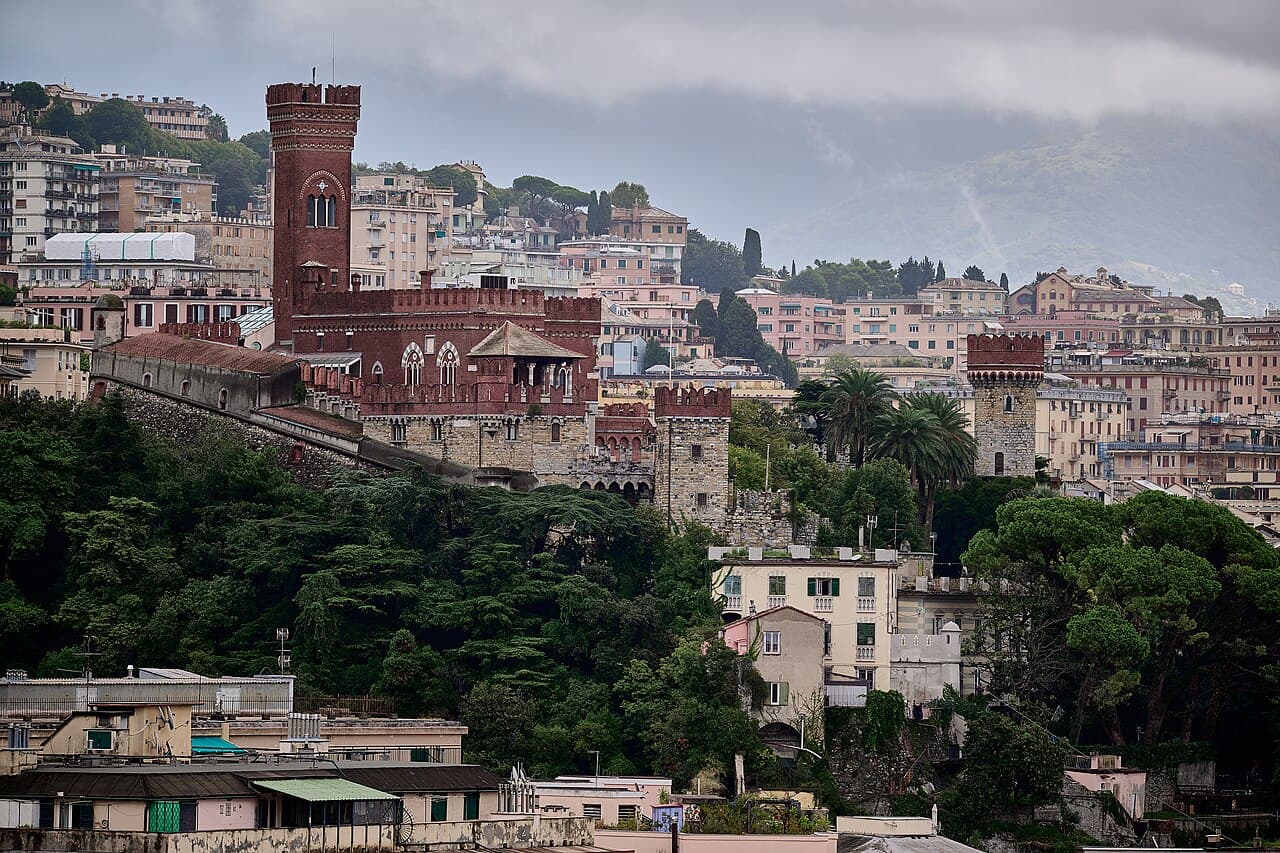
Albertis Castle
Albertis Castle, also known as Castello d'Albertis, is a remarkable historical residence located on Montegalletto hill in the Castelletto district of Genoa, Italy. This 19th-century hill castle stands as a testament to Genoa’s rich maritime history and architectural evolution, blending medieval fortifications with neo-Gothic revival aesthetics. Originally the home of the sea captain Enrico Alberto d'Albertis, the castle was donated to the city of Genoa upon his death in 1932 and now houses the Museo delle Culture del Mondo (Museum of World Cultures), inaugurated in 2004.
Historical background and strategic significance
The site of Albertis Castle has a layered history dating back to the 14th century, when it served as a city bastion forming part of Genoa’s extensive defensive system. This bastion was a crucial element in the protection of the city, especially during the 16th century when it was reinforced to adapt to new military technologies. The bastion's strategic importance was underscored in 1747 during the defense of Genoa against Austrian forces, with cannons positioned on the fortifications to repel invaders.
Over the centuries, the site witnessed various phases of military use, transitioning from medieval fortifications to Renaissance bastions designed by noted engineers such as Graziani and Francesco Parodi. These layers of construction reflect the evolving military architecture and urban defense strategies employed by Genoa.
Construction and architectural design of the castle
Between 1886 and 1892, Enrico Alberto d'Albertis undertook a significant transformation of the site, constructing the present-day castle atop the remains of the medieval and Renaissance fortifications. The design was executed with the architectural guidance of Alfredo d’Andrade, a prominent figure in the neo-Gothic revival movement. The castle’s inauguration coincided with the 400th anniversary of Christopher Columbus’s voyage to America, symbolically linking the castle to Genoa’s maritime legacy.
The castle's architecture is characterized by a blend of neo-Gothic revival elements, including merlons (notched battlements), poliforas (windows divided into multiple openings), and decorative stonework. These features draw inspiration from medieval Genoese buildings, Valdostan castles, and Florentine palaces, reflecting a romanticized vision of the past. Sculptors Allegro and Marc’Aurelio Crotta contributed artistic details that enhance the castle's aesthetic appeal.
One of the castle’s distinctive architectural features is the preservation and display of the underlying medieval and Renaissance masonry. Restoration efforts involved removing earth fill from the original bastion to reveal the stonework and structural elements beneath. A modern glass roofing structure was installed at the bastion’s geometric apex to protect and showcase these historical layers.
Interior collections and museum functions
Albertis Castle serves as the home to the Museo delle Culture del Mondo, which exhibits the extensive ethnographic and archaeological collections amassed by Enrico Alberto d'Albertis and his cousin Luigi Maria d’Albertis. These collections include a diverse array of weapons from regions such as Sudan and the Zambezi, European arms like halberds, Chinese spears, and indigenous crafts from the North American plains.
The museum also features ship models, nautical instruments, historical photographs, and the personal library of d'Albertis. A dedicated section, the Museo delle Musiche dei Popoli, showcases musical instruments from cultures worldwide, highlighting the global scope of the collections and the castle’s role as a cultural hub.
Restoration and preservation efforts
After a period of semi-abandonment in the 1970s, Albertis Castle underwent significant restoration to make it accessible to the public and suitable for exhibitions. These efforts focused on uncovering and preserving the historical masonry, enhancing the visibility of the castle’s multiple architectural layers, and integrating modern protective elements like the glass roofing over the bastion.
The restoration also aimed to maintain the castle’s well-preserved condition, balancing the preservation of original structures with the needs of a modern museum. The site’s integration into the urban fabric of Genoa is facilitated by its location on Montegalletto hill and connections through public transport and an elevator link to Piazza Acquaverde.
Cultural significance and local legends
Albertis Castle is not only an architectural and historical landmark but also a cultural symbol of Genoa’s maritime heritage and global connections. The castle’s collections and exhibitions celebrate the city’s historical role in exploration and cultural exchange.
Local folklore adds an intriguing dimension to the castle’s history, with stories of a mysteriously opening door and a secret tunnel that allegedly connects the castle to the port. This tunnel is said to have been used by the resistance during World War II, adding a layer of wartime legend to the site’s rich narrative.
The castle park and surroundings
The castle is surrounded by a park and courtyard that offer scenic views over Genoa and the surrounding landscape. The green spaces enhance the visitor experience, providing a tranquil setting that contrasts with the castle’s robust defensive origins. The park is accessible from the city center, making Albertis Castle a popular destination for both tourists and locals interested in history, architecture, and culture.
Frequently asked questions (FAQ)
- What are the visiting hours of Albertis Castle?
- Albertis Castle is generally open to visitors from 10:00 to 18:00, Tuesday through Sunday. It is advisable to check the official museum website for any seasonal changes or special closures.
- How do I get to Albertis Castle from the city center of Genoa?
- The castle is accessible via public transport, including buses, and there is an elevator connecting Piazza Acquaverde to the castle area, making it convenient to reach from central Genoa.
- What can I expect to see inside the Museo delle Culture del Mondo?
- Inside the museum, visitors can explore extensive ethnographic collections featuring weapons, musical instruments, ship models, and artifacts from Africa, Asia, Europe, and the Americas, showcasing global cultural diversity.
- When was Albertis Castle built and by whom?
- Albertis Castle was built between 1886 and 1892 by sea captain Enrico Alberto d'Albertis, with architectural guidance from Alfredo d’Andrade, incorporating earlier fortification remains.
- Is Albertis Castle wheelchair accessible?
- The castle and its museum strive to accommodate visitors with mobility challenges, with accessible paths and facilities. However, some historical areas may have limited access due to preservation constraints.
Photo gallery

Information
Sources & official resources
Verify the information above using these authoritative references.
Loading map...
Visitor reviews
No reviews yet. Been here? Write the first review and help other travelers!
Write the first reviewVisited this castle? Share your experience
Your review helps other travelers and adds first-hand knowledge to our encyclopedia.


