
Lydford Castle
Lydford Castle stands as a remarkable testament to England's Norman heritage and medieval legal history. Located in the town of Lydford, Devon, this site uniquely combines the remnants of an early Norman ringwork fortification with a later stone-built prison and courthouse. Its origins trace back to the immediate aftermath of the Norman Conquest of 1066, making it one of the earliest examples of Norman military architecture in the southwest of England.
The castle’s initial incarnation was a small ringwork fort constructed shortly after 1066, strategically placed within an existing Anglo-Saxon burh. This early fortification, primarily composed of earthworks and timber defenses, served to consolidate Norman control over the region, particularly in the face of local resistance and revolts such as those in 1068. Its primary function was defensive and logistical, including grain storage, supporting the Norman administration’s efforts to stabilize Devon.
By the mid-12th century, the original fort had fallen into disuse, partly due to a destructive fire and economic decline in the surrounding town. However, the site’s strategic and administrative importance was revived in 1195 with the construction of a new stone castle situated near Lydford’s parish church. This second castle was distinctly different in purpose and design, built as a prison and courthouse to enforce the stannary laws governing tin mining in Devon and Cornwall, as well as forest laws related to the nearby Dartmoor Forest.
Architectural evolution and features
The original Norman ringwork
The early ringwork fort was a roughly oval enclosure measuring approximately 55 by 60 meters. It incorporated and enhanced the earlier Anglo-Saxon earthworks, creating a defensible perimeter marked by ditches and raised banks. Within this enclosure, wooden structures primarily served as grain stores, underpinning the fort’s logistical role. Today, only the earthwork remains survive, visible as well-preserved mounds and ditches that outline this early fortification’s footprint.
The stone prison tower and bailey
The late 12th-century stone castle featured a robust square tower approximately 16 meters on each side, with walls up to 3.4 meters thick. Constructed from locally sourced slate and granite, the tower included narrow arrow slits for defense and a central spine wall dividing each floor into two main chambers. The entrance was likely elevated to the first floor, a common defensive feature designed to hinder attackers. Notably, the tower contained an internal water system, including a decorative water spout that still survives today.
Surrounding the tower was a rectangular bailey measuring roughly 55 by 40 meters, protected by embanked walls and deep ditches on vulnerable sides. The bailey’s southeast side housed the probable original entrance and served as a courtyard space. A well dating from the 15th century ensured a reliable water supply for occupants.
Rebuilding under Richard, Earl of Cornwall
In the 1260s, Richard, Earl of Cornwall, undertook significant renovations that reshaped the castle’s profile. The tower was slightly reduced in size to about 14 by 15 meters but rebuilt with higher-quality granite masonry and craftsmanship. This reconstruction added two upper floors, transforming the tower into a five-story structure when including the partially subterranean ground floor, which functioned as a prison pit or "puteus" for lower-status inmates. Access to this pit was controlled by a ladder from the first floor, emphasizing the building’s penal function.
A distinctive 5.2-meter-high earth mound was constructed around the tower's base during this period. Unlike traditional motte defenses, this mound was symbolic, elevating the tower visually to assert Norman authority and prestige rather than providing military protection.
The interior layout included various cells of differing comfort levels on the first floor, while the top floor housed a courtroom and the castle keeper’s chambers. The bailey continued to be fortified with embanked walls and ditches, utilizing the natural topography for defense.
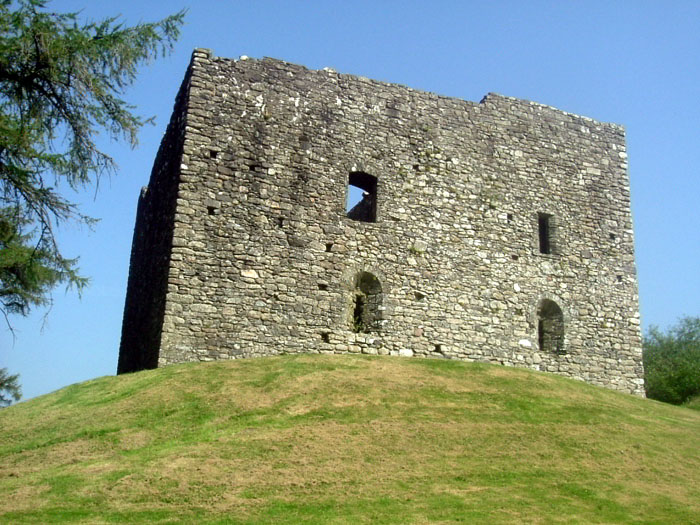
Photo by Steinsky • CC BY-SA 1.0
Role in law enforcement and judicial history
Throughout the medieval period, Lydford Castle served primarily as a prison and court dedicated to enforcing the stannary and forest laws. These laws regulated the vital tin mining industry and the use of forest resources, crucial to the regional economy and royal revenues. The castle’s reputation became infamous due to the harsh treatment of prisoners, giving rise to the term "Lydford Law" to describe unjust and severe imprisonment practices.
One notable episode occurred in 1510 when Richard Strode, a Member of Parliament campaigning for reform of the stannary laws, was imprisoned under exceptionally harsh conditions here. This incident highlights the castle’s role not only in law enforcement but also in political struggles surrounding mining rights and governance.
During the English Civil War (1642–1650), the castle was used as a military prison by Royalist forces. It was feared by the opposing Parliamentarian troops, underscoring its continued strategic and punitive significance. After the war, the castle fell into disrepair, described as almost completely ruined by the late 17th century.
Later history and conservation
Periodic repairs in the 17th and 18th centuries included modifications to the courtroom windows and internal walls to improve lighting and functionality. The courtroom was equipped with a judge’s chair, seating for officials, and a railed area for the public, also serving as a local meeting hall. However, the castle’s judicial use ceased in the 19th century following the opening of Dartmoor Prison, which assumed its penal functions.
In 1932, ownership transferred from the Duchy of Cornwall to the state’s Office of Works, initiating formal conservation efforts. Archaeological investigations and preservation work during the 20th century helped stabilize the ruins. Today, English Heritage manages the stone castle ruins, while the earlier Norman earthworks are protected by the National Trust. Both components are designated as scheduled ancient monuments, recognizing their historical and architectural significance.
Architectural remains and visitor experience
Visitors to Lydford Castle can explore the clearly defined Norman ringwork earthworks, which remain remarkably intact and accessible. The stone tower’s substantial walls survive without their original roof or floors, offering a vivid glimpse into medieval prison architecture. The visible arrow slits, thick masonry walls, and internal divisions reveal the dual defensive and administrative roles of the castle.
The castle’s setting within the natural landscape, including the protective valley and raised ground, enhances appreciation of its strategic location. The juxtaposition of the early wooden fortifications with the later imposing stone tower illustrates the evolution of Norman military and legal architecture over several centuries.
Lydford Castle remains a significant landmark in the history of English law enforcement, medieval governance, and Norman architecture. Its preserved ruins and earthworks continue to attract historians, archaeologists, and visitors interested in England’s rich medieval past.
Frequently asked questions (FAQ)
- How do I get to Lydford Castle?
- Lydford Castle is located in the village of Lydford, Devon. It is accessible by car and public transport, with parking available nearby. The site is within walking distance from the village center.
- What are the opening hours for visiting Lydford Castle?
- Lydford Castle is managed by English Heritage and is generally open to visitors during daylight hours. It is advisable to check the official English Heritage website for the most current opening times before planning your visit.
- Is there an admission fee to enter Lydford Castle?
- Entrance to Lydford Castle is free of charge, as it is an open historic site managed by English Heritage. Donations to support conservation efforts are welcome.
- What makes Lydford Castle architecturally significant?
- Lydford Castle is architecturally significant as it combines an early Norman ringwork earthwork fortification with a later stone-built prison tower. Its unique design reflects the evolution of medieval military and judicial architecture in England.
- Can I explore the interior of the stone tower at Lydford Castle?
- The stone tower at Lydford Castle is a ruin without floors or a roof, so visitors can view the interior from above but cannot safely explore inside. The site offers clear views of the masonry and defensive features.
- Why is Lydford Castle important historically?
- Lydford Castle is historically important as England's earliest purpose-built prison and a center for enforcing stannary and forest laws. Its role in medieval law enforcement and governance highlights its significance in English legal history.
Photo gallery

Information
Loading map...
Visitor reviews
No reviews yet. Be the first to share your experience!