
Launceston Castle
Launceston Castle stands as a remarkable example of Norman military architecture in Cornwall, England. Built soon after the Norman Conquest, this high medieval hill castle occupies a commanding position on a prominent motte overlooking the town of Launceston and the surrounding countryside. Originally known as Dunheved, the castle was strategically placed to guard the main gateway into Cornwall, controlling important river crossings and routes between Bodmin Moor and Dartmoor.
The castle's origins date back to the late 11th century, likely constructed by Robert, Count of Mortain, half-brother to William the Conqueror, as part of the consolidation of Norman control over newly acquired lands. Initially, it was a classic motte-and-bailey fortress with earthworks and timber defenses, featuring a large motte in one corner of a roughly rectangular bailey. This early wooden structure functioned as both a military stronghold and the administrative center for the Earldom of Cornwall.
Architectural evolution and stone reconstruction
During the 12th century, Launceston Castle underwent significant stone reconstruction, transforming it from a timber fortification into a formidable stone castle. The most prominent addition was the construction of a circular stone shell keep atop the motte, measuring approximately 26 meters in diameter. This keep replaced the original timber tower and provided enhanced defensive capabilities.
In the early 13th century, under the patronage of Richard of Cornwall, brother to King Henry III and Earl of Cornwall, the castle was extensively redeveloped. Richard, who benefited from the wealth generated by Cornwall's tin mines, invested in strengthening the castle's defenses and improving its status as a noble residence. Among his contributions was the addition of a tall tower on top of the existing keep, approximately 12 meters wide, featuring large windows and a fireplace. This tower served as a viewing platform over the surrounding lands and symbolized the lord's prestige.
Alongside the keep enhancements, Richard replaced the original timber palisades with robust stone curtain walls surrounding the bailey. These walls incorporated several defensive towers, including the notable "Watch" or "Witch" Tower, a D-shaped structure guarding the approach causeway to the motte. Although this tower collapsed in the 19th century, its foundations have been documented through archaeological studies.
Substantial gatehouses were constructed during this period, including the imposing south gatehouse with its two rounded drum towers and a portcullis-equipped gateway. This gatehouse originally had three floors and was connected to a wall walk along the curtain wall, providing defenders with a vantage point to repel attackers. The north gatehouse, built in the late 13th century, served as the main entrance from the town and later functioned as the constable's residence and prison.
Historical significance and changing roles
Launceston Castle's importance peaked during the 12th and early 13th centuries as the administrative heart of the Earldom of Cornwall. However, in 1272, Richard's son Edmund moved the earldom's administrative center to Lostwithiel, initiating a gradual decline in the castle's political significance. By the mid-14th century, the castle was increasingly dilapidated and primarily used as a prison and venue for judicial assizes.
The castle saw military action during the 1549 Prayer Book Rebellion, when it was seized by rebels opposing religious reforms. Later, during the English Civil War in the 17th century, Launceston was garrisoned by Royalist forces. Its poor state of repair meant that Parliamentary forces did not find it necessary to inflict further damage upon capturing it. After the war, the castle was systematically dismantled, with much of its stonework repurposed for other buildings, leaving it largely in ruins.
Despite its decline, parts of the castle remained in use as a prison well into the 19th century. Known colloquially as "Castle Terrible" due to its harsh conditions, the gaol was finally closed in 1842, and prisoners were transferred to the newly built Bodmin Gaol. Subsequently, the castle grounds were landscaped into a public park by the Duke of Northumberland, a transformation that preserved the site for future generations.
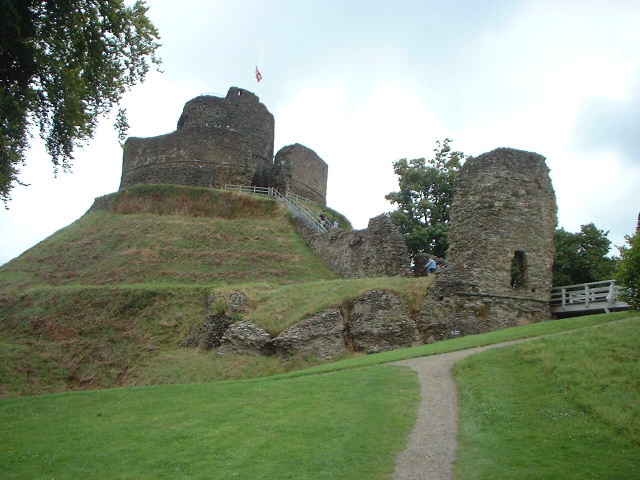
Photo by Chris Shaw • CC BY-SA 2.0
Architectural remains and archaeological discoveries
Today, visitors to Launceston Castle can explore the impressive ruins that include the stone shell keep on the motte, remnants of the curtain walls, and parts of the gatehouses. The motte itself was modified over the centuries, heightened and terraced to stabilize its slopes. The castle's walls were constructed primarily from local shale stone, with granite and Polyphant stone used for structural and decorative elements such as doorways and window frames.
Within the bailey, archaeological excavations have uncovered the foundations of several 13th-century buildings, including a great hall measuring approximately 22 by 7 meters, a courtroom hall, and a large kitchen area. These findings provide insight into the castle's function as a residence and administrative center. The site also features a Victorian-era cottage near the south gatehouse, which is believed to stand on the location of the original earl's hall and private chambers.
The south gatehouse remains a striking feature despite the loss of much of its dressed stone facing. It originally included defensive elements such as a portcullis and multiple floors for guards and officials. The 14th-century barbican, a fortified bridge protecting the south approach, survives in part, with its arched stone structures and arrow loops still visible.
Modern use and visitor experience
Launceston Castle is owned by the Duchy of Cornwall and managed by English Heritage as a significant cultural and historical site. The castle is open to the public from early April to the end of October, offering an interactive display that traces its thousand-year history. Visitors can explore exhibitions featuring artifacts uncovered during archaeological excavations, enriching their understanding of the castle's role through the centuries.
The castle grounds, now a public park, provide scenic views over the town and the surrounding Cornish landscape. The elevated position of the keep and tower allows visitors to appreciate the strategic importance of the site. Launceston Castle remains a powerful symbol of Norman authority and medieval governance in Cornwall, attracting history enthusiasts and tourists alike.
Visitor information and accessibility
- Opening times: Daily from early April to the end of October.
- Facilities include interpretive displays, guided tours at select times, and accessible pathways.
- The site is suitable for families and those interested in medieval history and architecture.
- Nearby attractions include the town of Launceston, known as the "gateway to Cornwall," with its historic streets and cultural landmarks.
Launceston Castle's enduring presence offers a tangible link to England's Norman past and the evolution of medieval fortifications. Its architectural features, historical significance, and well-preserved ruins make it a compelling destination for those seeking to explore Cornwall's rich heritage.
Frequently asked questions (FAQ)
- When was Launceston Castle built and by whom?
- Launceston Castle was likely built soon after the Norman Conquest, around 1068, by Robert, Count of Mortain, half-brother to William the Conqueror.
- What architectural features can visitors see at Launceston Castle?
- Visitors can explore the stone shell keep on the motte, remains of the curtain walls, gatehouses, and foundations of medieval buildings within the bailey.
- Is Launceston Castle open to the public year-round?
- The castle is open daily from early April to the end of October each year, with interactive displays and exhibitions available for visitors.
- What was the historical significance of Launceston Castle?
- Launceston Castle served as the administrative center for the Earldom of Cornwall and played a key role in regional governance and defense during the medieval period.
- Can I visit Launceston Castle with children?
- Yes, the castle grounds are family-friendly, featuring accessible pathways and educational exhibits suitable for children interested in history.
Photo gallery

Information
Opening hours
Daily from early April to end of October
Current owner
Duchy of Cornwall
Website
Visit websiteSources & official resources
Verify the information above using these authoritative references.
Loading map...
Visitor reviews
No reviews yet. Been here? Write the first review and help other travelers!
Write the first reviewVisited this castle? Share your experience
Your review helps other travelers and adds first-hand knowledge to our encyclopedia.