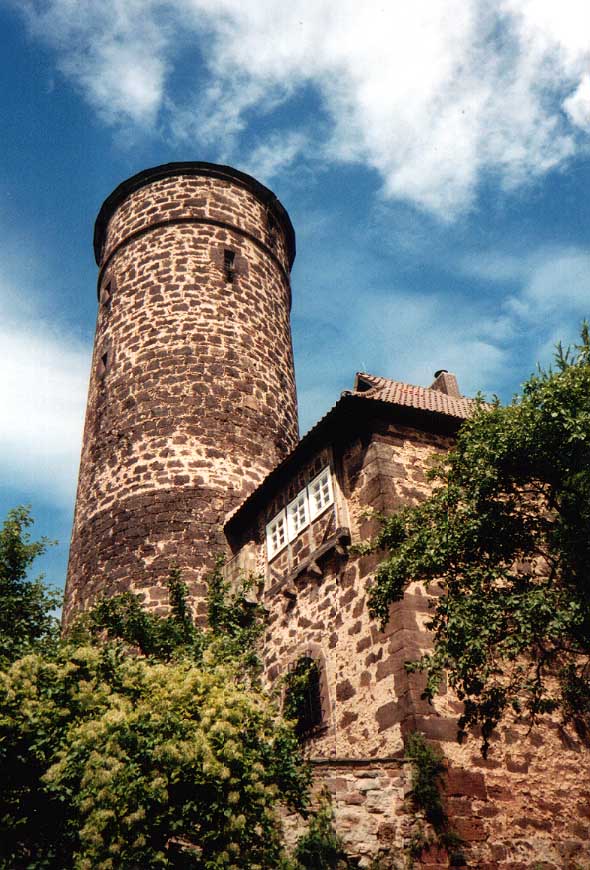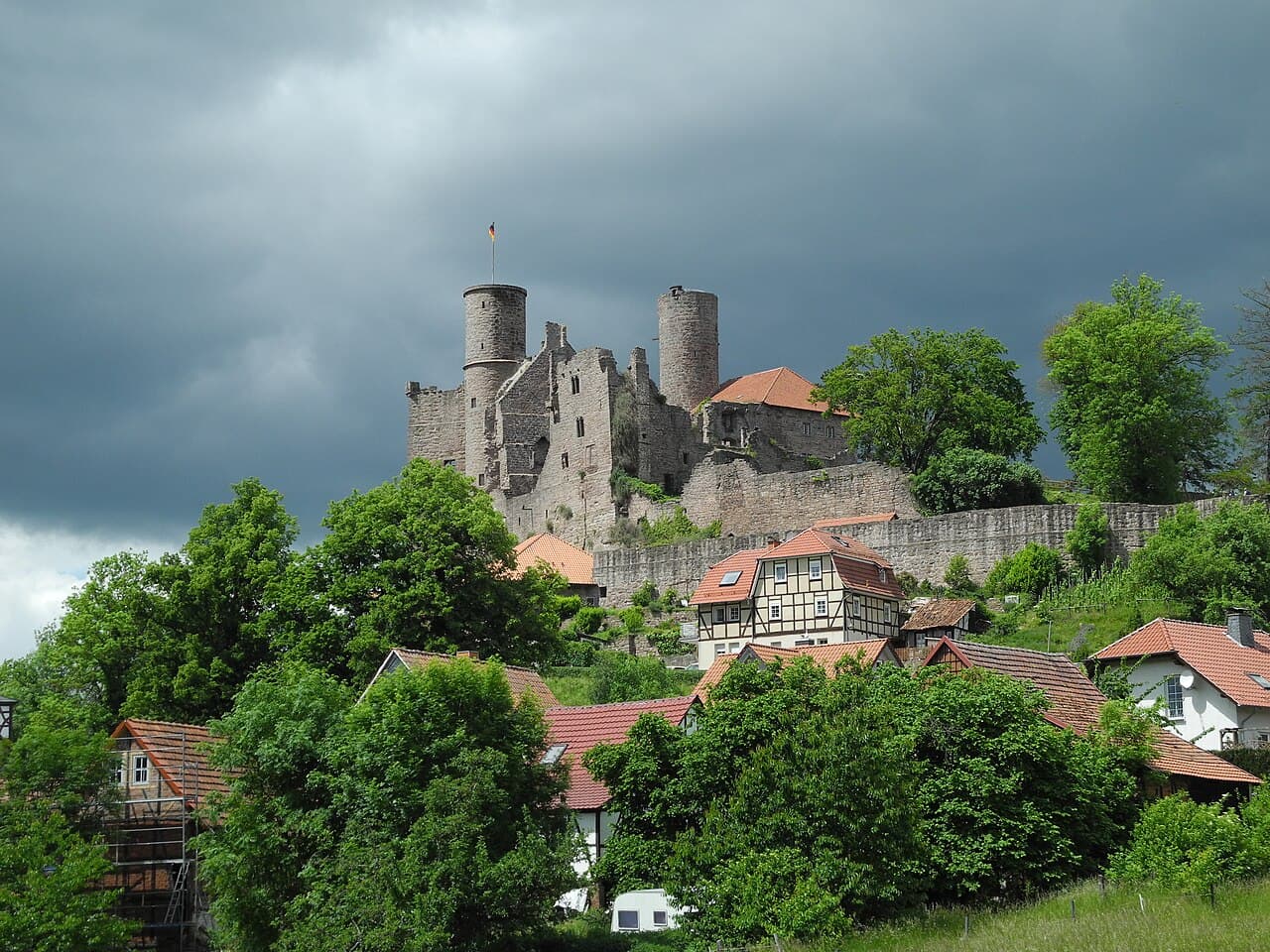
Hanstein Castle
Hanstein Castle stands as a remarkable example of a medieval hill castle in Germany, perched atop a sandstone rock spur at approximately 390 meters above sea level. Its strategic position offers commanding views over the surrounding landscapes, including notable geological fault lines, making it a significant fortress in the region's history. Originally built during the High Middle Ages, the castle played a crucial role in securing control over the contested borderlands of the Eichsfeld region.
The earliest recorded mention of Hanstein Castle dates back to 1070, when it was destroyed during the Saxon Wars by King Heinrich IV. At this time, the castle belonged to Count Otto von Northeim, suggesting its origins likely extend into the late 11th century or earlier. Following its destruction, Otto von Northeim is believed to have overseen its reconstruction, restoring its defensive capabilities and reaffirming its importance in regional power dynamics.
Historical ownership and strategic significance
After 1144, ownership of the castle shifted from the Northeim family to the influential Welf dynasty. The castle's strategic importance was further elevated in 1209 when control passed to Siegfried, Archbishop of Mainz, through Otto IV, son of Henry the Lion. This transition marked Hanstein Castle's role as a vital border fortress for the Archbishopric of Mainz within the Eichsfeld region, an area frequently contested by various territorial powers.
The von hanstein family's legacy
In 1308, Heinrich and Lippold von Hanstein received permission from the Archbishop of Mainz to undertake extensive rebuilding efforts. These renovations began with wooden structures and progressed to robust stone fortifications, laying the architectural foundation for the ruins that visitors see today. The castle became the hereditary residence of the von Hanstein family, who expanded their regional influence throughout the 14th and 15th centuries, consolidating their authority and maintaining the castle as a symbol of their power.
Architectural features and castle layout
Hanstein Castle is notable for its Gothic architectural elements, which have remained largely intact since the castle's abandonment in the 16th century. The fortress originally featured a complex layout with five distinct gates controlling access from the outer courtyard, or bailey, into the inner core castle. This design reflects typical medieval defensive strategies aimed at delaying and controlling enemy advances.
Key structural components
The castle's interior included a well within the former kitchen area, an essential feature for sustaining occupants during prolonged sieges. The inner ward housed a chapel, which contained a valuable altar installed in 1417 by Martin von Hanstein. The chapel was supported by endowments and served by the parish priest from the nearby village of Rimbach, indicating the castle's religious significance and its integration with the local community.
Another significant structure was the prison, or kerker, which remained in use until the 18th century, highlighting the castle's administrative functions beyond military defense. In the 19th century, the von Hanstein family constructed a knights' hall near the ruins, providing a venue for family gatherings and ceremonies, thereby preserving the site's heritage.
Damage, decline, and later uses
The Thirty Years' War in the 17th century inflicted partial destruction on Hanstein Castle, particularly at the hands of Swedish forces. This damage contributed to the castle's decline as a permanent residence. Despite this, the von Hanstein family continued to use the site for social functions and maintained its symbolic importance.
In the 20th century, the castle's northern tower was repurposed by East German border troops as a watchtower due to its advantageous vantage point near the inner-German border. This military use underscores the castle's enduring strategic value even in modern times.
Geological setting and preservation
The castle rests on layers of colored sandstone known as Buntsandstein from the Solling Formation, with Muschelkalk (shell limestone) exposed on its eastern slopes. Several small quarries below the castle likely supplied building materials during its original construction phases. The geological features contribute to the castle's dramatic setting and have influenced its architectural development.
Today, the northern tower remains accessible to visitors, offering panoramic views of the surrounding landscapes, including the Hoher Meißner, Kaufunger Wald, Leinebergland, and Eichsfeld. On clear days, views extend to the Harz Mountains and the Brocken peak. The southern tower, however, is closed to the public.
Village of rimbach and castle support
The adjacent village of Rimbach historically supported the castle's personnel and maintained its own parish church. The village was also the site of the castle's earliest gate and held market rights, possibly with its own defensive works, emphasizing the interconnectedness of the castle and its surrounding community.
Cultural and heritage significance
Hanstein Castle is a valuable cultural monument reflecting the turbulent history of the Eichsfeld region. Its well-preserved Gothic ruins offer insights into medieval fortification techniques, noble residence life, and the shifting political landscape of central Germany. Conservation efforts initiated in the mid-1980s and the castle's transfer to municipal ownership in 1990 have ensured its preservation as a heritage site and tourist attraction, fostering cultural remembrance and education.
Frequently asked questions (FAQ)
- When was Hanstein Castle originally built?
- Hanstein Castle was likely established in the late 11th century, with the earliest recorded mention in 1070.
- What architectural style characterizes Hanstein Castle?
- The castle prominently features Gothic architectural elements, especially visible in its surviving ruins.
- Can visitors access the towers of Hanstein Castle?
- The northern tower is accessible to visitors and offers panoramic views, while the southern tower is closed to the public.
- What role did Hanstein Castle play during the Thirty Years' War?
- The castle suffered partial destruction by Swedish forces during the Thirty Years' War, contributing to its decline as a residence.
- Is Hanstein Castle open to the public for visits?
- Hanstein Castle is open to the public, with the northern tower accessible; however, specific visiting hours and ticket prices vary and should be confirmed locally.
Photo gallery

Information
Sources & official resources
Verify the information above using these authoritative references.
Loading map...
Visitor reviews
No reviews yet. Been here? Write the first review and help other travelers!
Write the first reviewVisited this castle? Share your experience
Your review helps other travelers and adds first-hand knowledge to our encyclopedia.