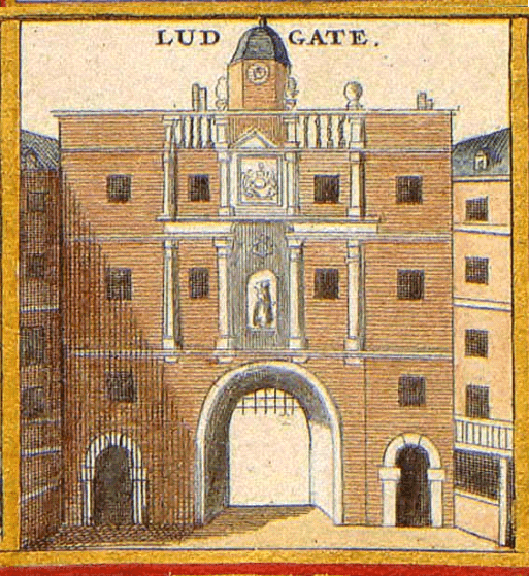
Ludgate served as the westernmost gate in the ancient London Wall, a defensive structure surrounding the City of London. Originally constructed during the Roman period, Ludgate was part of the city's fortifications that marked the western entrance to the Roman city of Londinium. Its strategic location made it an important access point for travelers and merchants entering from the west.
Roman origins and medieval rebuilding
The gate's origins trace back to the 1st century AD when the Romans built the London Wall, including several gates such as Ludgate. Over the centuries, Ludgate underwent numerous reconstructions to adapt to changing defensive needs and urban development. During the medieval period, the gate was rebuilt multiple times, incorporating architectural styles and fortifications typical of the era. These rebuildings reflected the city's ongoing efforts to maintain strong defenses against external threats.
Architectural features and fortifications
Ludgate was characterized by robust stone walls and defensive elements common to medieval city gates. It featured arched gateways to allow controlled passage, flanked by towers or bastions that provided vantage points for guards. The gate's construction materials evolved over time but primarily consisted of stone sourced locally or recycled from earlier Roman structures. The gate was integrated into the London Wall, which itself was a formidable fortification stretching several kilometers around the city.
Role in London's urban development
As London expanded beyond its Roman boundaries, Ludgate remained a significant landmark. The gate controlled traffic between the city and the western suburbs and countryside. Over time, the area around Ludgate developed into a busy commercial and residential district. The name "Ludgate" lives on in several nearby locations, including Ludgate Hill, Ludgate Circus, and Ludgate Square, which are integral parts of modern London’s urban landscape.
Demolition and legacy
Ludgate was ultimately demolished on 30 July 1760 as part of London's modernization and urban improvement efforts. The gate had become obsolete as city walls lost their defensive function and traffic demands increased. The materials from the gate were sold for £148, reflecting the value of the stone and other building materials. Despite its demolition, Ludgate's historical significance remains recognized through place names and historical records.
Historical significance and cultural memory
Ludgate's presence in London's history illustrates the city's evolution from a Roman settlement to a medieval stronghold and then to a modern metropolis. The gate was part of a network of fortifications that shaped the city's defense and growth for over a millennium. Today, Ludgate is remembered primarily through its enduring toponyms and as a symbol of London's layered past.
Nearby landmarks and modern context
The area once dominated by Ludgate is now a bustling part of central London, close to landmarks such as St. Paul's Cathedral and the River Thames. The historical footprint of Ludgate is commemorated in street names and local history tours, providing insight into London's rich architectural and urban heritage.
Frequently asked questions (FAQ)
- When was Ludgate originally built?
- Ludgate was originally constructed during the Roman period, likely in the 1st century AD as part of the London Wall fortifications.
- What was the purpose of Ludgate?
- Ludgate served as the westernmost entrance to the City of London, controlling access and providing defense as part of the London Wall.
- Why was Ludgate demolished?
- Ludgate was demolished in 1760 because it had become obsolete and was removed to improve traffic flow and urban development in London.
- Are there any remains of Ludgate today?
- No visible remains of Ludgate exist today, but its location and significance are commemorated by nearby street names such as Ludgate Hill and Ludgate Circus.
- Is Ludgate accessible to visitors?
- Since Ludgate was demolished in the 18th century, there is no structure to visit, but the area is accessible and rich in historical context within central London.
Photo gallery

Photo by Anonymous cartographer/etcher;[1]; from University of Toronto Wenceslaus Hollar Digital Collection. Scanned by University of Toronto. High-resolution version extracted using custom tool by User:Dr_Sachs.•Public domain
Information
Loading map...
Visitor reviews
No reviews yet. Been here? Write the first review and help other travelers!
Write the first reviewVisited this castle? Share your experience
Your review helps other travelers and adds first-hand knowledge to our encyclopedia.