Baynard's Castle
Baynard's Castle refers to two historically significant buildings located on adjacent sites in the City of London, situated between the modern landmarks of Blackfriars station and St. Paul's Cathedral. The castle's origins trace back to the 11th century, when the original structure was built as a Norman fortification by Ralph Baynard, the 1st feudal baron of Little Dunmow in Essex. This first castle was strategically positioned at the confluence of the old Roman walls and the River Fleet where it met the River Thames. The north wall of this early fortress notably incorporated the Roman-era river wall from the 3rd century, distinguished by a tile course of Roman brick, demonstrating the reuse of ancient construction materials and techniques.
The original Norman castle stood for over a century until it was demolished by King John in 1213, during a period of political unrest. Following the Barons' Revolt, the castle was apparently rebuilt but eventually the site was sold in 1276 to establish the precinct of the Blackfriars Monastery, a significant religious institution of the time.
The second Baynard's Castle: a medieval palace
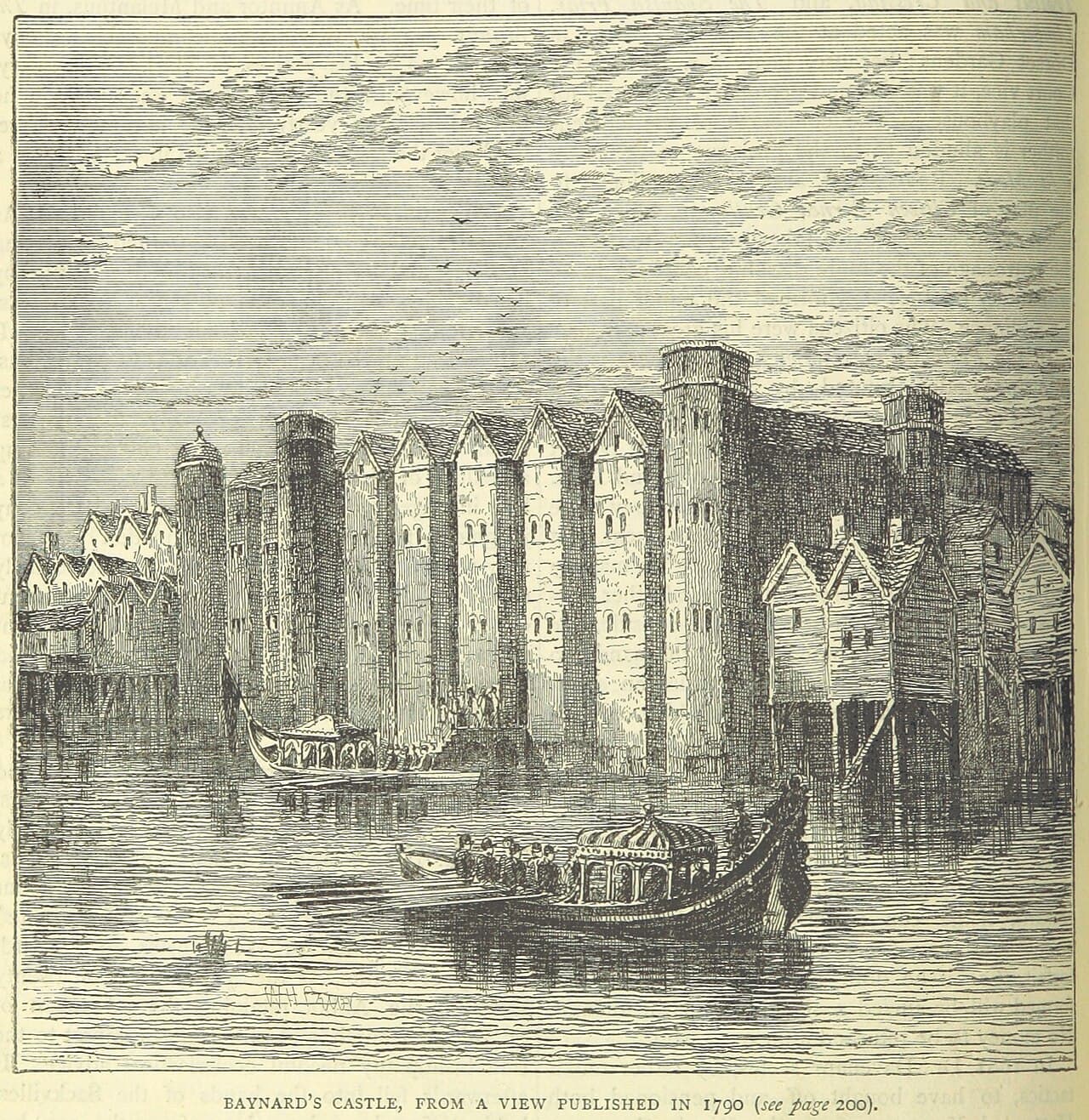
Approximately a century after the sale of the original site, a new mansion was constructed on reclaimed land from the Thames, located to the south-east of the first castle's site. This new medieval palace was rebuilt after 1428 and became prominent as the London headquarters of the House of York during the Wars of the Roses. One of the castle's most notable historical moments was on 3 March 1461, when the accession of King Edward IV was agreed upon and proclaimed within its walls.
Royal connections and architectural expansions
The mansion was extensively reconstructed as a royal palace by King Henry VII at the end of the 15th century, reflecting the transition from medieval fortress to a more refined royal residence. Later, Henry VIII gifted the palace to Katherine of Aragon on the eve of their wedding, further cementing its status as a royal dwelling.
In 1551, during the reign of King Edward VI, the palace was granted to William Herbert, 1st Earl of Pembroke, brother-in-law to Queen Katherine Parr, Henry VIII's widow. Herbert undertook significant expansions, adding a large extension around a second courtyard, which transformed the palace into a complex and grand residence suitable for high nobility.
Baynard's Castle during the English Civil War and its destruction
The Herbert family supported the Parliamentary side during the English Civil War. After the Restoration of the Monarchy in 1660, the castle was occupied by Francis Talbot, 11th Earl of Shrewsbury, a Royalist nobleman. Despite its turbulent history, the castle remained a significant London landmark until it was largely destroyed in the Great Fire of London in 1666.
Although the fire left Baynard's Castle in ruins, fragments of the structure survived into the 19th century, offering glimpses into its former grandeur. Today, the original sites of Baynard's Castle are occupied by modern buildings, including the BT office known as Baynard House. The castle's legacy endures in the names of Castle Baynard Street and the Castle Baynard Ward of the City of London.
Architectural significance and historical context
Baynard's Castle is a rare example of a site that evolved from a Norman hill castle into a medieval palace with royal associations, reflecting the changing political and social landscape of London from the 11th century through the 16th century. The initial Norman fortification's use of Roman masonry highlights the continuity of urban development in London from Roman times through the medieval period.
The castle's role as a powerful fortress and later as a royal residence illustrates the dual nature of castles in medieval England as both military strongholds and centers of governance and aristocratic life. Its connection to significant historical events, such as the Wars of the Roses and the Great Fire, places Baynard's Castle firmly within the narrative of London's rich history.
Key architectural features
- Roman river wall foundation: The north wall of the original castle incorporated a Roman-era river wall with distinctive Roman brick tile courses.
- Medieval palace courtyards: The later mansion included at least two courtyards, with expansions by William Herbert adding a second courtyard, enhancing its residential and administrative functions.
- Royal palace renovations: Reconstruction under Henry VII introduced elements befitting a royal palace, though detailed architectural descriptions are scarce due to the Great Fire's destruction.
Legacy and commemoration
While Baynard's Castle no longer stands, its historical importance is recognized through place names and archaeological interest. The site's transformation over centuries from a Norman fortress to a royal palace, and its destruction in one of London's most devastating events, the Great Fire, mark it as a significant chapter in the city's architectural and political history.
Modern developments on the site, including Baynard House, serve as reminders of the layered history beneath contemporary London. The castle's memory is preserved in the Castle Baynard Ward, which continues to be an administrative division within the City of London.
Frequently asked questions (FAQ)
- When was Baynard's Castle originally built?
- Baynard's Castle was originally constructed in the 11th century by Ralph Baynard as a Norman fortification in London.
- What happened to Baynard's Castle during the Great Fire of London?
- Baynard's Castle was mostly destroyed in the Great Fire of London in 1666, leaving it in ruins with only fragments surviving into the 19th century.
- Can visitors see Baynard's Castle today?
- The original castle no longer exists, and the site is now occupied by modern buildings including Baynard House. There are no visible remains to visit, but the location is commemorated by Castle Baynard Street and the Castle Baynard Ward.
- What was the significance of Baynard's Castle during the Wars of the Roses?
- Baynard's Castle served as the London headquarters of the House of York during the Wars of the Roses, where King Edward IV's accession was proclaimed in 1461.
- Who owned Baynard's Castle after the reign of Henry VIII?
- After Henry VIII, the castle was granted to William Herbert, 1st Earl of Pembroke, who expanded the palace around 1551.
Photo gallery

Public domain
Information
Current owner
Private owner
Loading map...
Visitor reviews
No reviews yet. Been here? Write the first review and help other travelers!
Write the first reviewVisited this castle? Share your experience
Your review helps other travelers and adds first-hand knowledge to our encyclopedia.