Bridewell Palace
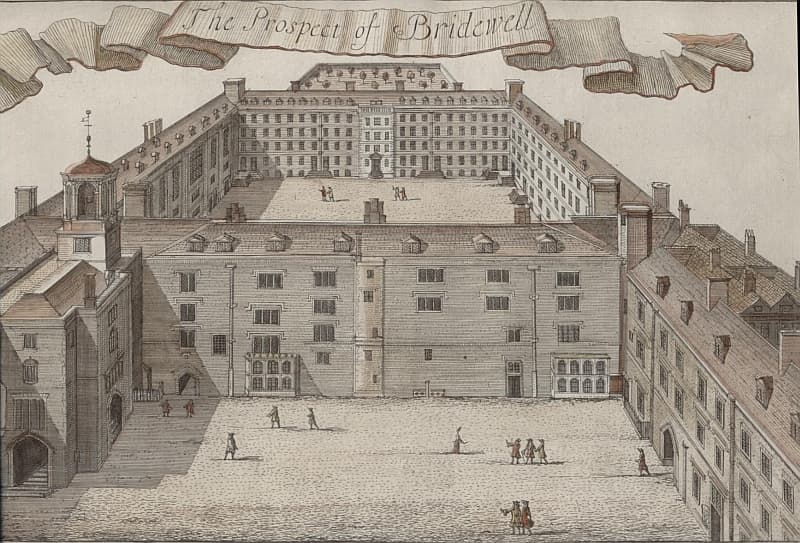
Bridewell Palace in London is a significant historical site that reflects the evolution of royal residences into early correctional institutions. Originally constructed as a residence for King Henry VIII early in his reign, Bridewell Palace served as one of his homes for approximately eight years. This location, situated on the banks of the Fleet River in the City of London, occupied a strategic position between Fleet Street and the River Thames in an area now known as Bridewell Place, near New Bridge Street.
Construction and royal origins
The palace was constructed in the early 16th century, during the Tudor period, reflecting the architectural and functional preferences of the era. As a royal residence, Bridewell Palace was designed to accommodate the king and his court, though its exact architectural details are not extensively documented. The site’s proximity to the Fleet River provided both a scenic and practical advantage, facilitating transport and access within London.
Transformation into a hospital and prison
In 1553, following the death of Henry VIII, his son King Edward VI granted Bridewell Palace to the City of London Corporation. This marked a pivotal change in the building’s purpose, as it was converted into Bridewell Hospital. The hospital functioned as an orphanage and a place of correction for wayward women, embodying early efforts in social reform and public welfare during the mid-16th century.
By 1556, part of Bridewell Hospital had been adapted into a jail, known as Bridewell Prison. This institution was notable for being among the first to appoint a doctor to care for inmates, highlighting an early recognition of health care within the penal system. The prison and hospital operated concurrently, addressing both social and criminal issues of the time.
Architectural features and layout
While detailed records of Bridewell Palace’s original architectural style are limited, the site underwent significant modifications to accommodate its new functions. The conversion involved the creation of lodgings for inmates and patients, as well as the establishment of secure areas for detention. The palace’s location along the river likely influenced its layout, with defensive and practical considerations shaping the design of walls and enclosures.
Decline and demolition
Bridewell Prison continued to function for several centuries but eventually closed in 1855. The buildings were demolished between 1863 and 1864, reflecting urban development pressures and changing penal practices in Victorian London. Today, the site is classified as archaeological ruins, with little remaining of the original structures but significant historical importance.
Cultural legacy and influence
The name "Bridewell" became synonymous with jails, influencing the terminology for correctional facilities not only in England but also in cities across the British Empire, including Dublin and New York. This legacy underscores Bridewell Palace’s role in the development of institutional correction and social welfare systems.
Historical context and significance
Bridewell Palace represents an important chapter in the history of London’s urban and social development. Its transformation from a royal residence to a pioneering correctional institution illustrates shifts in governance, social policy, and architectural adaptation from the Tudor period through the Victorian era. The site’s association with King Henry VIII and King Edward VI further enhances its historical relevance.
Early social reform efforts
The establishment of Bridewell Hospital as an orphanage and correctional facility was part of broader mid-16th century efforts to address poverty, vagrancy, and social disorder in London. It served as a model for subsequent institutions aimed at rehabilitating marginalized populations.
Urban development impact
The demolition of Bridewell Palace’s buildings in the 19th century reflected the rapid expansion and modernization of London. The site’s location near major thoroughfares like Fleet Street and the River Thames placed it at the heart of urban transformation.
Visitor information and current status
Today, Bridewell Palace exists primarily as archaeological ruins, with limited visible remains. The site is recognized for its historical significance rather than as an architectural monument. Visitors interested in Tudor history, early correctional practices, and London’s urban evolution may find the location noteworthy, though physical remnants are scarce.
Frequently asked questions (FAQ)
- What is the historical significance of Bridewell Palace?
- Bridewell Palace, originally built in the early 16th century, served as a royal palace and later as a prison and workhouse. Its history is intertwined with notable figures, including King Henry VIII, who used it for various royal functions. Today, it stands as a testament to London's rich history and architectural evolution.
- When was Bridewell Palace constructed?
- Bridewell Palace was constructed in 1515 during the reign of King Henry VIII. The palace has undergone various transformations over the centuries, reflecting the changing needs and uses of the building. Its architectural significance has made it a noteworthy site for both historians and visitors alike.
- Can I visit Bridewell Palace?
- Yes, Bridewell Palace is open to visitors, offering guided tours that explore its fascinating history and architectural features. It is advisable to check the official website for the latest visiting hours and any special events. Be sure to book in advance if you plan to join a tour.
- What are the opening hours for Bridewell Palace?
- Bridewell Palace typically opens to visitors from 10 AM to 5 PM, but hours may vary on weekends and public holidays. It is recommended to visit the official website for the most current hours of operation and any seasonal changes. Planning your visit during weekdays might offer a quieter experience.
- Is Bridewell Palace accessible for visitors with disabilities?
- Bridewell Palace strives to be accessible to all visitors, with facilities for those with mobility challenges. The site provides ramps and accessible restrooms. It’s best to contact the palace in advance to confirm specific accessibility needs and any available services.
- What are the ticket prices for visiting Bridewell Palace?
- Ticket prices for Bridewell Palace vary depending on age and whether you are part of a guided tour. Generally, adult tickets are reasonably priced, while discounts are often available for students and seniors. Check the official website for up-to-date pricing and any special offers.
- When is the best time to visit Bridewell Palace?
- The best time to visit Bridewell Palace is during the spring and early autumn when the weather is mild and pleasant. Avoiding peak summer tourist season may also provide a more relaxed experience with fewer crowds. Additionally, weekdays tend to be less busy than weekends.
- Are there any nearby attractions to visit along with Bridewell Palace?
- Yes, there are several attractions near Bridewell Palace, including St. Paul's Cathedral and the historic Fleet Street. Visitors can also explore the vibrant cultural scene in the surrounding area, which includes galleries, shops, and restaurants. This makes it easy to plan a full day of sightseeing.
Photo gallery

Photo by John Strype•Public domain
Information
Current owner
City of London Corporation
Address
Bridewell Place, off New Bridge Street, City of London
Loading map...
Visitor reviews
No reviews yet. Been here? Write the first review and help other travelers!
Write the first reviewVisited this castle? Share your experience
Your review helps other travelers and adds first-hand knowledge to our encyclopedia.