Lubliniec
Lubliniec Castle, located in the town of Lubliniec, Poland, is a historic site with origins tracing back to the late medieval period. According to tradition, the city of Lubliniec and its castle were founded by the Opole duke Władysław around 1270. While historical records are scarce and archaeological research remains limited, it is believed that the original structure served as a defensive stronghold or watchtower, strategically positioned on a small elevation surrounded by marshy terrain. This location provided natural protection and control over the surrounding area.
The earliest documented mention of the castle dates to 1379, when it was owned by Duke Władysław Opolczyk. His antagonistic policies towards the Polish crown led to military conflict, culminating in a 1396 campaign led by Kraków's voivode Spytko of Melsztyn. This campaign resulted in the capture of Lubliniec along with nearby towns. The conquered lands were granted to Spytko as a fief, and in 1401, his daughter Jadwiga brought Lubliniec as a dowry to Duke Bernard of Niemodlin. After Bernard's childless death, the castle reverted to the Opole dukes.
Transformation during the Renaissance and Baroque periods
In 1576, Jan Kochcicki took possession of Lubliniec and its surrounding villages as a pledge and fully acquired it in 1587. Under Kochcicki's ownership, the castle was transformed from a medieval fortress into a noble residence, becoming his main seat. Unfortunately, no detailed architectural records survive to reconstruct the original appearance of this Renaissance-era residence. The estate was elevated to the status of a lower-rank state country, reflecting its administrative importance.
The castle remained with the Kochcicki family until 1629, when it was confiscated due to the involvement of Count Andrzej Kochcicki in the Thirty Years' War on the anti-Habsburg side. The property was then transferred to Andrzej Cellary. A devastating fire in 1650 severely damaged the castle, but during reconstruction, the builders incorporated surviving walls into the new structure. This rebuilding phase gave rise to much of the present palace's core, now featuring a baroque architectural style. The Cellary family retained ownership until 1727.
Later ownership and architectural modifications
In 1727, the de Garnier family acquired the castle. Around 1760, the first surviving sketch of the palace was made by Fryderyk Wernher, providing valuable insight into its appearance during this period. From 1763 onward, the castle changed hands frequently and was often left unoccupied. It was not until 1784, when Franciszek Grotkowski purchased the property, that it regained its status as a family seat.
Grotkowski undertook significant renovations, bestowing the building with a new neoclassical facade. It is likely that during this time the side risalits were expanded to include staircases, enhancing the palace's functionality and grandeur. Due to the absence of heirs, Grotkowski bequeathed the castle to serve as an orphanage. However, despite this testamentary intent, the Prussian authorities sold the property after his wife's death.
19th and 20th-century uses and decline
Between 1815 and 1892, the castle passed through several private owners before being purchased by the Regency of Opole. In 1893, it was repurposed as a hospital for the mentally ill, a function it served until 1975. After the hospital's closure, the castle fell into disuse and gradually deteriorated into ruins.
Modern restoration and current status
In March 1999, the foundation "Zamek Lubliniecki" was established with the goal of restoring the castle and returning it to the community and visitors. Ownership transferred from the Silesian Marshal's Office to the city of Lubliniec, and subsequently, in 2001, a private company acquired the property through a tender process. Following extensive renovations, the castle was restored and adapted into a hotel.
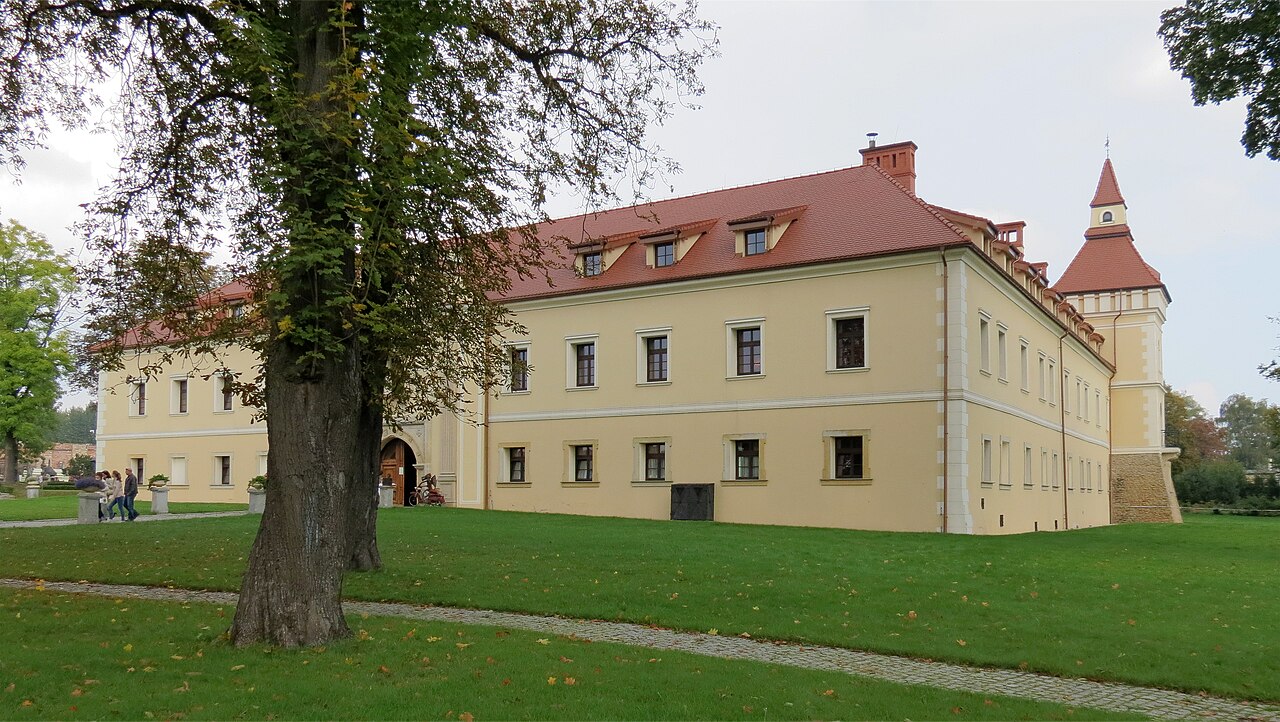
Today, the former ducal residence stands as a two-story palace featuring elements of baroque and neo-Renaissance architecture. The building is constructed on a rectangular plan with a small western risalit and two lateral risalits, reflecting its layered historical development. This transformation from a medieval fortress to a stately palace encapsulates the complex history and architectural evolution of Lubliniec Castle.
Architectural features and heritage significance
Lubliniec Castle's architectural journey reflects broader trends in Polish and Silesian noble residences. Its initial defensive role gave way to Renaissance and Baroque residential functions, marked by stylistic adaptations and expansions. The surviving structural elements, including the risalits and facade treatments, illustrate the castle's adaptation to changing tastes and functions over centuries.
The site's historical importance is underscored by its association with prominent regional figures such as Władysław Opolczyk, Spytko of Melsztyn, and the Kochcicki and Cellary families. Its endurance through military conflicts, fires, and political shifts attests to its resilience and significance in regional history.
Preservation challenges and future prospects
Despite periods of neglect and ruin, recent restoration efforts have stabilized and revitalized the castle. The adaptation into a hotel provides a sustainable use that promotes heritage tourism and local engagement. Continued conservation will be essential to preserve the castle's architectural integrity and historical legacy for future generations.
Frequently asked questions (FAQ)
- When was Lubliniec Castle originally built?
- Lubliniec Castle was originally built in the late medieval period, with the first documented mention in 1379 and significant construction around 1396.
- What architectural styles are represented in Lubliniec Castle?
- The castle features a mix of architectural styles including late medieval defensive elements, baroque interiors, and neoclassical facades from later renovations.
- Can visitors tour Lubliniec Castle today?
- Yes, after extensive restoration, Lubliniec Castle has been adapted into a hotel and can be visited by guests and tourists.
- What historical events affected Lubliniec Castle?
- The castle was involved in regional conflicts such as the 1396 military campaign against Duke Władysław Opolczyk and suffered damage in a major fire in 1650.
- Who were some notable owners of Lubliniec Castle?
- Notable owners include Duke Władysław Opolczyk, the Kochcicki family, Andrzej Cellary, the de Garnier family, and Franciszek Grotkowski.
Information
Loading map...
Visitor reviews
No reviews yet. Been here? Write the first review and help other travelers!
Write the first reviewVisited this castle? Share your experience
Your review helps other travelers and adds first-hand knowledge to our encyclopedia.