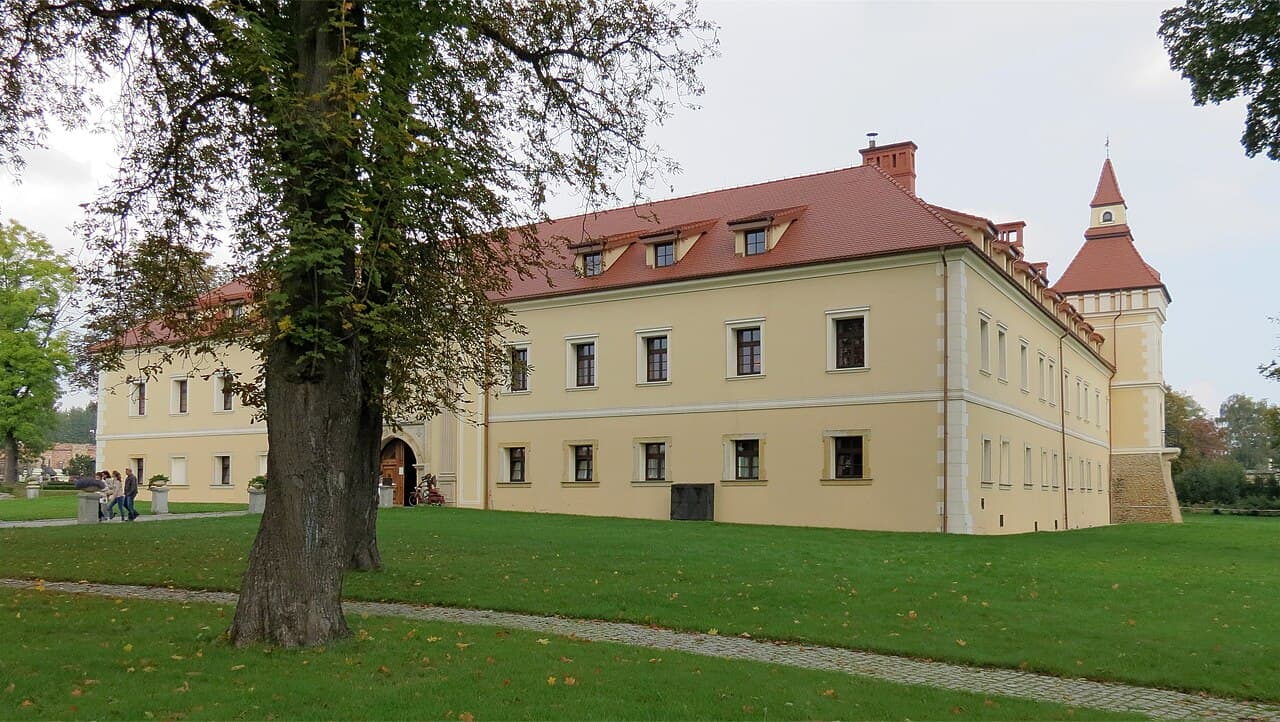
Tarnowice Stare
Tarnowice Stare Castle stands as a remarkable example of a Renaissance hill castle in Poland, located in the district of Tarnowice within Tarnowskie Góry. Its origins trace back to the medieval period, with the earliest fortified residence dating from the 14th century, but the current castle structure was built in the 16th century in the Renaissance architectural style. The castle has witnessed centuries of noble ownership, architectural transformations, and recent restoration efforts that have revived its cultural and historical significance.
Medieval origins and early history
The site of Tarnowice Stare Castle has a long-standing association with the local Silesian nobility. The first known fortified residence appeared near the parish church in Tarnowice, marked today by an earthen mound that indicates the location of a medieval stronghold. This early fortress was linked to Adam de Tarnowice, documented between 1310 and 1351, who is recognized as the earliest known occupant. Throughout the 14th and early 15th centuries, the stronghold served as an important noble seat for regional knights such as Święcisław, a courtier to Duke Konrad II of Oleśnica, and the Włodków family, who were prominent local landowners.
During this period, the castle's role was primarily defensive and administrative, typical of medieval fortified residences. The knights associated with Tarnowice played significant roles in regional politics, including arbitration in ducal disputes, reflecting the castle's importance as a noble seat.
Renaissance construction and architectural features
In the 16th century, the original medieval fortress was replaced by the present Renaissance castle, constructed on a new site within Tarnowice. The castle was founded by the Włodków family, who owned the village from 1520 to 1570, or possibly by Piotr Wrochem, recorded as the estate owner in 1525. The castle was designed on a square plan, consisting of four four-story wings arranged around an inner courtyard.
A distinctive feature of the castle is the three-story southeastern tower, reinforced with buttresses, which provided both defensive capabilities and a commanding view of the surroundings. The western wing housed the entrance hall, serving as the main access point to the castle. Surrounding the courtyard were arcaded cloisters on the ground floor, supported by pillars, and on the upper floor, by columns, creating an elegant Renaissance courtyard space.
The castle's architectural style is characteristic of the Renaissance period, emphasizing symmetry, proportion, and decorative elements. The western wing features a central risalit crowned with an á pans pediment adorned with friezes and ornamental vases on pseudo-pedestals, adding to the facade's decorative richness. Three heraldic shields decorate the pediment: the central coat of arms of the Duchy of Bytom and two smaller crests representing the Wrochem and Donnersmarck families, symbolizing the castle's historical ownership lineage.
Embedded in the western wing is a Renaissance portal dated 1545, originally from a palace in Płonina, illustrating the practice of reusing architectural elements to enhance the castle's aesthetic. An arbor from the same palace was relocated to the castle park, contributing to the landscaped environment and reflecting the Renaissance appreciation for harmonious integration of architecture and nature.
Later modifications and changes
Over the centuries, Tarnowice Stare Castle underwent several modifications, particularly during the 18th and 19th centuries. These changes altered its original Renaissance appearance. The northern wing was expanded, the entrance hall remodeled, and the cloisters around the courtyard were walled up, changing the spatial dynamics of the castle interior. The use of brick during these renovations contrasted with the original stone construction, and the entire complex was plastered and covered with a double-pitched roof clad in tiles.
In 1820, the castle was acquired by Count Karol Łazarz Henckel von Donnersmarck from Gottlieb von Büttner. Later, the estate was incorporated into a fideicommissum by Count Guido Henckel von Donnersmarck for his younger son Kraft, who inherited it in 1916 but preferred to reside in a newly built palace near Repty. This period marked a decline in the castle's prominence as a noble residence.
20th-century decline and restoration
After World War II, Tarnowice Stare Castle was nationalized under the Polish People's Republic and became the seat of a state agricultural enterprise (PGR). This shift led to neglect and gradual deterioration of the historic structure. Following the collapse of the PGR system, the castle was left abandoned, and vandalism further damaged the property.
A turning point came in 2000 when the castle complex was purchased by Rajner and Krystyna Smolorz. They initiated a comprehensive restoration project that lasted a decade, culminating in 2010. The restoration carefully preserved the castle's Renaissance character while adapting the outbuildings for modern use. The barn and stable were converted into a hotel and tavern, respectively, and the orangery was restored, enhancing the estate's historical ambiance.
In June 2011, the renovated castle reopened as the Center for Arts and Traditional Crafts, revitalizing its cultural role and making it accessible to the public. This adaptive reuse has ensured the castle's preservation and continued relevance.
Architectural and cultural significance
Tarnowice Stare Castle is an important example of a Renaissance hill castle in the Silesian region, combining defensive features with elegant residential architecture. Its four-winged layout around a cloistered courtyard reflects Renaissance ideals of symmetry and order. The castle's heraldic decorations and reused architectural elements provide valuable insights into the region's noble heritage and artistic influences.
The castle complex, including the restored outbuildings and landscaped park, offers a comprehensive picture of a noble estate's evolution from medieval stronghold to Renaissance residence and modern cultural institution. Its successful restoration demonstrates the potential for preserving historical architecture while adapting it for contemporary use.
Visitor experience and current use
Today, Tarnowice Stare Castle serves as a cultural center hosting exhibitions, workshops, and events focused on traditional arts and crafts. Visitors can explore the castle's architectural features, including the courtyard, cloisters, and Renaissance portal, as well as enjoy the surrounding park and adapted hotel facilities. The castle's location in Tarnowskie Góry makes it accessible for those interested in Silesian history and heritage tourism.
Preservation challenges and future prospects
Maintaining the castle's structural integrity and historical authenticity remains a priority for its owners. Ongoing conservation efforts aim to protect original Renaissance elements while accommodating modern functions. The castle's role as a cultural hub supports its sustainable preservation by engaging the community and attracting visitors.
Frequently asked questions (FAQ)
- When was Tarnowice Stare Castle originally built?
- The current Renaissance castle was built in the 16th century, replacing an earlier medieval stronghold dating back to the 14th century.
- What architectural style characterizes Tarnowice Stare Castle?
- Tarnowice Stare Castle is primarily built in the Renaissance style, featuring a square plan with four wings around an inner courtyard and arcaded cloisters.
- Can visitors tour the castle and its grounds?
- Yes, Tarnowice Stare Castle functions as a cultural center with exhibitions and events, allowing visitors to explore the castle, its courtyard, and surrounding park.
- What is the current condition of Tarnowice Stare Castle?
- The castle was restored between 2000 and 2010 and is now well-preserved and used as a center for arts and traditional crafts.
- Who owns Tarnowice Stare Castle today?
- The castle is privately owned by Rajner and Krystyna Smolorz, who purchased and restored the property starting in 2000.
Photo gallery

Information
Sources & official resources
Verify the information above using these authoritative references.
Loading map...
Visitor reviews
No reviews yet. Been here? Write the first review and help other travelers!
Write the first reviewVisited this castle? Share your experience
Your review helps other travelers and adds first-hand knowledge to our encyclopedia.



