Lublana
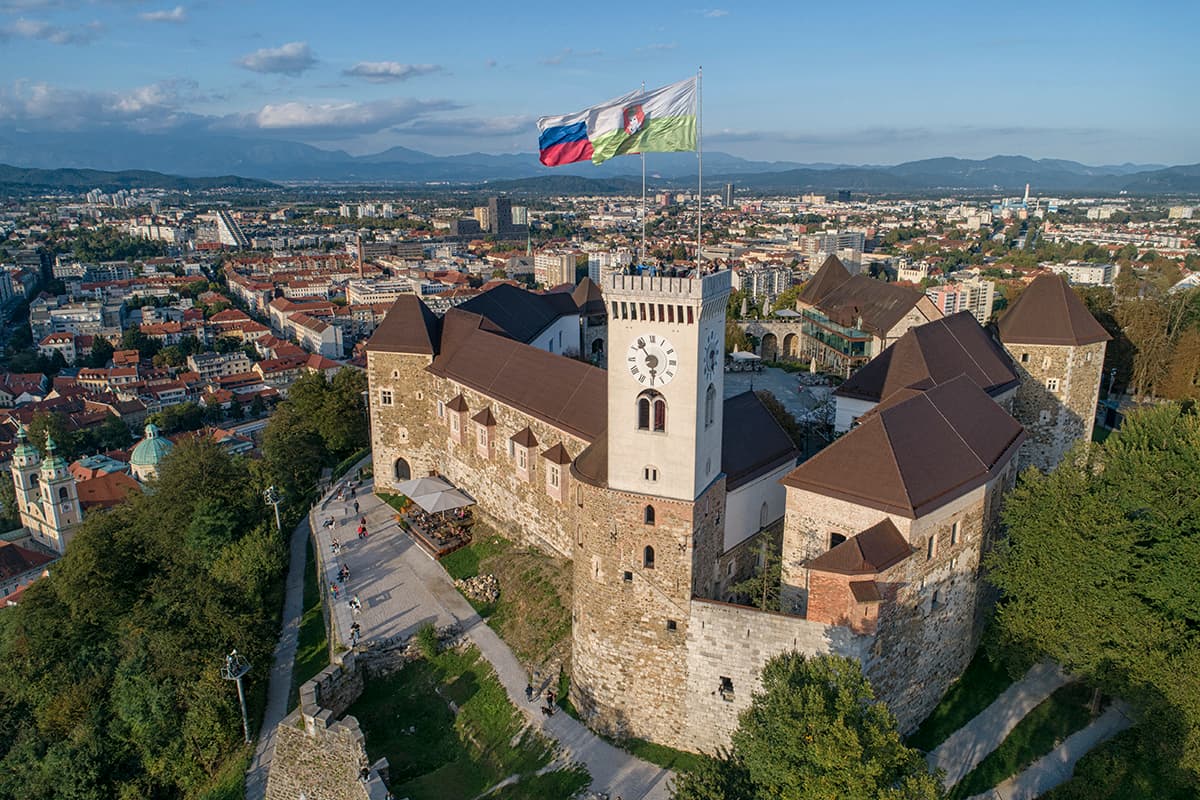
Ljubljana Castle stands prominently on Castle Hill, overlooking the downtown area of Ljubljana, the capital of Slovenia. This late-medieval bastioned fortress is not only a key historical landmark but also a vibrant cultural venue attracting visitors from around the world. Its strategic location atop the hill has made it a crucial defensive and administrative center through centuries of regional history.
Ancient origins and early settlement
Archaeological evidence reveals that the site of Ljubljana Castle has been continuously inhabited since around 1200 BC, during the transition from the Bronze Age to the Iron Age. Early settlers of the so-called "urn culture" likely established a fortified settlement here, protected by earthworks and wooden palisades. This prehistoric occupation reached its zenith in the 9th and 8th centuries BC.
Later, between 100 and 50 BC, the Romans established a military garrison on the left bank of the Ljubljanica River, founding the settlement of Emona. Remnants of Roman defensive walls still survive, marking the area's importance in antiquity. However, Emona was destroyed in the 5th century AD during the Hunnic invasions, marking the end of Roman dominance in the region.
Medieval development and the house of sponheim
The early medieval history of the hill remains somewhat obscure until the 12th century. In 1106, the castle and surrounding lands came under the control of the Sponheim family, princes of Carinthia. By 1200, the settlement on the right bank of the Ljubljanica River had grown sufficiently to be granted town rights, and the Sponheims erected a castle on the hill overlooking the town. Initially, this fortress was likely constructed mainly of wood, with only the princely palatium built in stone.
The Sponheim dynasty ruled the area for over 150 years until the death of Ulrich Spanheim in 1269. The following year, King Ottokar II of Bohemia seized Ljubljana and its castle. After Ottokar's defeat and death at the Battle of Marchfeld in 1278, the Habsburgs, under Rudolf I, took control of the region. Over the next century, the castle changed hands several times before becoming hereditary property of the Habsburgs in 1335. Ljubljana was elevated to the capital of the Duchy of Carniola in 1364, cementing the castle's administrative importance.
Fortification against turkish invasions and architectural transformation
In response to the growing Ottoman threat in the 15th century, significant defensive upgrades were undertaken. Between 1485 and 1495, the original Sponheim castle was demolished and replaced with a modern fortress adapted for artillery warfare. The new castle featured an irregular plan conforming to the hill's shape, with defensive walls integrated with the city's fortifications. The main entrance was originally approached via a northern drawbridge.
The castle suffered damage during an earthquake in 1511 but was subsequently rebuilt and expanded throughout the 16th and 17th centuries. New residential, economic, and military buildings were added around the courtyard. A new southern entrance was created in a pentagonal tower, featuring a double drawbridge, enhancing the fortress's defense capabilities.
Decline and changing uses from the 18th century onwards
By the mid-18th century, Ljubljana Castle's military significance declined. It was repurposed as an arsenal and gunpowder storage, which posed a fire hazard. Plans to demolish the castle in the 1790s were abandoned following the French occupation in 1797. During the Napoleonic Wars, the castle served as barracks and a military hospital.
After Austrian restoration in 1815, the castle was converted into a prison, a function it maintained until the 1895 Easter earthquake. During this period, the central courtyard was planted with trees and used as a prison yard. In 1905, the municipality purchased the castle and adapted parts of it for residential use, housing families until the 1960s.
20th century restoration and cultural renaissance
Extensive restoration began in the late 1960s and continued for over three decades, transforming the castle into a cultural hub. Today, Ljubljana Castle hosts exhibitions, concerts, theater performances, and weddings, making it a lively center of cultural activity.
The castle is accessible by road, hiking trails, and since 2006 by a funicular railway, which ascends the hill along the medieval city walls. The funicular enhances visitor access, linking the castle to the city center efficiently.
Architectural highlights and notable features
Castle chapel and towers
The oldest surviving structure is the castle chapel, dedicated to St. George, St. Pancras, and St. Helena, originally consecrated in 1489. The chapel retains Gothic elements alongside Baroque renovations from the 18th century. Several medieval towers remain, including the Archers' Tower, Frederick's Tower, the pentagonal tower, and the Tower of Erasmus, historically used as a noble prison. The walls of the Tower of Erasmus bear carved coats of arms, including that of the notorious baron Erasmus Luegger.
Defensive walls and panoramic terrace
The castle's defensive walls connect the various towers and provide a panoramic terrace offering sweeping views of Ljubljana and the surrounding landscape. The terrace was historically a summer retreat and now serves as a popular vantage point for visitors.
Prison and underground spaces
The prison area lies between the castle walls and natural rock formations, accessed only from the courtyard level by lowering prisoners with ropes or chains. Conditions were harsh, with no roof and minimal shelter. The castle also contains cisterns and underground galleries that historically collected and stored water.
Modern additions and cultural facilities
The castle includes a modern building from the 1980s housing wedding rooms, a cafeteria, and a souvenir shop. The Slovenian History Museum occupies part of the former gunpowder store, and art exhibitions are held throughout the castle. The virtual museum in the panoramic tower presents the castle's history in multiple languages.
Cultural events and visitor experience
Visitors can enjoy free access to the castle courtyard, which features cafes and galleries showcasing Slovenian craftsmanship. The castle hosts a range of cultural events, including concerts, theater performances, outdoor cinemas, and the annual medieval day in September. Wedding ceremonies are held regularly, adding to the castle's vibrant atmosphere.
The castle's location and historical significance are symbolized on Ljubljana's coat of arms, which features the castle topped by a dragon, a legendary city emblem.
Frequently asked questions (FAQ)
- How do I get to Lublana Castle?
- Lublana Castle is easily accessible from the city center of Ljubljana. You can take a funicular railway that provides a scenic ride to the castle, or enjoy a leisurely hike up the hill for stunning views of the city.
- What is the historical significance of Lublana Castle?
- Lublana Castle has a rich history that dates back to the 11th century, serving as a fortress and royal residence. It played a crucial role in the defense of the city and has witnessed many historical events throughout Slovenia's history.
- When was Lublana Castle built?
- The original structure of Lublana Castle was built in the late 11th century, although it has undergone numerous renovations and expansions over the centuries. The castle as it stands today reflects various architectural styles, showcasing its evolution over time.
- Can I explore Lublana Castle on my own?
- Yes, visitors are welcome to explore Lublana Castle independently. There are informative displays and signs throughout the castle that provide insight into its history and architecture, making it easy to navigate without a guided tour.
- Why is Lublana Castle a popular tourist attraction?
- Lublana Castle is a popular tourist attraction due to its stunning panoramic views of Ljubljana, its historical significance, and its well-preserved architecture. The castle also hosts various cultural events and exhibitions, enhancing its appeal to visitors.
- Is it possible to visit Lublana Castle year-round?
- Yes, Lublana Castle is open year-round, although opening hours may vary depending on the season. It's advisable to check the official website for the most current visiting hours and any special events that may affect access.
- What are the ticket prices for Lublana Castle?
- Ticket prices for Lublana Castle are generally affordable, with discounts available for students and seniors. A standard ticket typically includes access to the castle grounds and exhibitions, while additional fees may apply for guided tours.
- What is the best time to visit Lublana Castle?
- The best time to visit Lublana Castle is during the spring and early autumn when the weather is pleasant and the surrounding gardens are in full bloom. However, the castle is a year-round attraction, so you can enjoy its beauty at any time.
- Are there any nearby attractions to Lublana Castle?
- Yes, Lublana Castle is located near several other attractions, including the picturesque Ljubljana Old Town, the central market, and the Dragon Bridge. Exploring these nearby sites can enhance your overall experience of Ljubljana.
Photo gallery

Information
Website
Visit websiteSources & official resources
Verify the information above using these authoritative references.
Loading map...
Visitor reviews
No reviews yet. Been here? Write the first review and help other travelers!
Write the first reviewVisited this castle? Share your experience
Your review helps other travelers and adds first-hand knowledge to our encyclopedia.