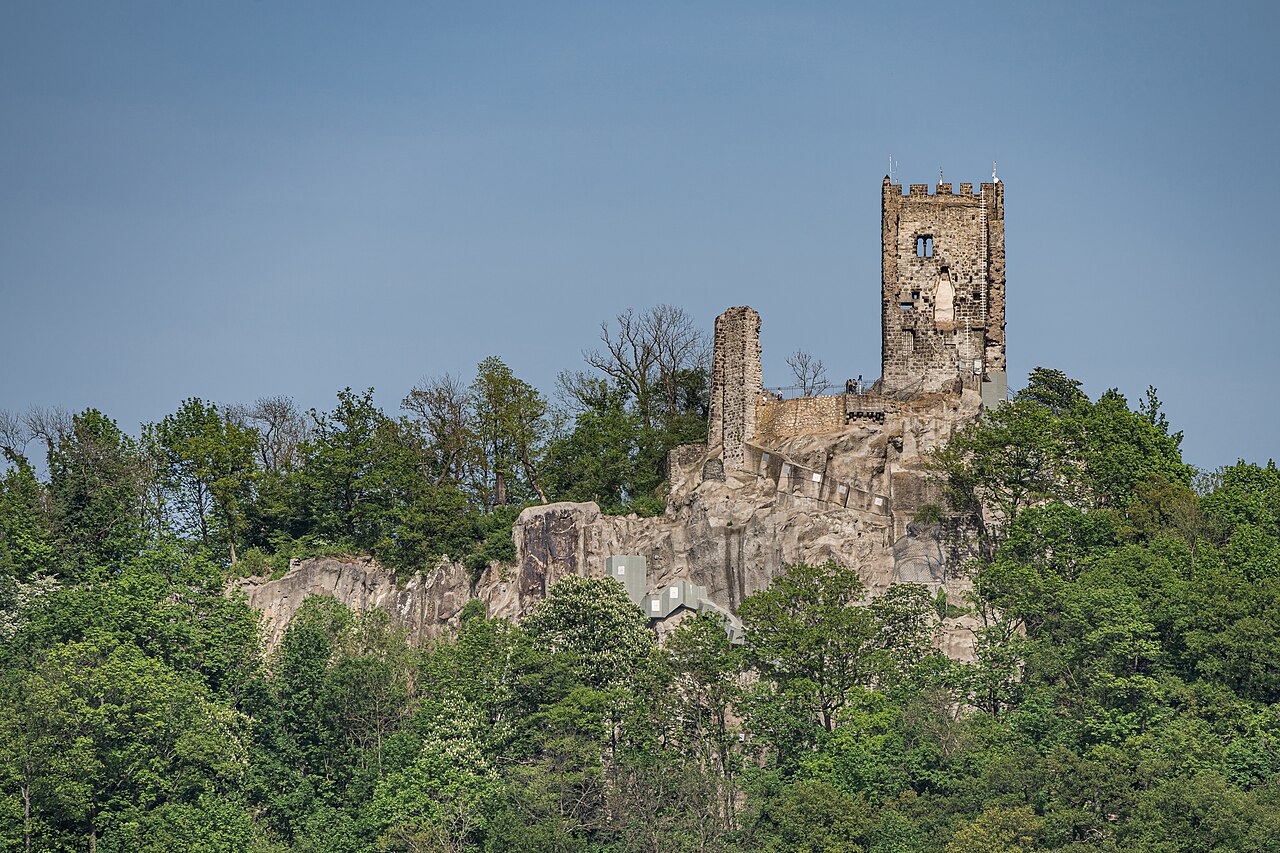
Löwenburg
Löwenburg Castle stands as a remarkable example of a medieval hill castle ruin located near Bad Honnef, Germany. Constructed in the 12th century by the Counts of Sayn, it served as a strategic border fortress during an era marked by frequent territorial disputes. Its elevated position atop a volcanic hill made it an imposing defensive site, while its enduring ruins offer valuable insights into medieval fortification and noble residence architecture.
Historical origins and medieval significance
The origins of Löwenburg trace back to the latter half of the 1100s, when Heinrich II, Count of Sayn, commissioned the castle to counterbalance the influence of nearby fortifications controlled by the Electorate of Cologne. The castle's first documented mention occurs in a 1247 charter, where it is referenced as "castrum Lewinberg" during the division of the Sayn family estates. This document highlights Countess Mechthild of Sayn retaining residence rights, underscoring the castle's ongoing importance in regional power dynamics.
Throughout the 13th century, Löwenburg underwent significant construction phases that shaped its core structures, including the main castle complex, the surrounding outer bailey, and a northern defensive ring. By 1269, the castle passed to the nephews of Mechthild, members of the Counts of Sponheim-Heinsberg lineage, who adopted the title Lords of Löwenburg. Their primary residence was in the nearby town of Honnef, with a secondary seat in Merheim, indicating Löwenburg's role within their regional network of power and administration.
Ownership transitions and decline
Over the following centuries, ownership of Löwenburg changed hands multiple times. By 1484, the castle came under the control of the Duchy of Jülich-Berg, where it functioned as the administrative center for the local district known as Amt Löwenburg until the mid-1500s. The castle's strategic importance waned over time, and military conflicts towards the end of the 16th century inflicted substantial damage, leading to its gradual decline into ruin.
19th and 20th century preservation efforts
In the 19th century, preservation efforts faced challenges. The bergfried (main tower) suffered partial demolitions in 1832 and again in 1881 due to structural weaknesses after unsuccessful attempts at preservation. Some conservation work was completed in 1834. From 1861, the Royal Prussian Forestry Office Siebengebirge assumed responsibility for the site, conducting restoration in 1862 and a major stabilization campaign between 1897 and 1901. A viewing tower was added atop the highest point in 1906, but it was likely destroyed during combat near the end of World War II in 1945. Additionally, an anti-aircraft observation post was established within the upper castle area in 1939.
Following the dissolution of Prussia in 1947, ownership transferred to the state of North Rhine-Westphalia. By the early 1950s, overgrowth rendered the ruin difficult to access, prompting plans for improved visitor routes. Between 1979 and 1985, a significant phase of conservation and archaeological excavation was undertaken through collaboration between state forestry authorities and the Bonn State Building Authority, overseen by the Rheinisches Landesmuseum. The restored site reopened officially in October 1985. In the late 1980s, sculptor Sigrid Wenzel created bronze plaques depicting the castle’s original appearance, enhancing visitor understanding of its historical form.
Further investigations in 2013 addressed damage to the bergfried’s remaining stump, combining masonry repairs with archaeological digs. These excavations uncovered approximately a dozen fragments of Siegburg stoneware pottery, now displayed in local museums. Modern surveying techniques including tachymetry and photogrammetry documented the ruin’s condition with precision, contributing to ongoing preservation and research.
Architectural features and castle layout
Löwenburg occupies an elevated, man-made plateau stretching roughly east to west atop a volcanic hill composed of ancient lava deposits known as nepheline-latite. The main castle complex is situated at the western and highest point of this plateau, while the outer bailey extends along the lower western area. Traditional access is via a steep, circular path winding around the mountain’s slope, with traces of an older hollow way marking the original route to the fortress.
The castle’s defensive system includes a neck ditch carved into the southwest side below the outer ring wall. This trench served as the first barrier against attackers and also provided building material; the adjacent latite quarry remains visible today. The walls were primarily constructed from rough latite stones quarried on site, giving the castle a distinctive volcanic rock appearance. In contrast, finer architectural details such as window and door frames in the palas (main residential building) were crafted from imported materials including trachyte and volcanic tuff, chosen for their refined qualities.
The bergfried, or central tower, originally founded on a roughly 10 by 10 meter base, survives only as an uneven stump due to 19th-century partial demolitions. Within the courtyard lies a preserved cistern that would have stored rainwater, vital for sustaining the castle’s inhabitants during sieges or droughts.
Defensive structures and materials
The castle’s fortifications reflect typical medieval military architecture adapted to the local geology. The use of nepheline-latite stone not only provided robust defensive walls but also integrated the structure harmoniously into the volcanic landscape. The outer bailey and northern defensive ring added layers of protection, while the neck ditch functioned as a formidable obstacle for invaders.
Archaeological significance and cultural heritage
Löwenburg is recognized as a protected cultural monument (Bodendenkmal) due to its archaeological and historical importance. Excavations have revealed artifacts such as Siegburg stoneware fragments, providing insights into the daily life and material culture of its medieval occupants. Historical visual records, including a 1629 etching by Wenzel Hollar based on earlier watercolors, offer valuable perspectives on the castle’s appearance during the early modern period.
Today, the ruins stand as a testament to medieval fortification techniques, noble residence architecture, and the complex history of regional power struggles in the Rhineland. The site attracts historians, archaeologists, and visitors interested in exploring the layered history of this 12th-century hill castle.
Frequently asked questions (FAQ)
- How do I get to Löwenburg Castle near Bad Honnef?
- Löwenburg Castle is accessible via a steep, circular hiking path around the volcanic hill near Bad Honnef. Visitors should wear sturdy footwear and be prepared for a moderate climb to reach the castle ruins.
- What is the historical significance of Löwenburg Castle?
- Löwenburg was built in the 12th century by the Counts of Sayn as a strategic border fortress. It played a key role in regional power struggles and served as an administrative center under the Duchy of Jülich-Berg.
- Can I explore the castle ruins freely?
- Yes, visitors can explore the Löwenburg ruins freely during daylight hours. However, some areas may be uneven or partially unstable, so caution is advised when walking around the site.
- When was the castle last restored?
- Significant restoration and archaeological work took place between 1979 and 1985, with additional masonry repairs and excavations conducted in 2013 to preserve the bergfried remains.
- Is there an admission fee to visit Löwenburg Castle?
- There is no admission fee to visit Löwenburg Castle, making it an accessible historical site for all visitors interested in medieval architecture and history.
Information
Sources & official resources
Verify the information above using these authoritative references.
Loading map...
Visitor reviews
No reviews yet. Been here? Write the first review and help other travelers!
Write the first reviewVisited this castle? Share your experience
Your review helps other travelers and adds first-hand knowledge to our encyclopedia.