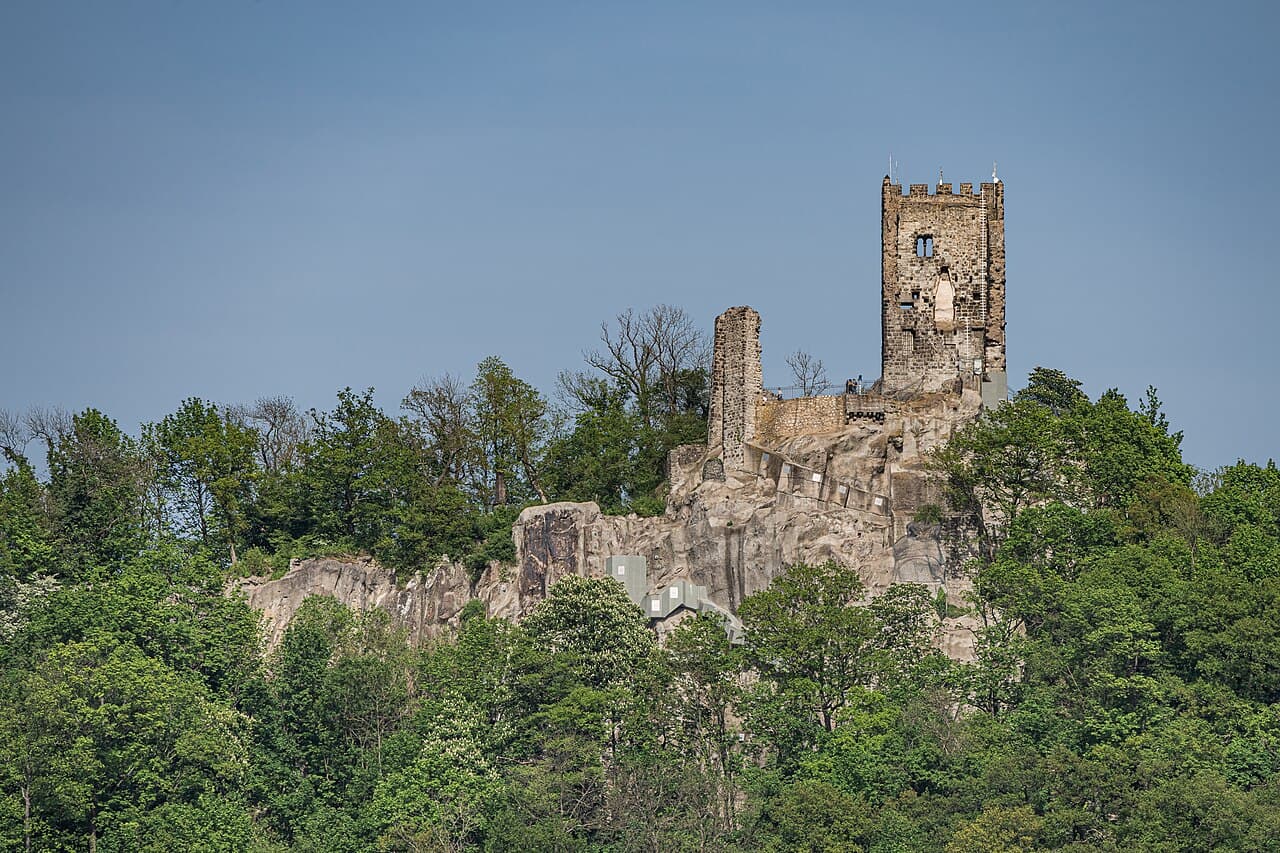
Burg Drachenfels
Burg Drachenfels stands as a captivating medieval hill castle ruin perched atop the thousand-foot Drachenfels hill in Königswinter, Nordrhein-Westfalen, Germany. This historic fortress, whose name means "Dragon's Rock," is steeped in rich legendary lore and significant medieval heritage. Built in the 12th century between 1138 and 1167 by Archbishop Arnold I of Cologne, the castle was strategically constructed to defend the Cologne region from southern threats. Its imposing bergfried tower, along with a chapel, living quarters, and defensive walls, formed a formidable stronghold that played a vital role in the region's medieval power dynamics.
Legend and cultural significance
The name Drachenfels is directly tied to numerous dragon legends that have captivated imaginations for centuries. One popular tale tells of a dragon that once inhabited the hill but was driven away by the prayers of a Christian maiden, symbolizing the triumph of faith over evil. Another legend recounts the defeat of a dragon through the use of early gunpowder, highlighting the castle’s connection to evolving military technology. Additionally, the myth of Fafnir, a dragon transformed from a cursed dwarf king's son and slain by the hero Sigurd, is linked to the treasure-filled caves believed to be located within the Drachenfels hill.
Beyond mythology, the hill's name may also derive from its geological significance. The Drachenfels is renowned for its trachyte quarries, which have been exploited since Roman times. This volcanic rock was prized for construction, notably used around the year 1000 for the building of the St. Maria im Kapitol church in Cologne. The quarrying tradition deeply connects the castle to the natural landscape, providing materials that shaped regional architecture.
Historical construction and strategic role
Burg Drachenfels was commissioned by Archbishop Arnold I of Cologne and completed by Gerhard von Are, provost of the Bonn St.-Cassius collegiate church, by 1149. The castle's primary purpose was to serve as a defensive bastion guarding the approaches to Cologne from the south. Its design featured a central bergfried tower approximately 25 meters tall, which provided a vantage point for surveillance and defense. The castle complex included a main castle (Hauptburg) with residential and ceremonial spaces, a chapel for worship, and a lower castle or outer bailey (Vorburg) that housed service areas and additional defenses.
Throughout the High Medieval period, the castle was managed by a hereditary family of burgraves, beginning with Godart von Drachenfels in 1176. This family maintained control until the early 16th century, overseeing the castle's operations and defense. The fortress witnessed several conflicts, including a violent family dispute in 1493 and occupation during the Cologne War in the late 16th century.
Military history and decline
Despite its initial strategic importance, the construction of the Bonn city walls in the mid-13th century diminished Burg Drachenfels' military role. The castle's significance further declined after its capture by Swedish Protestant troops during the Thirty Years' War in 1632. The following year, Spanish forces recaptured it, but Elector Ferdinand of Cologne ordered the demolition of the castle's outer defenses in 1634 to prevent future military use.
After being slighted, the castle was never rebuilt and gradually fell into ruin. Concurrently, intensified quarrying of the Drachenfels trachyte stone encroached upon the ruins, accelerating their deterioration. Quarrying was eventually banned in 1807 to protect the site, and the summit was acquired by the Prussian government in 1836 to preserve its heritage.
Architectural features and surviving remains
The surviving ruins of Burg Drachenfels reveal a complex layout comprising three main areas: the bergfried tower, the main castle, and the lower castle or outer bailey. Constructed primarily from locally quarried trachyte stone, the castle's architecture reflects typical High Medieval defensive design.
The bergfried is a rectangular tower about 25 meters tall with three internal floors. Its ground floor was windowless and lacked an entrance, emphasizing defense. The middle floor featured an eastern door, while the upper floor had three windows, one of which remains intact. A staircase once led to the roof, but a significant collapse in 1788 destroyed much of the southwest section. A large support pillar added in 1855 helps preserve the remaining structure.
The main castle area includes remnants of walls and the distinctive "Kölner Fenster" (Cologne Window), a partially preserved architectural feature. A rounded corner turret once guarded the approach path, illustrating the castle's layered defensive strategy.
The lower castle is accessed near the entrance gate, protected by a round tower likely two stories high. Surviving corbels indicate former wooden floors, and narrow arrow slits in the northern wall suggest a defensive walkway behind battlements. Archaeological evidence points to the presence of a knights' hall, residential buildings, a chapel, and service areas such as kitchens and stables, though some were lost in the 1788 rockfall.
19th and 20th-century preservation and cultural legacy
In the 19th century, Burg Drachenfels became a symbol of Romanticism, attracting poets like Heinrich Heine, who immortalized the castle in his 1819 poem "Die Nacht auf dem Drachenfels." Restoration efforts included structural reinforcement in 1855 and repairs in the 1890s. The 20th century saw further stabilization following a major rockfall in 1967, with the installation of steel anchors and concrete supports between 1971 and 1973.
Today, the castle is state-owned and managed by a conservation association dedicated to preserving the Siebengebirge region's natural and historical heritage. Modern additions on the summit include a 1914 obelisk and a replica of the 1814 Landsturm memorial. Visitors can enjoy panoramic views of the Rhine valley, the Cologne skyline, and nearby fortresses such as Godesburg.
Burg Drachenfels remains a significant cultural and historical landmark, embodying centuries of medieval architecture, regional defense history, and legendary folklore. Its ruins offer a tangible connection to the past, inviting exploration and reflection on the complex interplay of nature, myth, and human endeavor in shaping this iconic German hill castle.
Frequently asked questions (FAQ)
- How do I get to Burg Drachenfels?
- Burg Drachenfels is easily accessible by train, with the Königswinter station located nearby. From the station, you can take a scenic walk or a short bus ride to the castle entrance.
- What is the historical significance of Burg Drachenfels?
- Burg Drachenfels dates back to the 12th century and is steeped in legends, particularly the tale of the dragon associated with it. The castle has played a significant role in the region's history, serving as a strategic lookout point over the Rhine River.
- When was Burg Drachenfels built?
- The castle was constructed in the early 12th century, with its first records dating back to 1138. Over the centuries, it has undergone various restorations and modifications, reflecting different architectural styles.
- Can I visit Burg Drachenfels year-round?
- Yes, Burg Drachenfels is open for visitors throughout the year, although opening hours may vary seasonally. It's best to check the official website for the latest information on opening times before planning your visit.
- Why is Burg Drachenfels a popular tourist destination?
- Burg Drachenfels offers breathtaking views of the Rhine Valley and surrounding landscapes, making it a favorite spot for photographers and nature lovers. Its rich history, along with nearby attractions like the Drachenfelsbahn cog railway, enhances its appeal.
- Is it possible to access Burg Drachenfels with a wheelchair?
- While parts of Burg Drachenfels can be challenging for wheelchair users due to uneven terrain, there are accessible paths leading to certain areas. It's advisable to contact the visitor center in advance for specific accessibility information.
- What are the ticket prices for visiting Burg Drachenfels?
- Tickets for Burg Drachenfels typically range from €5 to €10, depending on the areas of the castle you wish to explore. Discounts may be available for children, seniors, and groups, so it's worth checking the official site for current pricing.
- What are the best times to visit Burg Drachenfels?
- The best times to visit Burg Drachenfels are during the spring and fall when the weather is mild and the surrounding foliage is at its most beautiful. Weekdays tend to be less crowded than weekends, allowing for a more enjoyable experience.
- What nearby attractions can I visit while at Burg Drachenfels?
- Nearby attractions include the picturesque town of Königswinter, the beautiful Rhine promenade, and the romantic Drachenfelsbahn cog railway. You can also explore the nearby nature trails for hiking and stunning views of the Rhine.

Information
Website
Visit websiteSources & official resources
Verify the information above using these authoritative references.
Loading map...
Visitor reviews
No reviews yet. Been here? Write the first review and help other travelers!
Write the first reviewVisited this castle? Share your experience
Your review helps other travelers and adds first-hand knowledge to our encyclopedia.


