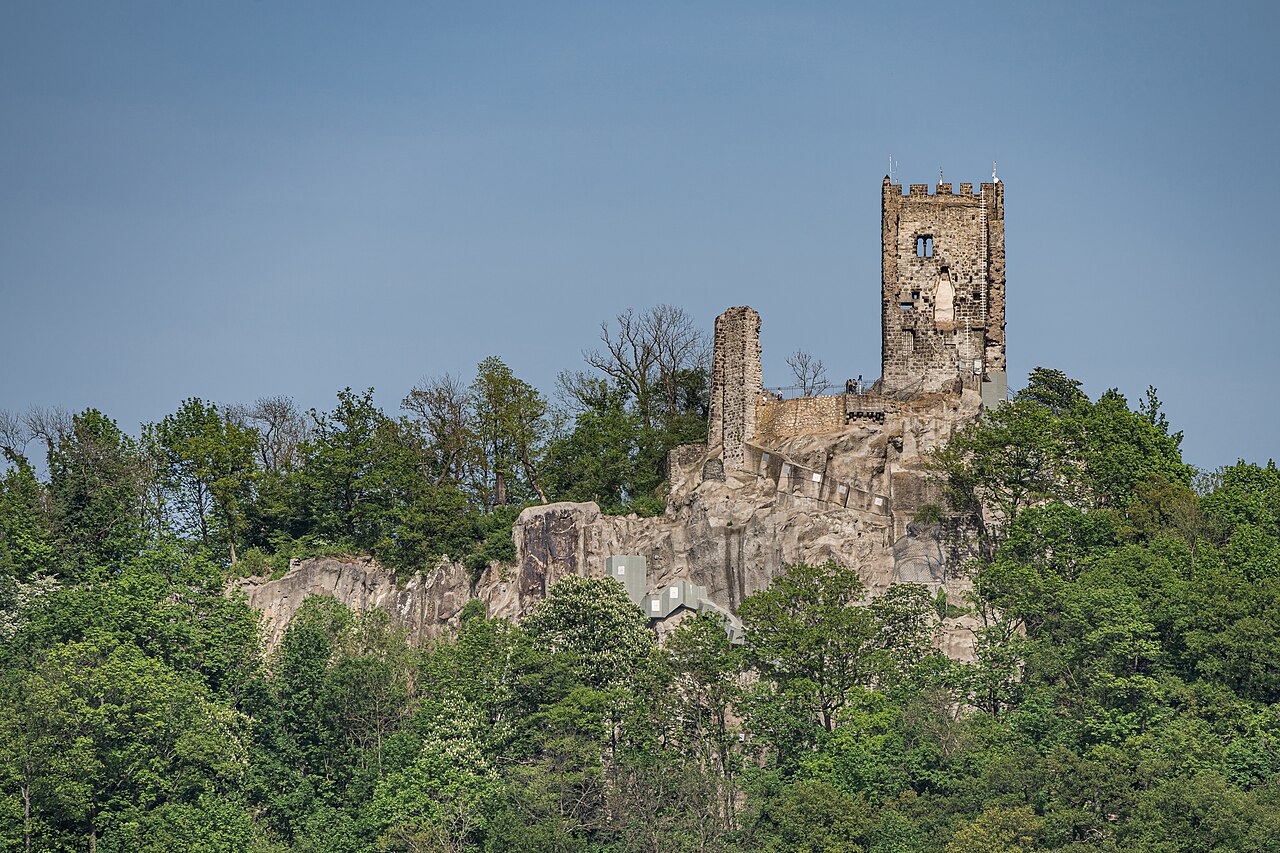
Burg Reitersdorf
Burg Reitersdorf stands as a significant medieval hill castle ruin located in the town of Bad Honnef, Germany. Constructed during the medieval period, this castle represents one of the earliest visible markers of the city's origins. Its remains offer valuable insights into the defensive architecture and feudal history of the region, reflecting the strategic importance of such fortifications in the Rhineland area during the 13th and 14th centuries.
The earliest documentary evidence of the area dates back to the year 866, where it appears under the name "villa rateresthorp" in historical records. This name evolved to "Retersdorpht" by 893, indicating a continuous settlement. By 1222, the settlement had gained administrative significance, serving as a messenger station for the local abbey, as recorded in the Prümer Urbar, a medieval land registry detailing holdings and rights in the region.
Construction and architectural features
The construction of Burg Reitersdorf began around 1270, initiated by Johann von Heinsberg following his expulsion from Löwenburg. The castle was likely intended as a new fortified residence for von Heinsberg and his followers, marking a fresh assertion of power within the region. By 1288, the castle, then known as "Castrum Reyterstorp", had come under the control of the Count of Jülich. The Count undertook significant expansions to bolster the castle's defenses and consolidate his authority over the surrounding territory.
Burg Reitersdorf was designed as a castellum, a compact fortified enclosure measuring approximately 25 by 25 meters. The castle's perimeter was defined by a robust curtain wall, reinforced with four rounded towers positioned at each corner. These towers provided strategic vantage points for surveillance and defense, allowing defenders to cover all approaches to the castle. The fortification was further enhanced by an incomplete moat surrounding the enclosure, intended as an additional obstacle against attackers.
Within the curtain walls, the core of the castle was a prominent square stone residential tower, serving as the main living quarters. This tower was likely originally surrounded by a wooden palisade, a defensive fence made from sharpened wooden stakes, adding an extra layer of protection. Adjacent to the main tower, archaeologists have identified the foundations of a rectangular building whose precise function remains unclear but was integral to the castle's occupation.
Evidence also suggests the existence of an outer bailey on the eastern side of the castle. This enclosed courtyard would have accommodated essential support functions such as stabling horses, workshops, and storage facilities, crucial for the daily operations of the castle inhabitants.
Historical significance and military conflicts
The castle's history is marked by military conflict, most notably in 1317, when the Archbishop of Cologne launched an attack during hostilities against the Count of Jülich. This assault inflicted substantial damage on both the castle and the surrounding settlement, reflecting the turbulent political landscape of the Rhineland during the late medieval period. Despite this destruction, the site continued to be recognized as "Rettersdorf" into the early 16th century, with records mentioning it as late as 1517.
Over subsequent centuries, the castle's military importance declined. Its structures were repurposed for more utilitarian uses, such as cellars and stables, reflecting changing social and economic conditions. The once formidable stronghold gradually fell into ruin, leaving behind foundational remains and partial walls.
Archaeological excavations and preservation efforts
The historical and archaeological value of Burg Reitersdorf has attracted scholarly interest since the 19th century. Initial excavations took place in 1872 during the construction of a villa by General von Seidlitz, uncovering foundational remnants of the castle. Renewed archaeological investigations occurred in 1980, revealing additional structural details and enabling partial restoration efforts to present the site to the public.
Today, the castle ruins are situated on the western edge of Bad Honnef's town center within Park Reitersdorf. This park not only preserves the castle's archaeological remains but also features a rare Ginkgo tree, symbolizing the blend of cultural heritage and natural beauty at the site. Restoration and conservation projects have been ongoing into the 21st century, with significant work beginning in 2017 focused on stabilizing the ruins and enhancing visitor access.
The site is protected under heritage conservation laws, ensuring its preservation for future generations. Interpretive signage and an information plaque installed in 1994 help connect visitors with the castle's medieval origins and historical context. Local toponyms such as Reitersdorfer Straße, established in 1948, further commemorate the legacy of the former settlement and its castle.
Architectural legacy and cultural importance
Burg Reitersdorf exemplifies the characteristics of a medieval hill castle in the Rhineland region, illustrating the evolution of feudal fortifications during the High to Late Middle Ages. Its compact design, featuring a fortified curtain wall with corner towers and a central residential tower, reflects typical defensive strategies of the period. The presence of an outer bailey highlights the multifunctional nature of such castles, serving both military and domestic needs.
The castle's ruins offer valuable insights into medieval construction techniques, including stone masonry and wooden defensive structures like palisades. Its historical narrative, shaped by political power struggles and military conflicts, enriches the cultural heritage of Bad Honnef and the broader region.
Today, Burg Reitersdorf stands as a protected archaeological site and a testament to medieval architecture and history. It attracts visitors interested in exploring the roots of Bad Honnef and understanding the region's feudal past through tangible remains and well-documented historical records.
Frequently asked questions (FAQ)
- When was Burg Reitersdorf built and by whom?
- Burg Reitersdorf was constructed around 1270 by Johann von Heinsberg after his expulsion from Löwenburg, serving as a new stronghold.
- What architectural features define Burg Reitersdorf?
- The castle features a roughly square curtain wall with four rounded corner towers, a central square stone residential tower, an incomplete moat, and evidence of an outer bailey.
- Is Burg Reitersdorf open to the public for visits?
- The castle ruins are located within Park Reitersdorf in Bad Honnef and can be visited by the public, though there are no formal ticketing or set opening hours.
- What historical events affected Burg Reitersdorf?
- In 1317, the castle was attacked by the Archbishop of Cologne during conflict with the Count of Jülich, resulting in significant damage to the castle and settlement.
- How has Burg Reitersdorf been preserved over time?
- Archaeological excavations since the 19th century, including major work in 1980 and restoration efforts starting in 2017, have helped stabilize and preserve the ruins.
Information
Website
Visit websiteSources & official resources
Verify the information above using these authoritative references.
Loading map...
Visitor reviews
No reviews yet. Been here? Write the first review and help other travelers!
Write the first reviewVisited this castle? Share your experience
Your review helps other travelers and adds first-hand knowledge to our encyclopedia.