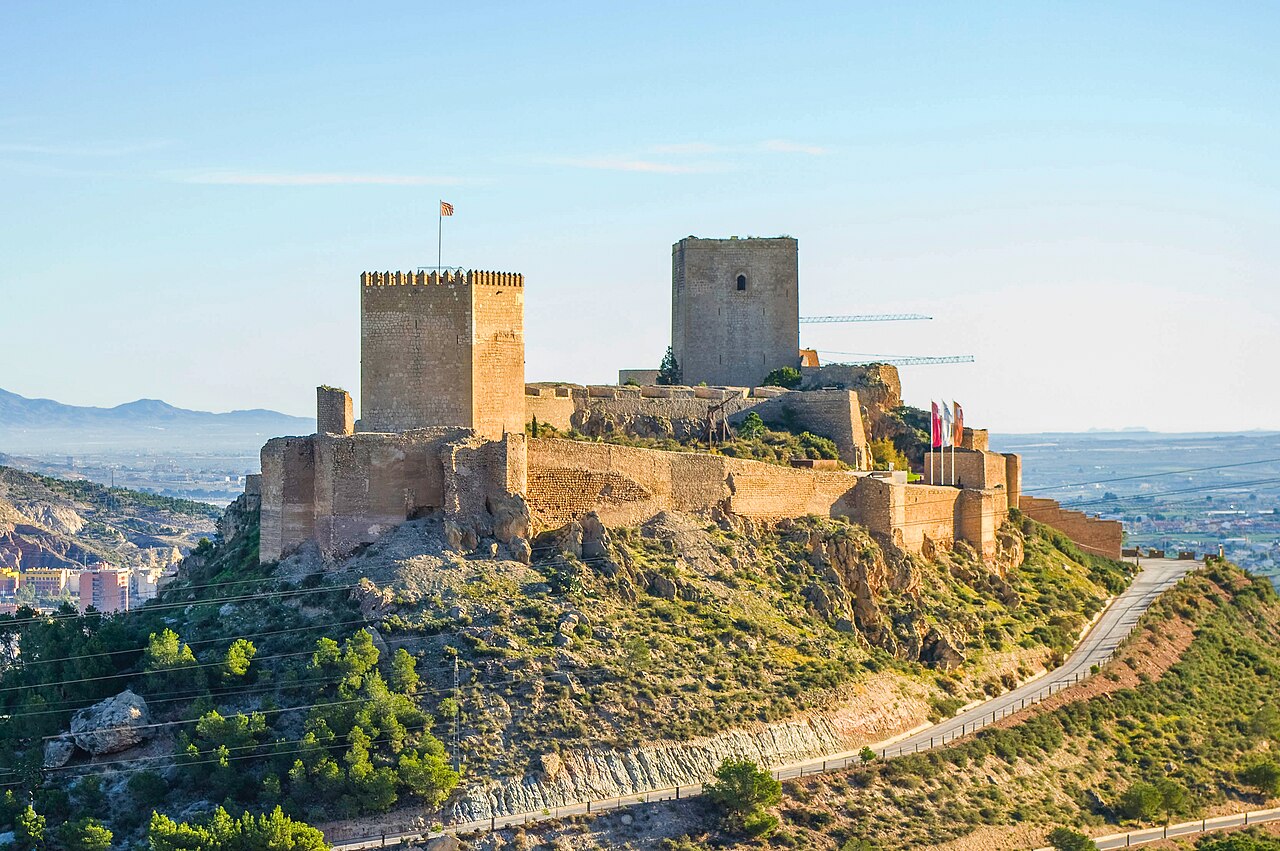
Aledo Castle

Aledo Castle: Moorish fortress in Murcia with medieval keep
Aledo, Murcia, Region de, Spain
High Medieval (11th–13th c.)
Well Preserved

Aledo Castle, also known as Castillo de Aledo, is a historic fortress located in the small town of Aledo in the Region of Murcia, Spain. This castle occupies a commanding position on a promontory in the southern foothills of the Sierra Espuña, rising approximately 125 meters above the Guadalentín valley. Its strategic location offered extensive views and control over the surrounding landscape, which was critical during the turbulent High Medieval period.

Origins and moorish construction in the 11th century

The castle was originally constructed in the 11th century by the Almoravids, a Muslim dynasty known for their military architecture and expansion in the Iberian Peninsula. The Almoravid builders selected the site for its natural defensive advantages, incorporating the rugged terrain into the castle's fortifications. The design reflected typical Moorish military architecture of the time, emphasizing strong walls and elevated positions to withstand sieges.

Conflict and control during the Reconquista

In 1088, during the Christian Reconquista, the castle was captured by the Castilian nobleman García Giménez. This event occurred in the aftermath of the significant Christian victory at Toledo in 1085, which destabilized Muslim control in the region. Despite the initial success, maintaining control over Aledo Castle proved challenging. The Almoravid caliphate mounted three sieges to reclaim the fortress, all unsuccessful at first. However, due to logistical difficulties and the inability to effectively defend the castle, the Castilians eventually abandoned it, allowing the Almoravids to regain control.

Christian reconquest and medieval reconstruction

By the late 13th century, the castle was once again conquered by Christian forces as part of the ongoing Reconquista efforts. Following this conquest, significant reconstruction took place to adapt the fortress to the evolving military needs and architectural styles of the time. The most prominent surviving feature from this period is the 20-meter-high square keep, which was built to serve as a stronghold and lookout point. Unfortunately, much of the original curtain walls and towers from both the Moorish and Christian phases have not survived.

Architectural features of the keep

The square keep stands as a testament to the medieval military architecture of the Christian reconquest era. Its robust stone construction and height provided defenders with a vantage point to monitor the surrounding valley and detect approaching threats. The keep likely contained living quarters, storage areas, and defensive positions such as arrow slits and battlements.

Current condition and visitor experience

Today, Aledo Castle remains a significant historical monument and is open to visitors for a fee. The castle's well-preserved keep offers panoramic views over the Guadalentín valley and the surrounding countryside, making it a popular destination for history enthusiasts and tourists alike. Despite being located in a quiet town, the castle's imposing presence and scenic location provide a memorable experience.

Visitor information and accessibility

The castle is accessible via the town of Aledo, with the address at Plaza Castillo 6. Visitors can explore the keep and enjoy the surrounding landscape. While the rest of the castle's fortifications have largely disappeared, the site still conveys the historical significance and strategic importance of this fortress during the medieval period.

Frequently asked questions (FAQ)

When was Aledo Castle originally built and by whom?
Aledo Castle was originally built in the 11th century by the Almoravids, a Muslim dynasty that controlled parts of the Iberian Peninsula.
What is the most prominent surviving feature of Aledo Castle?
The most prominent surviving feature is the 20-meter-high square keep, constructed during the Christian reconquest in the late 13th century.
Can visitors access Aledo Castle today?
Yes, Aledo Castle is open to visitors for a fee, allowing access to the keep and views over the Guadalentín valley.
Where is Aledo Castle located?
Aledo Castle is located in the town of Aledo, in the Region of Murcia, Spain, specifically at Plaza Castillo 6.
What historical events affected the control of Aledo Castle?
The castle changed hands multiple times during the Reconquista, initially built by the Almoravids, captured by Castilian forces in 1088, retaken by the Almoravids, and finally reconquered by Christians in the late 13th century.

Information

Hill Castle

Address

Plaza Castillo 6, Spain

Loading map...

Visitor reviews

No reviews yet. Been here? Write the first review and help other travelers!

Write the first review

Visited this castle? Share your experience

Your review helps other travelers and adds first-hand knowledge to our encyclopedia.

Write a review

(5/5)

0/2000 characters

Your review will be visible after admin approval

Nearby castles

14.8 km

Castillo de Alhama

Alhama de Murcia, Spain

Castillo de Alhama stands as a remarkable example of medieval military architecture in southeastern Spain, located in the municipality of Alhama de Murcia. This hill castle, perched at an elevation of 248 meters above the Guadalentín valley, offers a commanding view of the surrounding landscape, underscoring its strategic importance throughout history. Originally constructed by Islamic builders between the 11th and 12th centuries, the fortress exemplifies Almohad architectural design, which skillfully integrates natural terrain to enhance defensive capabilities. The castle began as a ḥiṣn, a fortified settlement typical of the Islamic period, intended to oversee and control the rural communities in the region. Its dual-purpose layout reflects the need for both military defense and civilian refuge, with distinct sections dedicated to political and military functions and residential areas for local inhabitants. This design highlights the castle's role not only as a military stronghold but also as a center of local governance and community protection. Historical context and significance Following the Treaty of Alcaraz in the early 13th century, which integrated the Kingdom of Murcia into the Crown of Castile, Castillo de Alhama came under Castilian control. It was granted to the nobleman Juan García de Villamayor, reflecting its continued strategic importance on the frontier between Christian and Muslim territories. During this period, the castle served as a crucial defensive outpost guarding the border area between the Crown of Aragon and the Nasrid Kingdom of Granada, illustrating the complex political and military dynamics of late medieval Spain. In the late 14th century, control of the castle and the adjacent town passed to the noble House of Fajardo. Throughout the 15th century, the Fajardo family used Castillo de Alhama as a noble stronghold from which they administered significant parts of the kingdom. The castle's role shifted increasingly towards administration and noble residence as the Reconquista advanced. After the completion of the Reconquista with the fall of Granada in 1492, the fortress's military importance declined. This decline was further accelerated by the suppression of the Morisco rebellion in 1571 and the subsequent expulsion of the region’s Arab-origin inhabitants by the late 17th century. These events led to a gradual abandonment of the castle and the surrounding area, contributing to its eventual ruin. Architectural features and remains Castillo de Alhama is a prime example of Almohad military architecture, characterized by its adaptation to the natural rocky hilltop and its robust defensive structures. The fortress is divided into two main sections: one dedicated to military and political functions, including the prominent prism-shaped keep or tower of homage, and another serving as a refuge and residential area for the local population. The surviving defensive walls, though fragmented, once formed a protective enclosure around the castle. The keep remains the central architectural element, featuring remnants of pointed arches typical of Islamic architecture. Within the keep, visitors can also find the vestiges of aljibes, or cisterns, which were essential for collecting and storing water during sieges or dry periods, demonstrating the castle’s self-sufficiency in harsh conditions. Other notable features include the castle’s strategic placement overlooking the Guadalentín valley, which allowed for extensive surveillance and defense against potential invaders. The castle’s layout and construction techniques reflect the military engineering skills of the Almohad period, emphasizing both functionality and resilience. Conservation and cultural importance After centuries of abandonment and deterioration, Castillo de Alhama has been recognized for its cultural and historical significance. Since 1997, it has held the status of Bien de Interés Cultural, a designation that protects it as a site of cultural interest in Spain. This status has helped to promote conservation efforts and archaeological research aimed at preserving the castle’s remains and uncovering its historical narrative. Recent decades have seen various conservation and excavation projects that have stabilized the ruins and provided valuable insights into the castle’s construction, use, and historical context. These efforts contribute to the broader understanding of Islamic and medieval military architecture in the region and highlight Castillo de Alhama’s role in the cultural heritage of Murcia. Today, the castle remains a significant landmark near the modern town of Alhama de Murcia, surrounded by agricultural land and low population density. It serves as a tangible connection to the region’s complex history, from its Islamic origins through the Reconquista and into the modern era. Visiting Castillo de Alhama Visitors to Castillo de Alhama can explore the ruins that reveal the castle’s historical and architectural features. The site’s elevated position offers panoramic views of the Guadalentín valley and the surrounding countryside, enhancing the visitor experience. While the castle is primarily in ruins, the preservation of key elements such as the keep and defensive walls allows for an engaging exploration of its medieval past. Access to the castle involves a climb up the rocky hill, which may require moderate physical effort. The surrounding area’s rural character and proximity to Alhama de Murcia make it a worthwhile destination for those interested in medieval history, Islamic architecture, and Spanish cultural heritage.

High Medieval (11th–13th c.)
Details
17.3 km
Lorca Castle — Spain castle

Lorca Castle

Lorca, Spain

Lorca Castle, locally known as Castillo de Lorca or Fortaleza del Sol, is a monumental fortress perched on a mountain ridge overlooking the city of Lorca in the Murcia region of southeastern Spain. This medieval fortress stands as one of the largest castles in Spain, stretching approximately 640 meters long and 120 meters wide, encompassing an extensive fortified complex that reflects a rich history spanning from the Neolithic period through the Middle Ages and into modern times. The site of Lorca Castle has been inhabited since the Neolithic and Bronze Ages, with archaeological evidence of an Argaric culture settlement beneath the fortress, including homes, funerary sites, and a protective wall. The first documented mention of a castle at Lorca dates back to the 9th century during the Muslim rule of the Iberian Peninsula, when the city was known as Lurqa and was part of the Cora of Tudmir, an administrative district of Al-Andalus. Muslim origins and fortress design During the Muslim era, Lorca Castle was a formidable alcazaba built on a mountain ridge running east to west. The fortress was divided by the Espaldón Wall into two main sections: the western bailey served as a protected area for storing livestock and grain during times of siege, while the eastern bailey, known as the barrio de Alcalá, was a residential quarter that included several cisterns and a significant Jewish neighborhood. The castle's walls extended beyond the main fortress to enclose surrounding neighborhoods and markets, reflecting its role as a key military and urban center in the region. Strategic importance during the reconquista In 1243, following the Treaty of Alcaraz which made the Muslim Taifa of Murcia a protectorate of Castile, Lorca refused to accept the treaty terms. This led to a siege in 1244 by a large Castilian army commanded by the future King Alfonso X of Castile. The fortress surrendered after the siege, marking the beginning of Christian rule. Subsequently, Lorca Castle became a vital defensive stronghold on the frontier against the Nasrid Kingdom of Granada. For over two and a half centuries, it served as a watchpoint and military bastion guarding the southeastern border of Christian Spain. Christian reconstruction and architectural evolution In the latter half of the 13th century, the castle underwent extensive reconstruction under Christian rule. The outer walls were reinforced and two prominent keeps were constructed: the Alfonsina Tower in the eastern bailey and the Espolón Tower in the western bailey. These towers replaced most of the original Muslim structures, leaving only foundational elements and the Espaldón Wall as remnants of the earlier phase. The Alfonsina Tower is a rectangular structure measuring approximately 22.7 by 19.4 meters, with walls up to four meters thick and a height nearing 30 meters. It contains three floors and a terrace, with brick vaults featuring diamond-shaped panels and arrow slits for lighting and defense. The Espolón Tower, square in plan with sides of 13 meters, features brick ribbed vaults supported by stone ribs, a battlemented terrace, and a basement cistern for water storage. Both towers were integral to the castle’s defensive capabilities. The jewish quarter within the alcazaba Within the fortress lies the remains of a Jewish quarter (Judería), covering about 5,700 square meters. Archaeological excavations uncovered twelve homes and a synagogue dating from the 14th century, the only known medieval synagogue in the Murcia region. The homes were rectangular with multiple rooms, elevated bedrooms, built-in benches, kitchens, and storage spaces. The synagogue is semi-subterranean, designed to maximize interior height while maintaining a discreet exterior profile, featuring a women's gallery and Gothic-style plasterwork decorating the niche for Torah scrolls. Decline and later history After the conquest of Granada in 1492, the frontier shifted southward, diminishing Lorca Castle’s military significance. The expulsion of Jews from Spain shortly thereafter led to the abandonment of the Jewish quarter and significant depopulation of the fortress area. Over the following centuries, the castle fell into ruin, with much of its structure deteriorating by the 18th century. The castle saw a revival during the early 19th century amid the Peninsular War (War of Spanish Independence), when walls and structures were repaired and modified, including the installation of artillery batteries that altered its medieval appearance. Modern recognition and preservation efforts In the 20th century, Lorca Castle gained official recognition for its cultural and historical value. The Alfonsina Tower and the castle were declared a National Historic Monument in 1931, and the historic center of Lorca, including the castle, was designated a Historic-Artistic Group in 1964. The castle suffered serious damage during the 2011 Lorca earthquake, particularly to the walls and the Espolón Tower. Restoration work was undertaken and completed by 2012, although some battlements were not reconstructed due to lack of historical documentation. Today, the castle precinct includes a Parador de Turismo, a luxury hotel integrated within the fortress that incorporates archaeological remains discovered during excavations, including parts of the Jewish quarter and synagogue. The castle is open to visitors for a fee and remains a significant cultural landmark and tourist attraction in the Murcia region.

Early Medieval (5th–10th c.)
Details
23.2 km

Torrecilla Tower

Near Diseminado Torrecilla, Spain

Torrecilla Tower, known locally as Torre de Torrecilla, is a historic watchtower situated on a hill south of the city of Lorca in the Murcia region of Spain. This tower is a notable example of High Medieval military architecture dating back to the 11th century, constructed during the period of Arab rule in the Iberian Peninsula. Its strategic location allowed it to guard the vital road connecting Murcia and Granada, playing a key role in regional defense and communication. Historical context and strategic importance During the High Medieval period, the Guadalentín valley was a crucial corridor for trade and military movements. The Torrecilla Tower was part of a network of watchtowers and fortifications established by the Arab rulers to monitor and protect this area. These towers provided early warning of approaching enemies and helped control movement through the valley. The tower’s position on a hill offered extensive views of the surrounding landscape, enabling effective surveillance. Architectural features and construction The tower features a square plan and rises to three floors, a common design for watchtowers of this era. Its robust stone construction reflects the military purpose of the structure, designed to withstand attacks and provide a secure vantage point. The walls are thick, and the tower’s height would have allowed sentries to observe distant terrain and signal to neighboring towers. Restoration efforts in recent decades have helped preserve the tower’s structural integrity while maintaining its historical character. The restoration work has ensured that the tower remains a visible landmark in the region and accessible to visitors. Current condition and visitor experience Today, Torrecilla Tower is well preserved and open to the public without an entrance fee. Visitors can reach the tower via a dirt road that almost allows driving directly to the site. The interior, while simple, shows signs of contemporary use, including graffiti, indicating it is a popular spot for local youth gatherings. Despite its modest size, the tower offers panoramic views over the Guadalentín valley and the surrounding hills, making it a rewarding destination for those interested in medieval military architecture and history. Its accessibility and free entry make it an attractive site for casual visitors and history enthusiasts alike. Role in regional heritage Torrecilla Tower stands as a tangible reminder of the region's medieval past and the complex history of Muslim-Christian interactions in southeastern Spain. It contributes to the cultural landscape of the Murcia region and serves as an educational resource illustrating the defensive strategies employed during the Arab period.

High Medieval (11th–13th c.)
Details