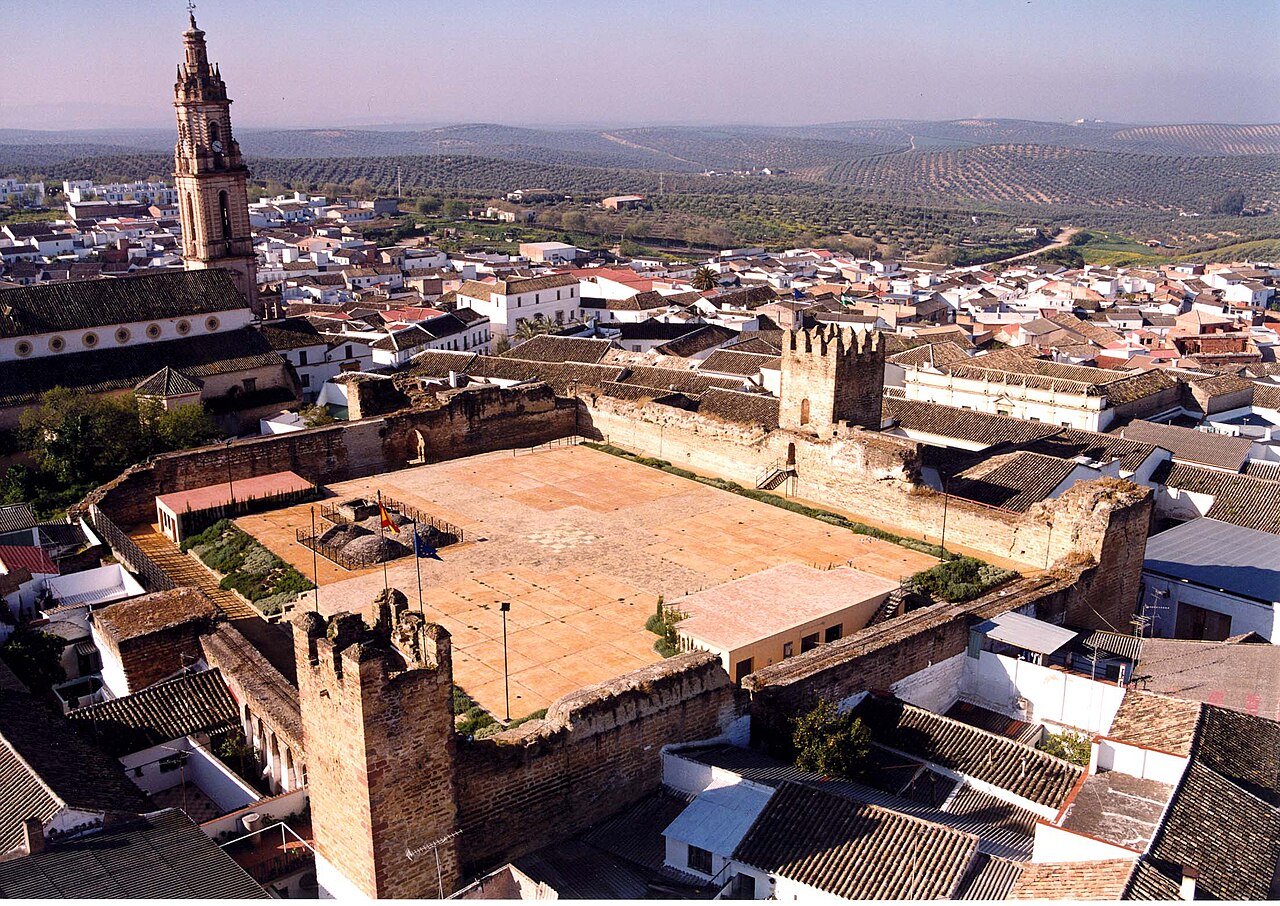
Lopera Castle stands prominently in the center of Lopera, Spain, as a significant example of high medieval military architecture. Constructed in the 11th century, this fortress exhibits a distinctive irregular pentagonal base formed by robust masonry walls. Its defensive design includes five towers, a combination of cylindrical and prismatic shapes, strategically positioned to cover all approaches. The castle's fortifications are enhanced by machicolated balconies, specialized openings that allowed defenders to repel attackers attempting to breach the entrances or scale the walls.
Early history and strategic location
The site of Lopera Castle has a layered history of occupation, beginning with Roman and Visigoth settlements before the Muslim conquest in the early 8th century. During the 9th and 10th centuries, the local population relocated to the present town site, where a small Muslim farmstead was established. This farmstead later evolved into a fortified position in the 11th century as a response to the increasing threat of Castilian attacks. The castle's location near the Guadalquivir River was strategically important, providing a vital escape route and access to water.
Construction and architectural features
Following the Christian reconquest of Lopera, King Ferdinand III granted control of the castle to the Order of Calatrava, a military order responsible for the defense and administration of frontier territories. The Order undertook significant construction to build the castle as it stands today, emphasizing military functionality. The combination of cylindrical and prismatic towers allowed for overlapping fields of fire and increased defensive coverage.
The machicolations on balconies and towers were a key defensive feature, allowing defenders to drop projectiles or boiling substances on attackers below without exposing themselves. The irregular pentagonal layout adapted to the terrain, maximizing defensive potential while accommodating the natural topography.
Towers and walls
The five towers vary in shape, with some cylindrical towers providing rounded surfaces that better deflect projectiles, and prismatic towers offering angular walls for stronger structural support. The walls themselves are composed of irregular masonry, typical of the period and region, combining local stone materials with mortar to create thick and durable fortifications.
Historical significance and ownership
The castle played a critical role in the border conflicts between Muslim and Christian forces during the Reconquista. Its fortification by the Order of Calatrava marked Lopera as a key defensive stronghold guarding the frontier against incursions.
In the 19th century, specifically in 1856, the castle was acquired by Alonso Valenzuela, who transformed it into public property, preserving its historical legacy for future generations.
Present condition and cultural importance
Today, Lopera Castle remains a well-preserved example of high medieval military architecture in Andalusia. Its combination of defensive towers, machicolations, and irregular layout offers insight into the strategic military thinking of the Order of Calatrava during the turbulent period of the Reconquista. The castle is a cultural landmark in Lopera, reflecting the layered history of conquest, settlement, and defense that shaped the region.
Visitors to the castle can appreciate the robust masonry, the varied tower designs, and the commanding views over the surrounding landscape and the nearby Guadalquivir River, which historically provided both strategic advantage and sustenance.
Frequently asked questions (FAQ)
- How do I get to Lopera Castle?
- Lopera Castle is located in the town center of Lopera, Andalusia, Spain. It is accessible by local roads and can be reached by car or public transport to Lopera town.
- What is the historical significance of Lopera Castle?
- Lopera Castle was a key defensive fortress during the Reconquista, built by the Order of Calatrava in the 11th century to protect against Castilian attacks.
- Can I visit the towers of Lopera Castle?
- Visitors can explore the exterior and some accessible parts of the castle, including its towers, which showcase a mix of cylindrical and prismatic designs.
- When was Lopera Castle built?
- The castle was constructed in the 11th century, during the high medieval period, on the site of earlier Muslim farmstead fortifications.
- Why does Lopera Castle have an irregular pentagonal base?
- The irregular pentagonal base adapts to the terrain and maximizes defensive coverage, a common strategy in medieval military architecture.
Information
Current owner
Public property
Loading map...
Visitor reviews
No reviews yet. Been here? Write the first review and help other travelers!
Write the first reviewVisited this castle? Share your experience
Your review helps other travelers and adds first-hand knowledge to our encyclopedia.