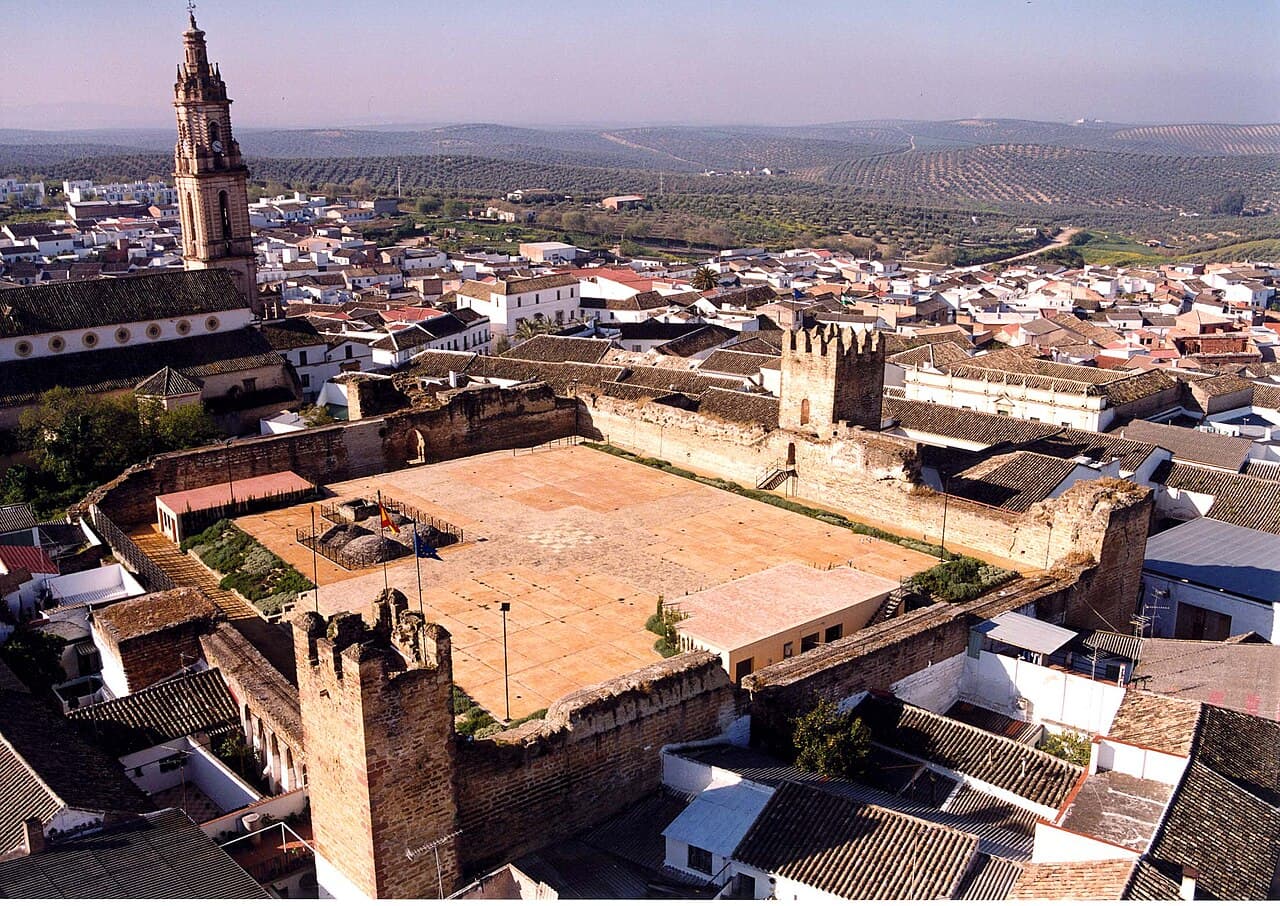
Bujalance Castle
Bujalance Castle, also known as the Alcazaba of Bujalance, stands as a remarkable example of 10th-century Muslim military architecture in the Iberian Peninsula. Constructed during the reign of Caliph Abd-ar-Rahman III in the early medieval period, this fortress was strategically built to serve as a defensive stronghold within Al-Andalus, the Muslim-ruled territories of Spain. Its location on a hilltop overlooking the town of Bujalance in the province of Córdoba highlights its military significance, providing commanding views for surveillance and protection.
The castle’s original Arabic name, Bury al-Hans, meaning "tower of the snake," is intimately linked to both the fortress's design and the identity of the town itself. The fortress originally featured seven defensive towers, a distinctive characteristic that inspired the modern name of the city and its coat of arms. Today, three of these towers remain — the Mazmorra Tower, the Malvavisco Tower, and the Palomas Tower — each restored to preserve their historical and architectural significance.
Historical context and evolution
The construction of Bujalance Castle dates back to the 10th century AD, during the height of the Caliphate of Córdoba. This period was marked by significant cultural and architectural developments under Muslim rule. The fortress was designed primarily for military purposes, reflecting the need for robust defense mechanisms amid ongoing conflicts in the region.
Following the Christian reconquest of the area, the castle underwent several modifications to adapt to new military and administrative needs. A notable renovation occurred in 1512, funded by Queen Joanna I of Castile, which introduced updates to the fortress's structure. These changes reflected the transition of the castle from a purely military installation to a site with administrative and cultural functions.
In the 20th century, the Spanish government recognized the castle's cultural and historical value by declaring it a Bien de Interés Cultural monument in 1963. Since then, restoration efforts have been ongoing to preserve the castle's fabric and adapt its spaces for public use.
Architectural features and layout
Bujalance Castle is built on a rectangular plan, measuring approximately 59 meters north-south and 51 meters east-west. Its design embodies the principles of Muslim military architecture, with thick defensive walls and strategically placed towers for optimal defense and surveillance.
The fortress originally boasted seven towers, a feature that was both symbolic and functional. These towers provided vantage points for archers and lookouts, enhancing the castle's defensive capabilities. Today, the surviving towers—Mazmorra, Malvavisco, and Palomas—stand as testaments to the castle’s original grandeur and strategic design.
One of the castle’s most fascinating architectural elements is the incorporation of a Roman miliarium, a milestone from the Via Augusta, the ancient Roman road. This stone, dating back to the reign of Emperor Claudius (41–54 AD), was repurposed as a doorpost within the fortress. Its presence symbolizes the layering of historical periods, connecting Roman antiquity with medieval Muslim and later Christian eras.
Courtyard and water management systems
The heart of the castle is its courtyard (patio de armas), an open central area that served as a multifunctional space within the fortress walls. Archaeological excavations have uncovered important features beneath the courtyard’s surface, including a cistern (aljibe) for water storage and a sedimentation basin (pileta de decantación), which was likely used to purify water. These installations were crucial for the fortress’s ability to withstand sieges by ensuring a reliable water supply.
Recent restoration projects aim to remove modern alterations from the courtyard to reveal these original elements more clearly. Plans include landscaping improvements to add shade and enhance visitor experience while respecting the site's historical integrity.
Restoration and cultural significance
Throughout the 20th and 21st centuries, Bujalance Castle has been the focus of extensive conservation efforts. The restoration of the northern and eastern walls, completed in 2021, exemplifies the commitment to preserving the fortress’s structural integrity and historical authenticity.
In 2015, the restoration of an 18th-century manor house within the castle grounds created a visitor interpretation center, providing educational resources and enhancing cultural tourism. This center helps contextualize the castle’s layered history for visitors, highlighting its significance in regional and national heritage.
The castle’s courtyard is actively used as a cultural venue, hosting events such as the Festival of Theatre, Music and Dance (Nights at the Citadel) and the Andalusian Dinner during summer months. These events celebrate the castle’s historical ambiance while promoting contemporary cultural engagement.
Archaeological discoveries and research
Archaeological investigations have been integral to understanding Bujalance Castle’s complex history. The discovery of the Roman miliarium within the castle walls was a significant find, linking the site to the broader historical landscape of Roman Hispania. This artifact was carefully extracted in 2022 for further scholarly study, underscoring the ongoing research interest in the site.
Excavations have also revealed multiple construction phases and adaptations, illustrating how the fortress evolved in response to changing political and military circumstances over more than a millennium.
Visitor information and accessibility
Today, Bujalance Castle is accessible to the public and serves as a prominent cultural landmark in the province of Córdoba. Visitors can explore the restored towers, walk the castle walls, and enjoy the scenic views of the surrounding town and countryside.
The visitor center offers interpretive exhibits that explain the castle’s history, architecture, and archaeological findings. Seasonal cultural events provide a unique opportunity to experience the castle’s historic atmosphere combined with live performances and traditional Andalusian cuisine.
Ongoing restoration and enhancement projects aim to improve visitor facilities while preserving the castle’s historical character, ensuring that Bujalance Castle remains a vibrant part of Spain’s cultural heritage.
Frequently asked questions (FAQ)
- What is the historical significance of Bujalance Castle?
- Bujalance Castle is a medieval fortress that dates back to the 13th century, reflecting the architectural and cultural influences of the period. It served as a strategic military stronghold during the Reconquista and symbolizes the rich history of the region.
- When was Bujalance Castle built?
- The castle was constructed in the 13th century, specifically around the year 1240, under the reign of King Ferdinand III of Castile. Its establishment marked a significant point in the defense against Islamic forces during the Reconquista.
- What are the opening hours for Bujalance Castle?
- Bujalance Castle is open to visitors from 10 AM to 6 PM daily. However, it is advisable to check for seasonal variations in hours or any special closures before planning your visit.
- Can I visit Bujalance Castle year-round?
- Yes, Bujalance Castle is open to visitors throughout the year. However, the best time to visit is during the spring and fall when the weather is mild and ideal for exploring the castle and its surroundings.
- Is there an admission fee to enter Bujalance Castle?
- Yes, there is a nominal ticket price to enter Bujalance Castle, which helps in the maintenance and preservation of the site. Discounts may be available for students, seniors, and groups, so be sure to inquire at the ticket office.
- How do I get to Bujalance Castle?
- Bujalance Castle is easily accessible by car, located just a short drive from the center of Bujalance. Public transportation options, including buses, also connect the town with nearby cities, making it convenient for visitors.
- What nearby attractions should I visit while in Bujalance?
- While in Bujalance, consider visiting the charming town square and the historic churches, including the Church of San Juan Bautista. Additionally, the surrounding countryside offers beautiful landscapes and opportunities for hiking and exploration.
- Is Bujalance Castle accessible for visitors with mobility challenges?
- The castle's terrain may present some challenges for visitors with mobility issues, as it includes uneven surfaces and stairs. However, staff are available to assist, and it is recommended to contact the castle in advance to discuss specific accessibility needs.
Photo gallery

Public domain
Information
Loading map...
Visitor reviews
No reviews yet. Been here? Write the first review and help other travelers!
Write the first reviewVisited this castle? Share your experience
Your review helps other travelers and adds first-hand knowledge to our encyclopedia.



