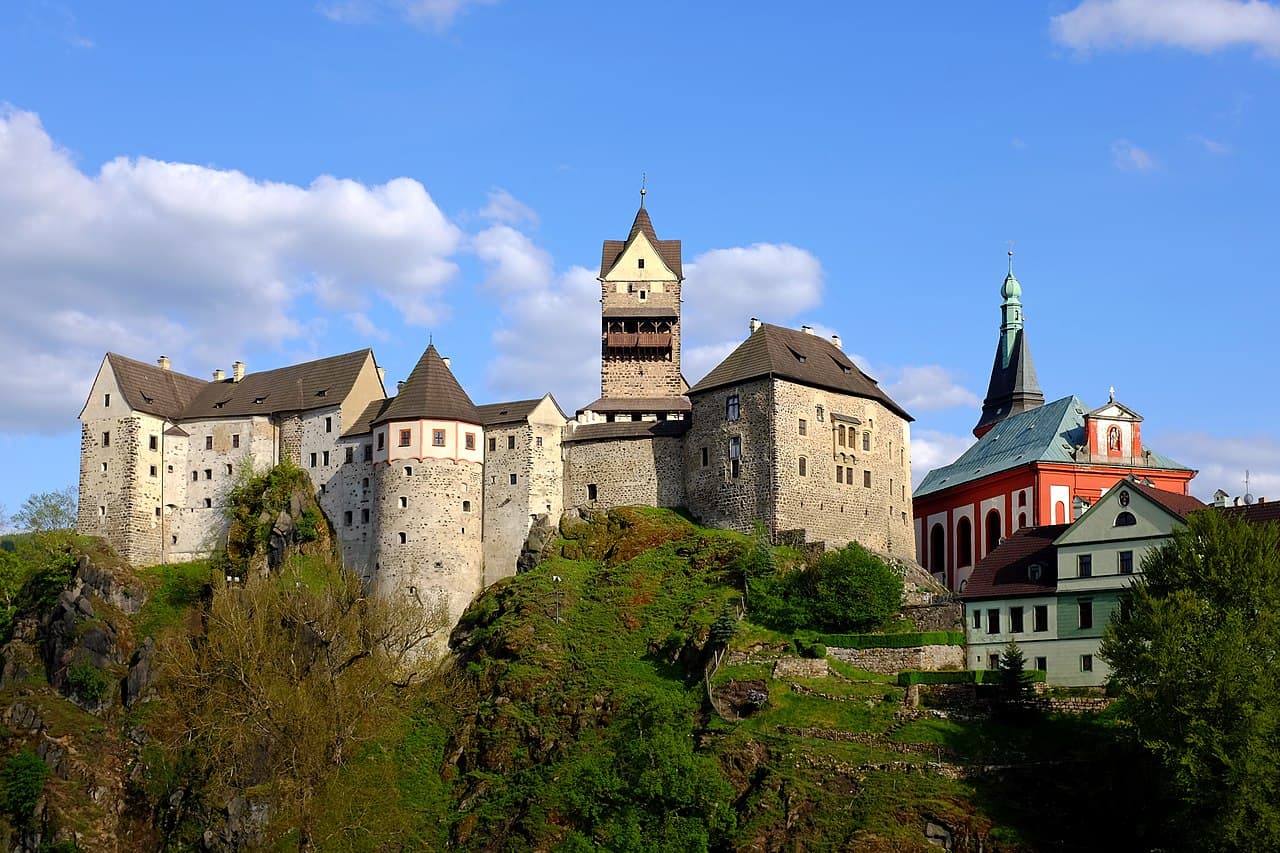
Loket Castle
Loket Castle, a majestic hill castle perched on a granite massif encircled by the Ohře river, is one of the most significant medieval fortresses in the Czech Republic. Founded in the 12th century, this fortress has stood for over 800 years, witnessing the rise and fall of dynasties, political intrigues, and military conflicts. Its strategic location on a rocky promontory provided natural defenses and control over important trade routes connecting Prague with Cheb and further to Plauen and Erfurt.
The castle's origins are linked to either the Czech King Vladislav I or officials under the Holy Roman Emperor Frederick I Barbarossa. Archaeological evidence, including a rare Romanesque rotunda integrated into the castle walls, strongly supports a foundation during the High Medieval period with influences from the Přemyslid dynasty. The rotunda, one of the smallest of its kind in the Czech Republic, exemplifies the castle's early Romanesque architectural roots and distinguishes Loket from typical Germanic fortifications.
Medieval origins and royal significance
The first written record of Loket dates to 1234, marking its emergence as a royal administrative center. Initially serving as a border fortress, Loket was crucial for protecting the kingdom’s western frontier and overseeing the lucrative merchant route. By the late 13th century, a settlement had developed around the castle, which was later elevated to the status of a royal town.
Under the reigns of Přemysl Otakar I, Václav I, and Přemysl Otakar II, the castle underwent significant expansion and fortification. Notably, during the reign of Přemysl Otakar II, new defensive walls with semicylindrical towers were constructed, transforming Loket into a formidable Gothic stronghold. The castle frequently hosted members of the royal family, underscoring its political importance.
The imprisonment of Charles IV
Loket played a pivotal role in the early life of Charles IV, future Holy Roman Emperor. During a dynastic conflict, Queen Elisabeth of Bohemia and her young son Václav (Charles IV) were imprisoned here by King John of Luxembourg in 1319. The young prince was confined in harsh conditions for approximately two months, an episode that left a lasting historical imprint and connected the castle to the broader narrative of Bohemian royal struggles.
Renaissance transformations and noble ownership
From the 15th century, Loket Castle entered a new phase under the ownership of the influential Šlik family. Chancellor Kaspar Šlik acquired the castle in 1434, initiating extensive renovations that introduced Renaissance architectural elements while preserving its Gothic character. The Šlik family transformed Loket into a representative noble residence, adding large halls, a chapel, and administrative buildings.
The castle withstood multiple sieges during the Hussite Wars, remaining loyal to the Catholic cause under the burgrave Půta of Illburk. Despite repeated attempts, Hussite forces failed to capture the fortress, cementing its reputation as the "Impregnable Castle of Bohemia."
Following the Šlik tenure, Loket passed to the Lords of Plavna and subsequently to the town burghers after disputes and confiscations. The castle's role shifted from a noble residence to an administrative and economic center for the town, reflecting changing political and social dynamics in the region.
Military conflicts and decline
The Thirty Years' War brought devastation to Loket and its surroundings. The town and castle endured multiple sieges and occupations by imperial, Swedish, and other forces. Economic hardship, plague, and war-related destruction severely impacted Loket, leading to a decline in its strategic importance.
A catastrophic fire in 1725 destroyed much of the castle’s upper structures, leaving only the ground floor and underground levels intact. Subsequently, the castle was partially rebuilt at a lower height, and the original Gothic church was replaced by a Baroque cathedral completed in 1734, designed by Wolfgang Braubock. The church features altar paintings attributed to Petr Brandl and side altars by local sculptor Jan Wild.
Castle as a prison and modern restoration
In the late 18th and 19th centuries, Loket Castle was converted into a town prison, a function it maintained until 1948. The prison cells and a chamber of torture have been preserved and are now part of the castle museum’s exhibits, providing visitors with a glimpse into the harsh judicial practices of the past.
After 1989, the castle was opened to the public and transferred to the administration of the Loket Castle Foundation in 1993. Since then, it has been restored and developed as a cultural and historical monument. The castle hosts exhibitions on local porcelain, medieval weaponry, and archaeology. It also features displays related to its prison history and the legend of the "bewitched burgrave" Elbogen meteorite, the largest meteorite found in the Czech Republic.
Architectural highlights and sections of the castle
- Margrave's House: Originally Romanesque, now a museum exhibiting locally-made porcelain and historical tombstones.
- Romanesque rotunda: A rare, small round chapel dating from the 12th century, integrated into the castle walls.
- Archaeological hall: Displays masonry from different construction phases, including original Romanesque walls and Renaissance kitchen remains.
- Prison cells and torture chamber: Preserved from the castle’s use as a prison, showcasing medieval and early modern punitive practices.
- Wedding and ceremonial halls: Spaces used for noble ceremonies and events.
- Historical arms and archaeological exhibits: Featuring medieval weaponry and artifacts uncovered during excavations.
- Burgrave’s house and captain’s house: 15th-century buildings reflecting the castle’s administrative functions.
- 16th-century palace: Two-winged structure with fortifications, demonstrating Renaissance architectural influence.
- Baroque cathedral: Built in 1734 on the site of the original Gothic church, featuring significant religious artworks.
Cultural significance and legends
Loket Castle is not only a monument of military and architectural history but also a cultural symbol entwined with local folklore. The legend of the goblin Gottstein, said to be the protector of the Loket rocks and the castle’s underworld, is commemorated by a bronze statue in the castle courtyard. This folklore adds a mystical dimension to the castle’s rich historical narrative.
Today, Loket Castle is a popular tourist destination and museum, attracting visitors interested in medieval architecture, Czech history, and cultural heritage. Its well-preserved structures, combined with extensive exhibitions and events such as the annual opera festival, make it a vibrant center for historical education and cultural engagement.
Frequently asked questions (FAQ)
- How do I get to Loket Castle?
- Loket Castle is located in the town of Loket, Karlovy Vary Region, Czech Republic. It is accessible by car and public transport, with parking available near the castle and regular bus connections from nearby cities like Karlovy Vary.
- What are the opening hours of Loket Castle?
- Loket Castle is typically open to visitors daily from 9:00 AM to 5:00 PM, with seasonal variations. It is advisable to check the official website or local tourist information for exact times before planning your visit.
- Can I take guided tours at Loket Castle?
- Yes, guided tours are available at Loket Castle, providing detailed insights into its history, architecture, and exhibits. Tours often include access to the porcelain collections, prison cells, and the torture chamber.
- What can I see inside Loket Castle?
- Visitors can explore various parts of Loket Castle including the Margrave's House with its porcelain museum, the Romanesque rotunda, prison cells, torture chamber, ceremonial halls, and archaeological exhibits showcasing medieval weaponry and artifacts.
- Is Loket Castle accessible for visitors with mobility issues?
- Due to its medieval hilltop location and historic structures, some areas of Loket Castle may be challenging for visitors with mobility issues. However, efforts have been made to improve accessibility, and visitors are advised to contact the castle administration for specific information.
- When is the best time to visit Loket Castle?
- The best time to visit Loket Castle is during the late spring to early autumn months when the weather is favorable for exploring the castle grounds and attending cultural events such as the annual opera festival.
- Are there any nearby attractions to visit along with Loket Castle?
- Nearby attractions include the historic town of Karlovy Vary, famous for its spas and architecture, as well as the scenic Ohře river valley. Visitors often combine a trip to Loket Castle with exploring these regional highlights.
Photo gallery

Information
Sources & official resources
Verify the information above using these authoritative references.
Loading map...
Visitor reviews
No reviews yet. Been here? Write the first review and help other travelers!
Write the first reviewVisited this castle? Share your experience
Your review helps other travelers and adds first-hand knowledge to our encyclopedia.



