Plikenštejn

Plikenštejn castle: medieval hill fortress in Czechia
Rovná-Sokolov, Czech Republic
High Medieval (11th–13th c.)
Archaeological Site

Plikenštejn Castle stands as a testament to the medieval fortifications that once dotted the landscape of what is now the Czech Republic. This hill castle is located near the municipality of Rovná-Sokolov, nestled on a rocky outcrop above the valley of the Lobezský stream. Its strategic position offered natural defensive advantages typical of hill castles, combining the rugged terrain with man-made fortifications to create a formidable stronghold in the medieval period.

The origins of Plikenštejn trace back to the mid-13th century, a time of significant regional colonization and castle-building activity in the area. The castle's establishment is linked to the noble family known as Plick or Plik, whose influence shaped the local landscape and governance. The family’s name is preserved in the castle's name and the surrounding estates, highlighting their historical importance. The initial construction phase likely occurred between 1250 and 1300, coinciding with settlement expansion that connected nearby strongholds such as Kynžvart Castle with Plikenštejn.

Medieval origins and noble lineage

Historical records indicate that Konrád Plik, a prominent figure of the family who died in 1335, divided his lands among his sons, with Petr Plik inheriting the castle of Nejdek alongside several villages and mining rights. This distribution reflects the typical feudal practice of land division and inheritance among noble families during the high medieval period. The castle's role was not only defensive but also administrative, overseeing local resources such as tin ore mining, which was economically significant at the time.

By the mid-14th century, the Plik family lost control of Plikenštejn, likely around 1360, when ownership transferred to the lords of Kynžvart. Subsequent documents from 1389 describe the castle as a fief held by the Leuchtenberg family, under the authority of the lords of Kynžvart and Albert Plik, who maintained a nearby manor. Despite these affiliations, Plikenštejn was already in decline by the late 14th century and was described as deserted, although it was still recognized as a small castle near the settlement of Vranov in records from 1390.

Ownership changes and decline in the renaissance

The 16th century brought several changes in ownership. In 1538, Heinrich of Plavna acquired the property, and by 1542, it passed to Count Jeroným Šlik. Land registers from this period refer to the castle as “Blickenstein near Fronaw,” reflecting linguistic variations and the evolving identity of the locality now known as Vranov. This era marked the continued decline of the castle as a military and residential site, coinciding with broader shifts in military technology and the reduced strategic importance of small hill castles.

Archaeological discoveries and site features

After centuries of neglect, archaeological excavations conducted in 1993 confirmed the exact location of Plikenštejn. The site revealed a modestly sized fortified complex adapted to the rocky terrain. The core area measured approximately 10 meters in length and was constructed directly on the rock surface, demonstrating advanced medieval masonry techniques rather than simple wooden structures.

The castle’s defensive system included a series of three ditches on the western side, which functioned as obstacles to hinder attackers. Additionally, three water moats surrounded the site, creating wet barriers that enhanced defense. These features indicate a thoughtful integration of natural and artificial defenses, typical of high medieval fortifications designed to maximize protection using the landscape.

Architectural layout and construction

The remains suggest a compact layout focused on a central fortified area with stone walls and buildings. Although the above-ground structures have largely vanished, archaeological evidence points to a well-planned stronghold with functional defensive elements such as moats and ditches. Only a single anchoring hole remains visible above ground today, marking where structural components once stood.

Legacy and commemoration

In 2016, a commemorative stone plaque bearing the Plick family coat of arms was installed on the castle rock, honoring the noble family responsible for founding the town of Nejdek and associating their legacy with Plikenštejn. This memorial serves as a tangible connection to the castle’s historical origins and the medieval nobility that shaped the region’s development.

Today, Plikenštejn remains an archaeological site of significant historical interest, offering insights into medieval castle construction, noble lineage, and regional history in Czechia. While the physical ruins are fragmentary, the site’s historical and cultural importance endures, attracting scholars and visitors interested in the medieval heritage of the region.

Frequently asked questions (FAQ)

What is the historical significance of Plikenštejn Castle?
Plikenštejn Castle, located in Rovná-Sokolov, Czechia, dates back to the 14th century and was built as a defensive stronghold. It played a crucial role in the region's history, serving as a residence for the local nobility and witnessing various historical events over the centuries.
When was Plikenštejn Castle built?
Plikenštejn Castle was constructed in the 14th century, with its origins tracing back to around 1350. The castle has undergone numerous renovations and restorations, preserving its historical architecture while adapting to modern visitor needs.
What are the opening hours for Plikenštejn Castle?
Plikenštejn Castle is typically open to visitors from April to October, with specific hours varying by season. It is advisable to check the official website for the most accurate and up-to-date information regarding opening times.
Can I take a guided tour of Plikenštejn Castle?
Yes, guided tours are available at Plikenštejn Castle, providing visitors with detailed insights into its history and architecture. These tours are led by knowledgeable guides who enhance the visitor experience with fascinating stories and facts about the castle.
Is Plikenštejn Castle accessible for visitors with disabilities?
The accessibility of Plikenštejn Castle can vary, as some areas may have limited access due to the castle's historical structure. It is recommended to contact the castle administration prior to your visit to inquire about specific accessibility options available for visitors with disabilities.
What is the best time to visit Plikenštejn Castle?
The best time to visit Plikenštejn Castle is during the spring and early autumn months when the weather is pleasant, and the surrounding landscape is vibrant. Additionally, visiting during these seasons often means fewer crowds, allowing for a more enjoyable experience.
Are there any nearby attractions to visit while at Plikenštejn Castle?
Yes, there are several nearby attractions to explore, including the picturesque town of Sokolov and the beautiful landscapes of the Slavkov Forest. Visitors can also enjoy local hiking trails and historical sites that enrich the experience of the region.
How much do tickets cost for Plikenštejn Castle?
Ticket prices for Plikenštejn Castle are generally affordable, with discounts available for children, students, and seniors. It is recommended to check the official website for the latest pricing information and any special offers that may be available during your visit.

Information

Hill Castle

Loading map...

Visitor reviews

No reviews yet. Been here? Write the first review and help other travelers!

Write the first review

Visited this castle? Share your experience

Your review helps other travelers and adds first-hand knowledge to our encyclopedia.
Write a review

(5/5)

0/2000 characters

Your review will be visible after admin approval

Nearby castles

9.7 km
Loket Castle — Czech Republic castle

Loket Castle

Loket, Czech Republic

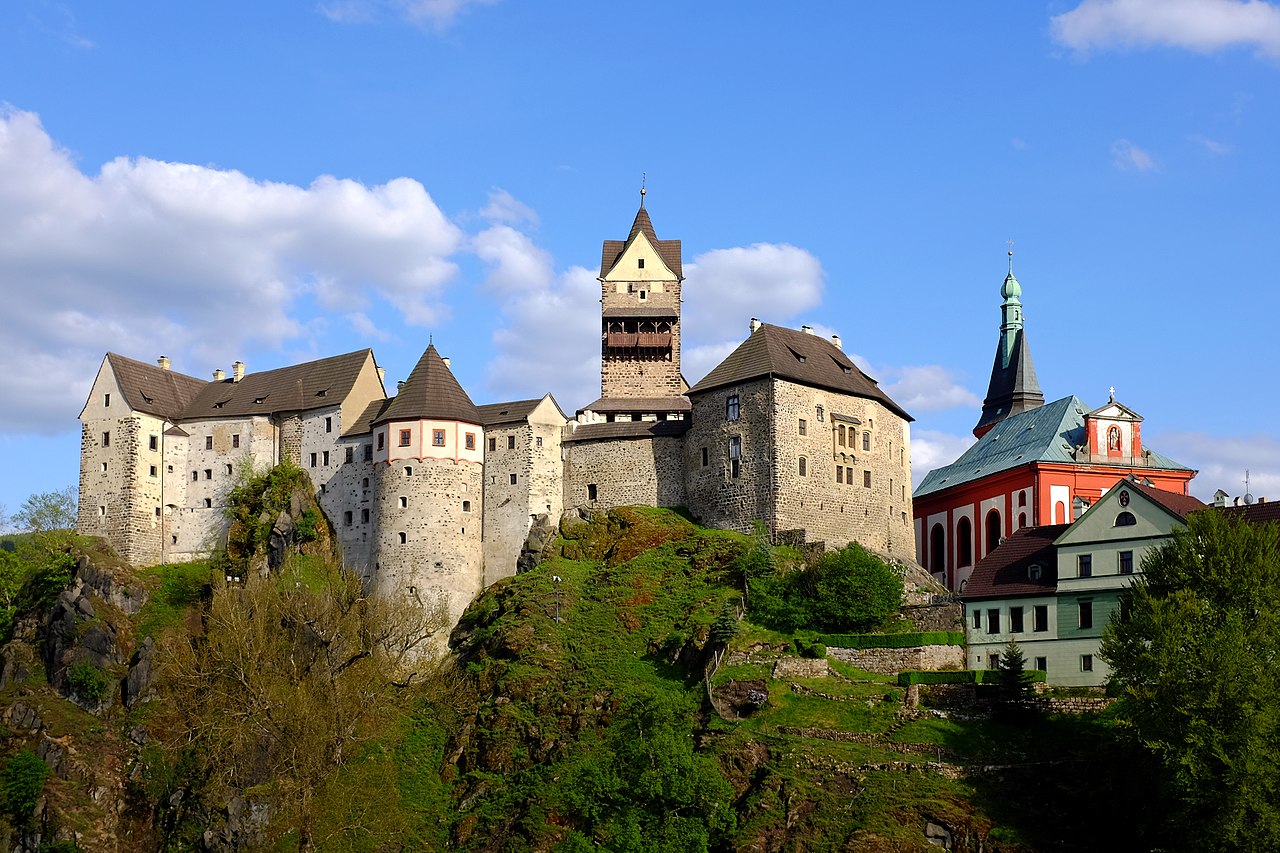
Loket Castle, a majestic hill castle perched on a granite massif encircled by the Ohře river, is one of the most significant medieval fortresses in the Czech Republic. Founded in the 12th century, this fortress has stood for over 800 years, witnessing the rise and fall of dynasties, political intrigues, and military conflicts. Its strategic location on a rocky promontory provided natural defenses and control over important trade routes connecting Prague with Cheb and further to Plauen and Erfurt. The castle's origins are linked to either the Czech King Vladislav I or officials under the Holy Roman Emperor Frederick I Barbarossa. Archaeological evidence, including a rare Romanesque rotunda integrated into the castle walls, strongly supports a foundation during the High Medieval period with influences from the Přemyslid dynasty. The rotunda, one of the smallest of its kind in the Czech Republic, exemplifies the castle's early Romanesque architectural roots and distinguishes Loket from typical Germanic fortifications. Medieval origins and royal significance The first written record of Loket dates to 1234, marking its emergence as a royal administrative center. Initially serving as a border fortress, Loket was crucial for protecting the kingdom’s western frontier and overseeing the lucrative merchant route. By the late 13th century, a settlement had developed around the castle, which was later elevated to the status of a royal town. Under the reigns of Přemysl Otakar I, Václav I, and Přemysl Otakar II, the castle underwent significant expansion and fortification. Notably, during the reign of Přemysl Otakar II, new defensive walls with semicylindrical towers were constructed, transforming Loket into a formidable Gothic stronghold. The castle frequently hosted members of the royal family, underscoring its political importance. The imprisonment of Charles IV Loket played a pivotal role in the early life of Charles IV, future Holy Roman Emperor. During a dynastic conflict, Queen Elisabeth of Bohemia and her young son Václav (Charles IV) were imprisoned here by King John of Luxembourg in 1319. The young prince was confined in harsh conditions for approximately two months, an episode that left a lasting historical imprint and connected the castle to the broader narrative of Bohemian royal struggles. Renaissance transformations and noble ownership From the 15th century, Loket Castle entered a new phase under the ownership of the influential Šlik family. Chancellor Kaspar Šlik acquired the castle in 1434, initiating extensive renovations that introduced Renaissance architectural elements while preserving its Gothic character. The Šlik family transformed Loket into a representative noble residence, adding large halls, a chapel, and administrative buildings. The castle withstood multiple sieges during the Hussite Wars, remaining loyal to the Catholic cause under the burgrave Půta of Illburk. Despite repeated attempts, Hussite forces failed to capture the fortress, cementing its reputation as the "Impregnable Castle of Bohemia." Following the Šlik tenure, Loket passed to the Lords of Plavna and subsequently to the town burghers after disputes and confiscations. The castle's role shifted from a noble residence to an administrative and economic center for the town, reflecting changing political and social dynamics in the region. Military conflicts and decline The Thirty Years' War brought devastation to Loket and its surroundings. The town and castle endured multiple sieges and occupations by imperial, Swedish, and other forces. Economic hardship, plague, and war-related destruction severely impacted Loket, leading to a decline in its strategic importance. A catastrophic fire in 1725 destroyed much of the castle’s upper structures, leaving only the ground floor and underground levels intact. Subsequently, the castle was partially rebuilt at a lower height, and the original Gothic church was replaced by a Baroque cathedral completed in 1734, designed by Wolfgang Braubock. The church features altar paintings attributed to Petr Brandl and side altars by local sculptor Jan Wild. Castle as a prison and modern restoration In the late 18th and 19th centuries, Loket Castle was converted into a town prison, a function it maintained until 1948. The prison cells and a chamber of torture have been preserved and are now part of the castle museum’s exhibits, providing visitors with a glimpse into the harsh judicial practices of the past. After 1989, the castle was opened to the public and transferred to the administration of the Loket Castle Foundation in 1993. Since then, it has been restored and developed as a cultural and historical monument. The castle hosts exhibitions on local porcelain, medieval weaponry, and archaeology. It also features displays related to its prison history and the legend of the "bewitched burgrave" Elbogen meteorite, the largest meteorite found in the Czech Republic. Architectural highlights and sections of the castle Margrave's House: Originally Romanesque, now a museum exhibiting locally-made porcelain and historical tombstones. Romanesque rotunda: A rare, small round chapel dating from the 12th century, integrated into the castle walls. Archaeological hall: Displays masonry from different construction phases, including original Romanesque walls and Renaissance kitchen remains. Prison cells and torture chamber: Preserved from the castle’s use as a prison, showcasing medieval and early modern punitive practices. Wedding and ceremonial halls: Spaces used for noble ceremonies and events. Historical arms and archaeological exhibits: Featuring medieval weaponry and artifacts uncovered during excavations. Burgrave’s house and captain’s house: 15th-century buildings reflecting the castle’s administrative functions. 16th-century palace: Two-winged structure with fortifications, demonstrating Renaissance architectural influence. Baroque cathedral: Built in 1734 on the site of the original Gothic church, featuring significant religious artworks. Cultural significance and legends Loket Castle is not only a monument of military and architectural history but also a cultural symbol entwined with local folklore. The legend of the goblin Gottstein, said to be the protector of the Loket rocks and the castle’s underworld, is commemorated by a bronze statue in the castle courtyard. This folklore adds a mystical dimension to the castle’s rich historical narrative. Today, Loket Castle is a popular tourist destination and museum, attracting visitors interested in medieval architecture, Czech history, and cultural heritage. Its well-preserved structures, combined with extensive exhibitions and events such as the annual opera festival, make it a vibrant center for historical education and cultural engagement.

High Medieval (11th–13th c.)
Details
11.2 km

Bečov Castle

Bečov nad Teplou, Czech Republic

Bečov Castle, located in the town of Bečov nad Teplou in the Czech Republic, is a remarkable example of a late medieval hill castle that evolved through centuries from a strategic fortress to a noble residence. Founded in the first half of the 14th century, the castle stands on a rocky promontory naturally defended by the Teplá River and the Dolský stream, providing a commanding position over the surrounding landscape. Its earliest documented reference dates to 1349, though archaeological evidence suggests origins possibly linked to the late 13th century and the noble family of Rýzmburk. The castle's original core comprises a bergfried (defensive tower) and a residential palace, which formed the upper castle area. Soon after 1352, construction began on a tower initially intended for residential use but repurposed as the Chapel of the Visitation of the Virgin Mary, uniquely oriented north rather than east due to spatial constraints. This chapel is renowned for its rare al secco wall paintings dating from around 1360, depicting biblical scenes with vivid colors and symbolic motifs. Following 1356, the castle expanded with the addition of a large keep, one of the largest in Bohemia, which served as a representative residential tower. The keep's interiors were adorned with late Gothic paintings, especially in the private chambers of the castle lord. A rampart connected the chapel tower and the keep, creating a fortified residential complex. Architectural evolution and noble ownership In 1495, the castle was acquired by the wealthy Pluhs of Rabštejn, whose fortune derived from tin mining in the nearby Slavkovský les mountains. They undertook significant modifications, including the Renaissance-style reconstruction of the oldest sections behind the bergfried, now known as the Pluh Houses. The Pluh family also connected the keep and chapel with a grand dining hall used for feasts and social gatherings, reflecting the castle's dual military and residential functions. The Thirty Years' War (1618–1648) marked a turbulent period for Bečov Castle. In 1624, the Questenberg family took ownership, primarily using the estate for agricultural purposes. The castle was garrisoned by imperial troops until 1648, when it was captured by General Königsmark. To bolster defenses, the Questenbergs added a cannon bastion above the moat, later incorporated into an octagonal Baroque tower in the 18th century. After the death of Adam Questenberk in 1752, the estate passed to Dominik Ondřej Kaunitz Jr., and later in 1813 to Friedrich August Beaufort-Spontin. The Beaufort-Spontin family played a critical role in the castle's 19th-century history, purchasing the St. Maurus Reliquary in 1838 and initiating extensive repairs and plans for a romantic reconstruction inspired by medieval styles. Architect Josef Zítek designed a project to connect the medieval castle with the adjacent Baroque chateau, but financial constraints limited the work to the restoration of the St. Peter's chateau chapel. Baroque chateau and landscape park The early 18th-century Baroque chateau built in the castle's forecourt by Johann Adam of Questenberg signaled a shift from fortress to aristocratic residence. This elegant structure featured terraced gardens, greenhouses, and a private theater, demonstrating the changing tastes and social functions of the estate. In the 19th century, the Beaufort-Spontin family developed an extensive landscape park, likened to the famous Průhonice Park, under the stewardship of Heinrich George and his wife Adelheid Sylva-Tarouca. Architectural features and interior highlights The chapel and wall paintings The castle chapel, consecrated on May 14, 1400, is a highlight of Bečov's architectural heritage. It features a ribbed cross-vaulted ceiling with painted keystones and a rich program of biblical frescoes illustrating scenes such as the Annunciation, Nativity, Calvary, and the Adoration of the Magi. The vault is decorated with celestial symbols including the sun, moon, stars, and representations of the four Evangelists. Heraldic elements, including the Rýzmburk family coat of arms, are integrated into the decorative scheme. The keep and residential towers The large rectangular keep and adjacent towers are built from finely dressed stone and contain late Gothic architectural details such as stone door portals and painted decorations. The residential quarters were expanded in the early 16th century, including the addition of Renaissance-style windows and halls in the Pluh Houses. Archaeological research has identified the castle kitchen in the northern section of these buildings. Defensive structures The castle's medieval defenses included a large round tower approximately 11 meters in diameter, positioned on solid rock at the southern edge. Although much of this tower was dismantled in the 17th and 18th centuries, remnants remain with Gothic bases and heraldic reliefs. The moat and ramparts were enhanced with a Baroque cannon bastion, reflecting evolving military technology. Modern history and preservation Following World War II, the Beaufort-Spontin family was dispossessed due to their association with the Nazi regime. The castle was repurposed as a school before being transferred to the Pilsen Historical Institute in 1969. Since then, ongoing restoration efforts have preserved key elements such as the Pluh Houses and the medieval chapel. A major highlight of the castle's modern cultural significance is the St. Maurus Reliquary, a precious Romanesque Christian artifact dating from the 13th century, discovered hidden in the castle chapel in 1985. After meticulous restoration, the reliquary has been on public display since 2002, housed in a dedicated modern exhibition space within the castle complex since 2021. This treasure is often described as "the finding of the century" and draws visitors from around the world. Today, Bečov Castle is recognized as a national cultural monument of the Czech Republic. It offers a unique window into medieval and Baroque architecture, noble history, and art. Visitors can explore the castle's diverse architectural layers, from Gothic chapels and Renaissance halls to Baroque residences and landscaped gardens, all set in a picturesque natural environment. Visiting Bečov Castle The castle complex is open to the public with exhibitions focusing on Gothic art, the history of the castle, and the St. Maurus Reliquary. Guided tours provide insight into the castle's architectural evolution, its noble owners, and the cultural significance of its collections. The surrounding park and gardens offer a serene setting for exploration. Bečov Castle stands as a testament to the rich historical tapestry of Bohemia, embodying centuries of architectural innovation, noble ambition, and cultural heritage.

Late Medieval (14th–15th c.)
Details
11.4 km

Kynzvart Castle Ruins

Lázně Kynžvart , Czech Republic

Kynzvart Castle Ruins stand as a remarkable testament to medieval fortification in the Czech Republic, perched at one of the highest elevations in the country at 827 meters above sea level. Originally constructed in the 13th century, this hill castle was strategically positioned near the present-day Kynžvart Chateau, famously associated with the Austrian Chancellor Metternich. The castle's original name, Königswart (meaning "Royal Guard"), reflects its foundational purpose as a border stronghold protecting the kingdom's frontier and a vital trade route connecting Plzeň and Cheb. Built during the high medieval period, Kynzvart Castle played a pivotal role in the defense and administration of the Bohemian borderlands. The castle's foundation is commonly attributed to King Václav I, with some evidence suggesting that construction may have been completed under his successor, Přemysl Otakar II. It is also possible that an earlier wooden fortress existed on the site before the stone castle was erected. The castle first appears in historical records in 1287, when it was held by the noble family of the Hartenberks, royal servants entrusted with its custodianship. Historical significance and ownership Throughout its history, Kynzvart Castle witnessed frequent changes in ownership and fluctuating fortunes. Its strategic location made it a key military post in a region often marked by conflict. In 1322, the nearby territory of Chebsko was formally reintegrated into the Kingdom of Bohemia under an imperial charter by Emperor Ludwig of Bavaria, enhancing the castle's importance as a border fortress. However, the castle's prominence declined sharply in 1347 when Emperor Charles IV ordered its complete destruction. This drastic measure was taken because the castle's owners at the time were involved in outlawed activities, leading to a prohibition against rebuilding the fortress. Consequently, Kynzvart was abandoned as a residence and military post. Despite its ruined state, the castle remained under the control of various noble families over the following centuries, including the influential Metternich family. The castle's defensive role effectively ended, and it suffered further damage during the Thirty Years’ War. In 1647, it was besieged and destroyed by both Swedish and imperial forces. After this final devastation, the castle was never restored. Instead, its stones were repurposed for the construction of the nearby Kynžvart Chateau and other local buildings, with documented reuse in a house rebuilt in 1770. Architectural features and layout Kynzvart Castle was designed with a well-planned layout that reflects typical high medieval military architecture. The core of the castle was a fortified enclosure, roughly trapezoidal or oval in shape, protected by thick curtain walls and surrounded by a water-filled moat. The inner section was further secured by an earthwork rampart. Within this core stood a prominent two-room tower palace, likely a bergfried—a tall tower used both as a residence and a final defensive refuge. Surrounding the inner castle was a double parkán wall, an outer defensive barrier that provided layered protection against attackers. Access to the inner castle was controlled by two drawbridges leading to a gate housed within a square bastion positioned at a corner of the walls. Near the northwest gate, a semicircular tower served as an integrated bastion, reinforcing the stronghold's defensive line rather than acting as a standalone bergfried. Between 1398 and 1400, the castle underwent expansion with the addition of an outer bailey, a fortified courtyard separated from the core by a rock-cut moat. This bailey was protected by further parkán walls, two substantial moats, and earthen ramparts. A tall rectangular tower was constructed to guard the western entrance of the bailey, strengthening the castle’s defenses. The castle's defensive walls reached approximately nine meters in height and were topped with wooden platforms that allowed defenders to repel attackers effectively. The overall design featured a tripartite structure: the inner core with its main fortifications and residential tower, the outer bailey serving as an additional protective courtyard, and extended artillery positions developed later during the Thirty Years’ War siege. The castle ruins today Today, the ruins of Kynzvart Castle offer a glimpse into its former grandeur despite centuries of decay and dismantling. Significant stone structures remain, including a large corner bastion, fragments of the palace walls, sections of the outer defensive walls, and the lower portion of the front square tower within the bailey. Other parts of the castle survive only as subtle traces in the landscape. The site is accessible via a marked tourist path from the town of Lázně Kynžvart, making it a popular destination for visitors interested in medieval history and castle architecture. The ruins are surrounded by scenic natural landscapes, offering a pleasant outing combined with cultural heritage exploration. The castle’s current condition is classified as deteriorating, reflecting the impact of centuries of exposure to the elements and the removal of stone for local construction projects. Despite this, the ruins remain an important cultural monument, preserving the memory of a castle that once played a crucial role in the defense of Bohemia's western borders. Cultural and heritage importance Kynzvart Castle Ruins hold significant cultural value as a symbol of medieval border defense and the complex history of the Bohemian kingdom. Its association with prominent historical figures such as King Václav I, Přemysl Otakar II, and the Metternich family adds to its historical prestige. The castle's story reflects broader themes of medieval politics, warfare, and architectural evolution in Central Europe. Visitors to the site can appreciate the castle's strategic location, architectural ingenuity, and its transformation over centuries from a royal fortress to a ruin integrated into local heritage. The ruins also complement the nearby Kynžvart Chateau, providing a layered historical experience that spans medieval fortification and later aristocratic residence. Visitor information The castle ruins can be reached by a marked hiking trail from Lázně Kynžvart, suitable for most visitors interested in history and nature. There is no entrance fee to visit the ruins, making it an accessible cultural site. Visitors are advised to wear sturdy footwear due to uneven terrain and to respect the fragile condition of the ruins. The best time to visit is during the warmer months when the trail is most accessible and the surrounding landscape is at its most picturesque. Nearby attractions include the Kynžvart Chateau and the spa town of Lázně Kynžvart, offering additional cultural and recreational opportunities.

High Medieval (11th–13th c.)
Details

